Coulomb's Law
Force between charges · attraction / repulsion
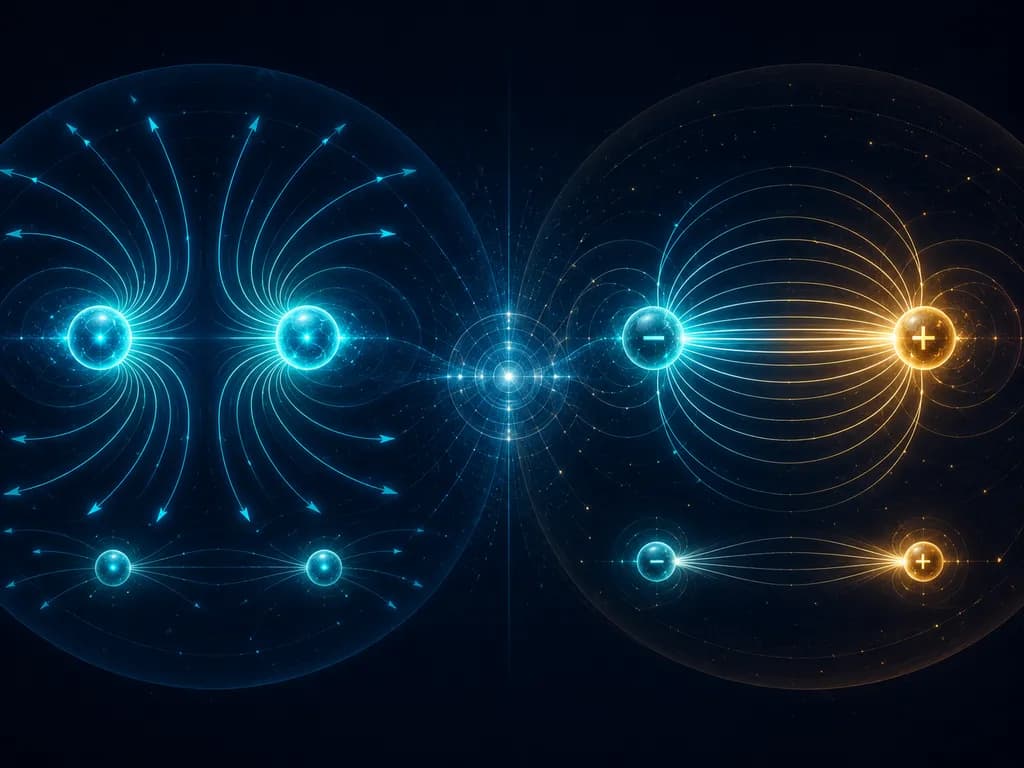
Charges can be entered in scientific notation, e.g. 1e-6 (1 µC) or -3.2e-9. The sign decides attraction/repulsion.
Coulomb's constant k = 8.99·10⁹ N·m²/C². The force decreases with the square of the distance — doubling the separation reduces it fourfold.
Coulomb's law describes the force of interaction between two point charges:
where , are the charges, and is the distance between them. The force decreases with the square of the distance — doubling the separation weakens it fourfold.
The sign of the product of the charges decides its character: like charges (the same sign) repel, unlike charges attract. You can enter the charges in scientific notation, e.g. 1e-6 (one microcoulomb).
Examples
Frequently asked questions
When do charges attract and when do they repel?+
Unlike charges (plus and minus) attract, like charges (two pluses or two minuses) repel. The calculator recognizes this from the signs of the charges you enter.
How does Coulomb's law resemble gravity?+
Both have the 1/r² form — the force decreases with the square of the distance. The difference: gravity always attracts, while the electric force can attract or repel.
Teaching? Embed this calculator on your site.
Free widget — paste it on your school site, blog or notes. It links to the full version.