Doppler effect
Change in sound frequency · moving source and observer
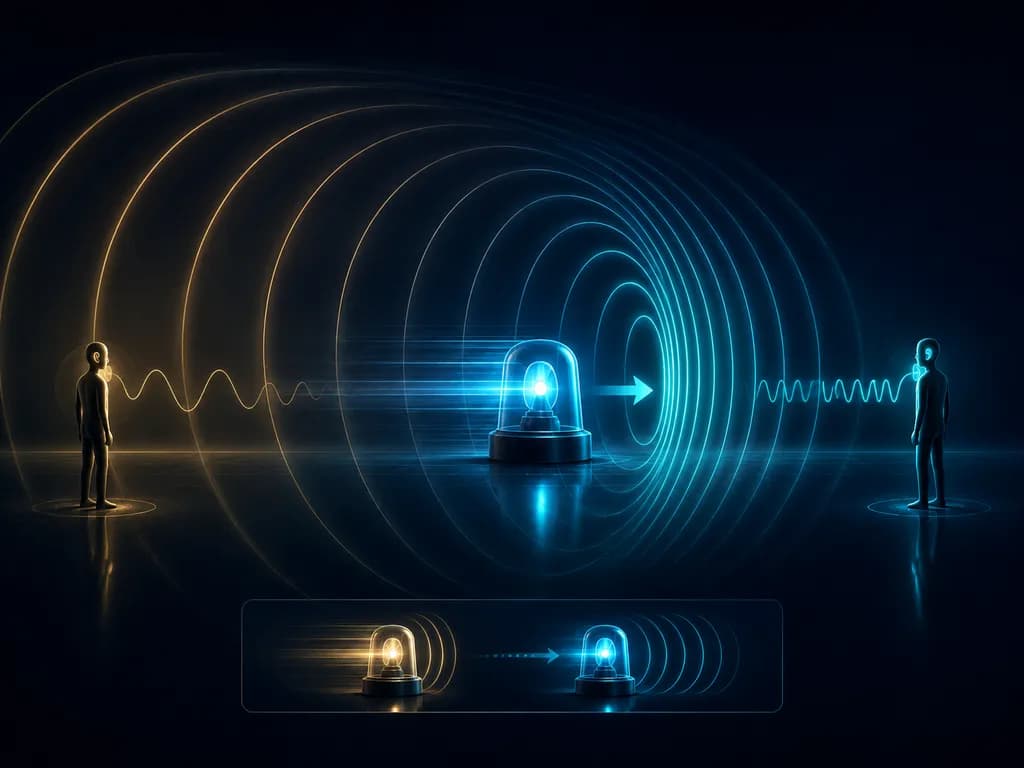
Convention: speed positive = approaching (the other object), negative = receding. Speed of sound v = 343 m/s.
When the source and observer approach, we hear a higher pitch; when they recede, a lower one. That is why an ambulance siren changes pitch as it passes us.
The Doppler effect is the change in the frequency we hear when the sound source and the observer move relative to each other:
where is the speed of sound, and speeds are counted as positive when approaching. When the objects approach, we hear a higher pitch; when they recede — a lower one.
That is why an ambulance siren sounds higher as it drives toward us, and suddenly lower once it passes. The same effect for light (redshift) lets us measure the recession speeds of galaxies.
Examples
Frequently asked questions
Why does a siren change pitch as it passes us?+
As it approaches, the sound waves are "compressed" — the frequency rises (higher pitch). After it passes, the waves "stretch out" — the frequency falls (lower pitch). This is the Doppler effect.
What is redshift?+
The Doppler effect for light: when a source recedes, the wavelength increases (shifts toward red). By measuring it, astronomers established that the Universe is expanding.
Teaching? Embed this calculator on your site.
Free widget — paste it on your school site, blog or notes. It links to the full version.