Gravitational field
Field strength g · gravitational force · celestial bodies
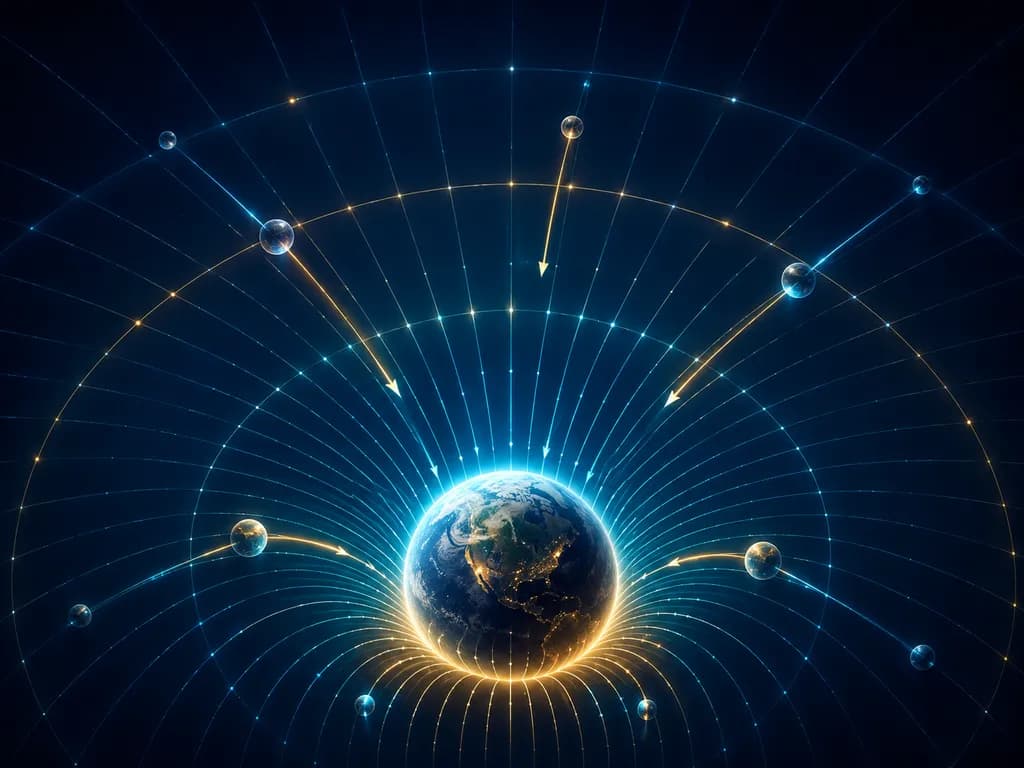
Gravitational constant G = 6.674·10⁻¹¹ N·m²/kg². At Earth's surface (M = 5.97·10²⁴ kg, r = 6371 km) the field strength g ≈ 9.81 m/s². Scientific notation: e.g. 5.97e24.
The gravitational field strength at a distance from a mass is the acceleration it gives to bodies:
and the gravitational force between masses and (Newton's law of universal gravitation):
where . Both quantities fall off with the square of the distance. The presets contain the masses and radii of Earth, the Moon, Mars and the Sun — for Earth this gives the familiar .
Examples
Frequently asked questions
Why are you lighter on the Moon?+
Because the Moon has a smaller mass, so the field strength g ≈ 1.62 m/s² — about six times less than on Earth. The mass of a body does not change, but its weight (F = mg) decreases.
How does the field strength depend on altitude?+
It falls off with the square of the distance from the centre of the planet (g ~ 1/r²). At high altitude g is noticeably smaller than at the surface.
Teaching? Embed this calculator on your site.
Free widget — paste it on your school site, blog or notes. It links to the full version.