Heat and heat balance
Q = mcΔT · phase changes · mixture temperature
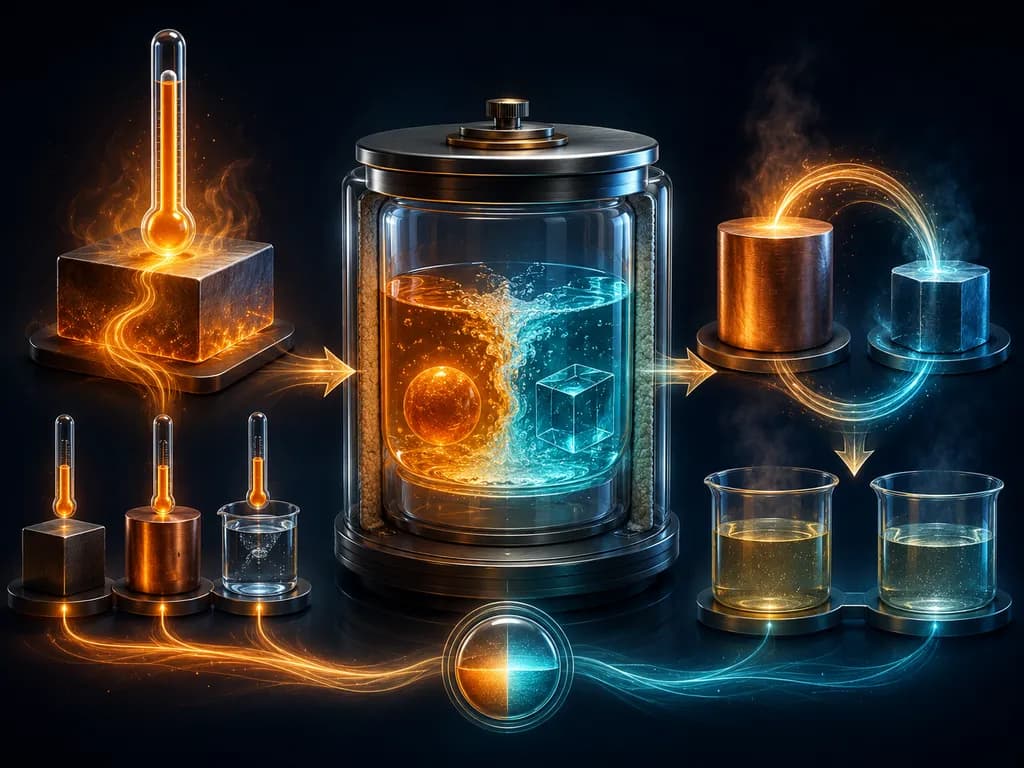
Q = m·c·ΔT. The specific heat c tells you how much energy is needed to warm 1 kg of a substance by 1 K. Water has a high c (4200) — it stores a lot of heat.
Three thermodynamics calculations. The heat of warming depends on mass, specific heat and the temperature change:
The heat of a phase change (melting, vaporisation) occurs at constant temperature: . The final temperature of a mixture of two bodies follows from the heat balance (heat released = heat absorbed):
The calculator has specific-heat presets (water 4200, aluminium 900, iron 450 J/kg·K).
Examples
Frequently asked questions
Why does water warm up so slowly?+
It has a high specific heat (4200 J/kg·K) — a lot of energy is needed to warm it. That is why it moderates climate: seas warm up slowly and cool down slowly.
Why doesn't the temperature rise during melting?+
Because the supplied heat breaks the bonds between molecules (changes the state of matter) instead of increasing their kinetic energy. Hence Q = mL at constant temperature.
Teaching? Embed this calculator on your site.
Free widget — paste it on your school site, blog or notes. It links to the full version.