Illuminance
E = I/r² · inverse-square law
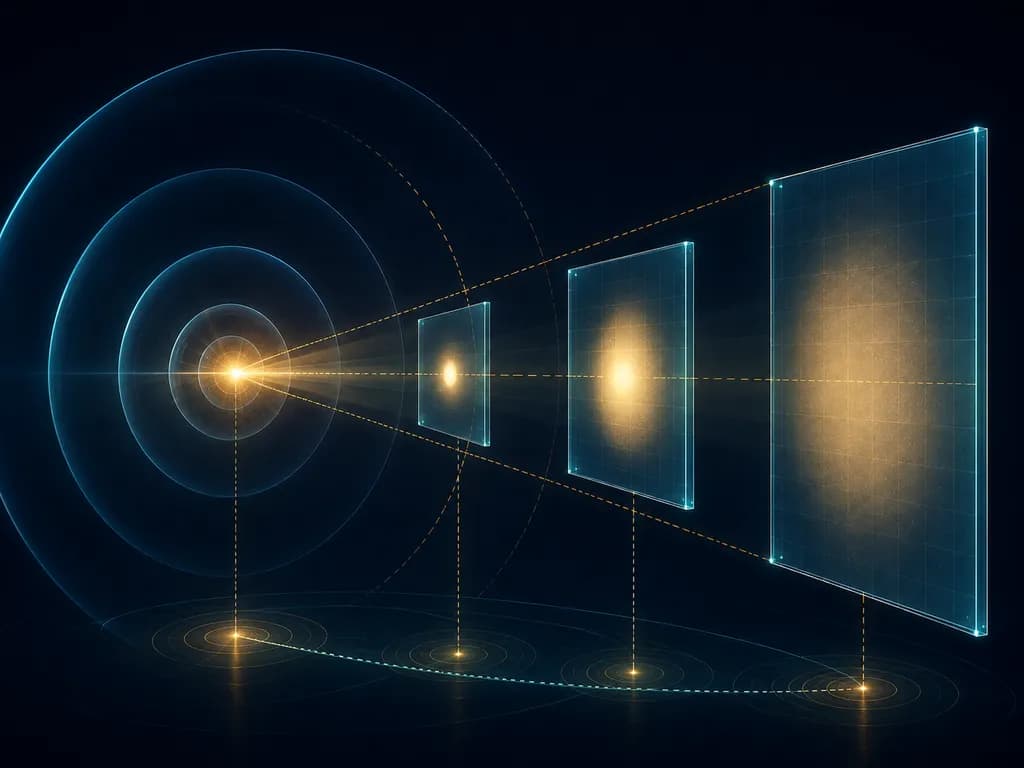
Inverse-square law: illuminance falls off with the square of the distance from the source. Moving twice as far away → four times dimmer. Units: luminous intensity in candelas (cd), illuminance in lux (lx).
Illuminance (in lux, lx) describes how strongly a point light source lights a surface at a distance :
where is the luminous intensity of the source (in candelas, cd). This is another example of the inverse-square law — illuminance falls off with the square of the distance, so moving twice as far from the lamp gives four times weaker lighting.
The calculator finds any of the three quantities (, , ). The same rule governs gravity and the interaction of charges — light, like those forces, "spreads out" over an ever larger spherical surface.
Examples
Frequently asked questions
How does luminous intensity differ from illuminance?+
Luminous intensity (candela) is a property of the source — how much light it emits in a given direction. Illuminance (lux) is the effect on a surface — it depends on the intensity and the distance.
Why does illuminance fall off with the square of the distance?+
Because light spreads over the surface of a sphere, which grows as r². The same amount of light is spread over an ever larger area, so less of it falls on each unit of area.
Teaching? Embed this calculator on your site.
Free widget — paste it on your school site, blog or notes. It links to the full version.