Lenses and mirrors
Lens equation · magnification · image type
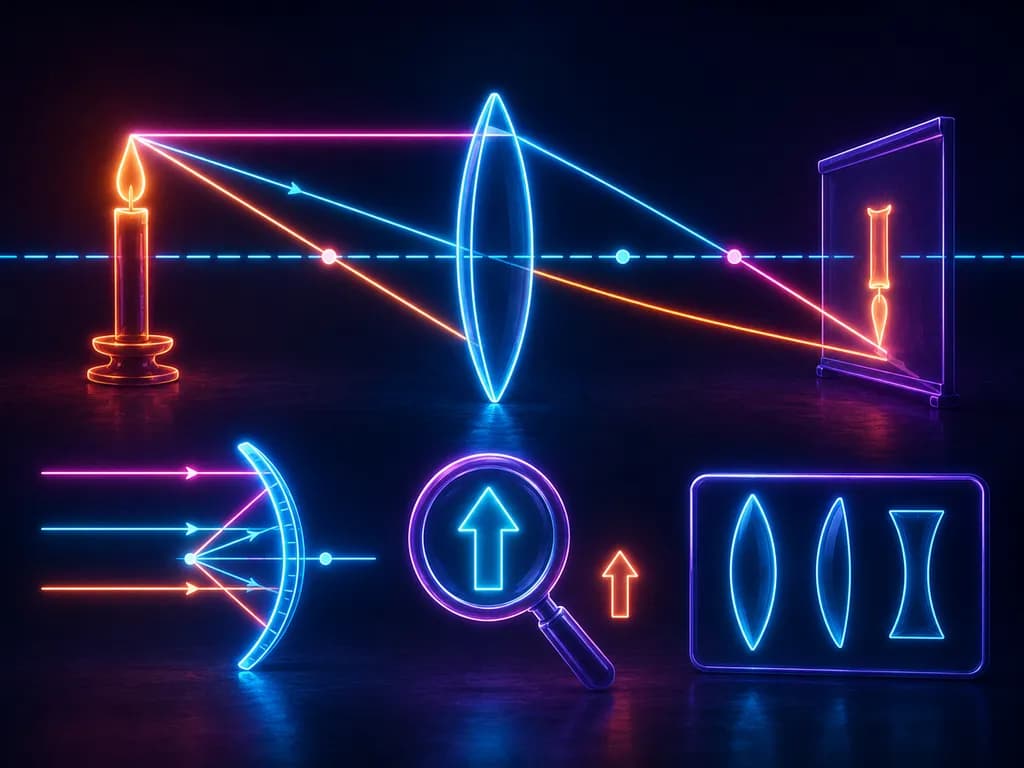
Any units, as long as they are consistent (e.g. cm). x — distance of the object from the lens.
Equation: 1/f = 1/x + 1/y. Magnification p = y/x. Positive y → real image (on the other side, inverted); negative y → virtual (on the same side, upright).
The position of the image formed by a lens (or spherical mirror) is described by the lens equation:
where is the focal length, — the object distance, — the image distance. The magnification is .
The sign of the result tells you the type of image: → a real image (inverted, on the other side), → a virtual one (upright, on the same side). A converging lens (and a concave mirror) has , a diverging one (and convex) — .
Examples
Frequently asked questions
When is the image real and when is it virtual?+
A real image (y > 0) forms when the object is farther than the focal point of a converging lens — it can be projected onto a screen. A virtual image (y < 0) is seen only by looking through the lens (e.g. a magnifying glass).
What does a negative focal length mean?+
A diverging lens or a convex mirror. They always produce a virtual, upright and reduced image.
Teaching? Embed this calculator on your site.
Free widget — paste it on your school site, blog or notes. It links to the full version.