Ohm's Law and Equivalent Resistance
U · I · R · P · series and parallel resistance
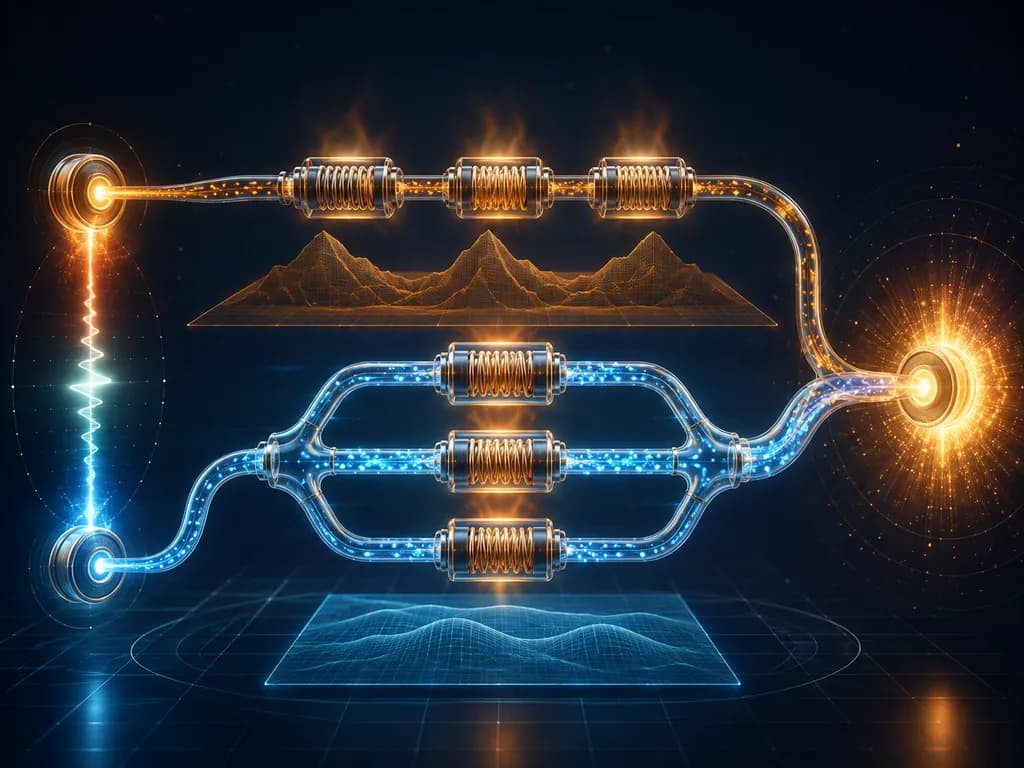
Enter any two quantities — I will compute the third from I = U/R.
Ohm's law: U = I·R. Power: P = U·I = U²/R = I²·R.
Ohm's law relates voltage, current and resistance:
Enter any two of the quantities , , — the calculator finds the third and the power .
The second mode computes the equivalent resistance of a circuit. In a series connection the resistances add up, and in a parallel one their reciprocals add up:
The resistance of a parallel connection is always smaller than the smallest resistor.
Examples
Frequently asked questions
Why is the parallel resistance smaller?+
Because the current has more paths to flow through — an extra branch lowers the total resistance. The resultant resistance of a parallel connection is always smaller than the smallest resistor.
How do you compute the power dissipated in a resistor?+
With three equivalent formulas: P = U·I = U²/R = I²·R. You pick the one that matches the data you have.
Teaching? Embed this calculator on your site.
Free widget — paste it on your school site, blog or notes. It links to the full version.