Optical power of a lens
D = 1/f · diopters · system of lenses
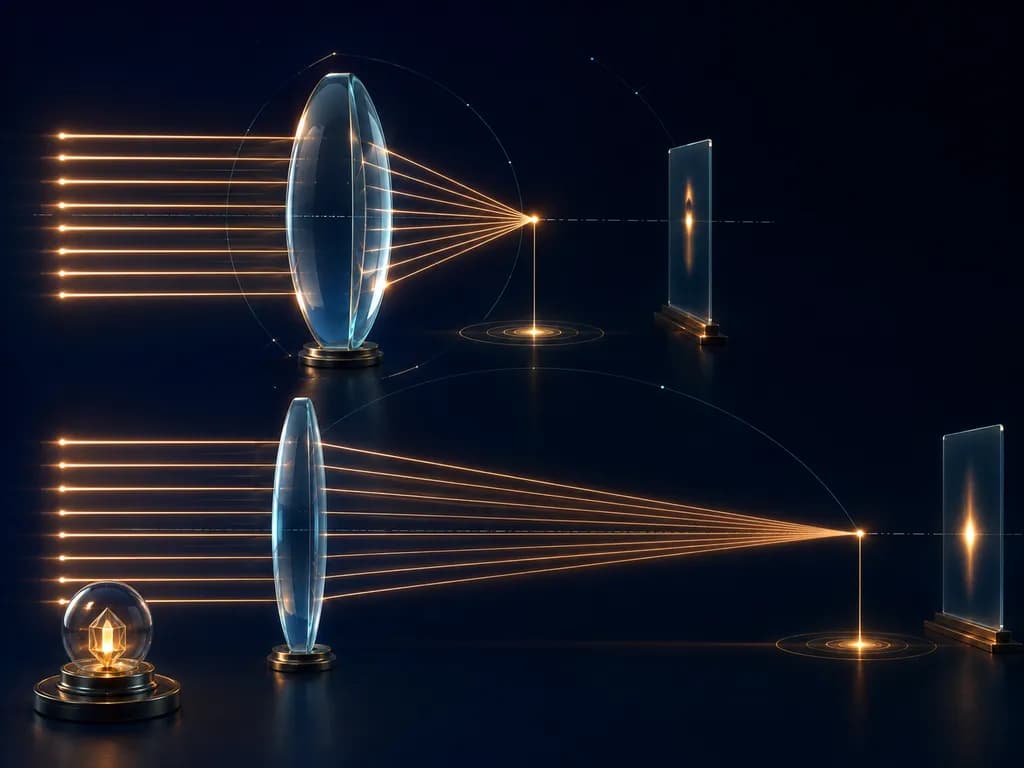
Optical power D = 1/f (f in meters) is measured in diopters (1 D = 1/m). A lens with f = 20 cm has D = +5 diopters. This is the quantity written on eyeglass prescriptions.
The optical power of a lens is the reciprocal of its focal length:
When is given in meters, comes out in diopters (1 D = 1 m⁻¹). This is exactly the quantity written on eyeglass prescriptions — a converging lens has , a diverging one .
For a system of thin lenses in contact with one another, the optical powers add up:
so a converging and a diverging lens can partly cancel each other out. A lens with a focal length of 20 cm has a power of +5 diopters.
Examples
Frequently asked questions
What does "−2.5 diopters" on glasses mean?+
A diverging lens with a power of −2.5 D (focal length −0.4 m). Such lenses correct nearsightedness. A plus sign would indicate a converging lens (farsightedness).
How do you compute the power of a set of lenses?+
For thin lenses in contact you add their optical powers (keeping the sign): D = D₁ + D₂. The focal length of the system is f = 1/D.
Teaching? Embed this calculator on your site.
Free widget — paste it on your school site, blog or notes. It links to the full version.