Photon energy
E = hf = hc/λ · joules and electronvolts
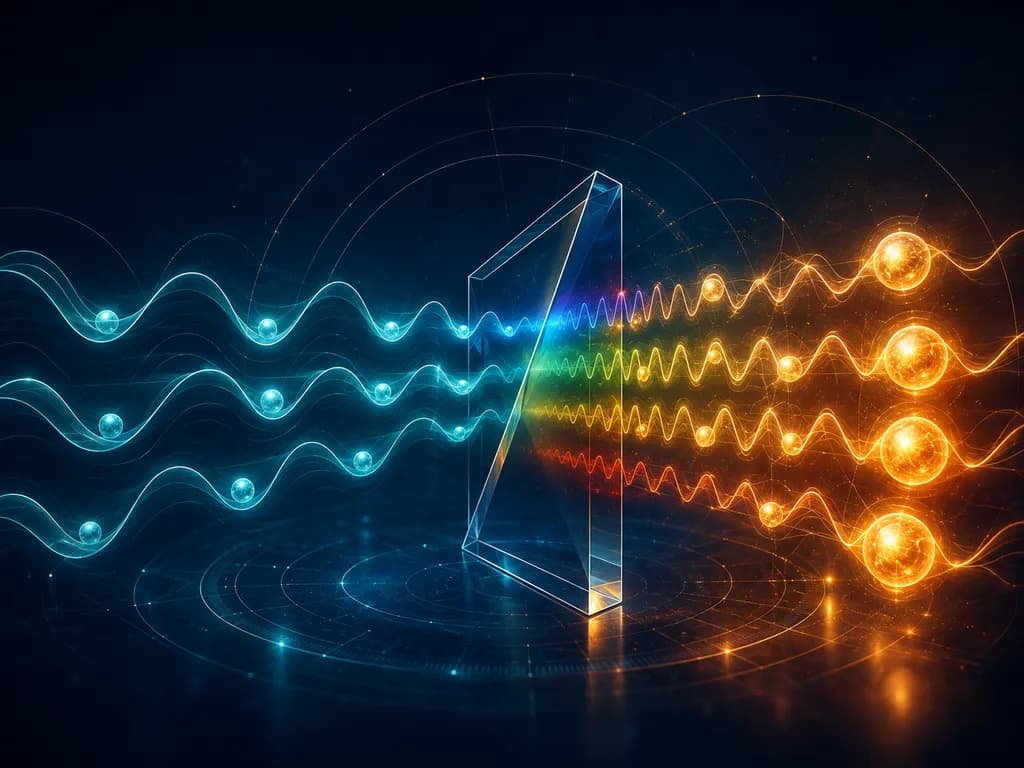
E = h·f = h·c/λ. h = 6.626·10⁻³⁴ J·s. A shorter wavelength = higher frequency = more energy (a violet photon carries more energy than a red one). 1 eV = 1.602·10⁻¹⁹ J.
Light carries energy in packets called photons. The energy of a single photon depends on its frequency (or wavelength):
where (Planck's constant) and . The shorter the wavelength (toward violet and beyond — UV, X-rays), the greater the energy of the photon.
Enter the wavelength (in nm), the frequency, or the energy (in eV) — the calculator converts the remaining quantities, including the energy in joules and electronvolts (). The presets correspond to the colours of visible light.
Examples
Frequently asked questions
Which photon has more energy — red or blue?+
Blue. It has a shorter wavelength and higher frequency, and energy grows with frequency (E = hf). That is why UV radiation is more dangerous than red light.
What is an electronvolt?+
A convenient unit of energy in atomic physics: 1 eV = 1.602·10⁻¹⁹ J. It is the energy an electron gains when accelerated through a potential of 1 V. Visible-light photons carry about 1.6–3.3 eV.
Teaching? Embed this calculator on your site.
Free widget — paste it on your school site, blog or notes. It links to the full version.