Pressure and Archimedes' principle
Hydrostatic pressure p = ρgh · buoyant force
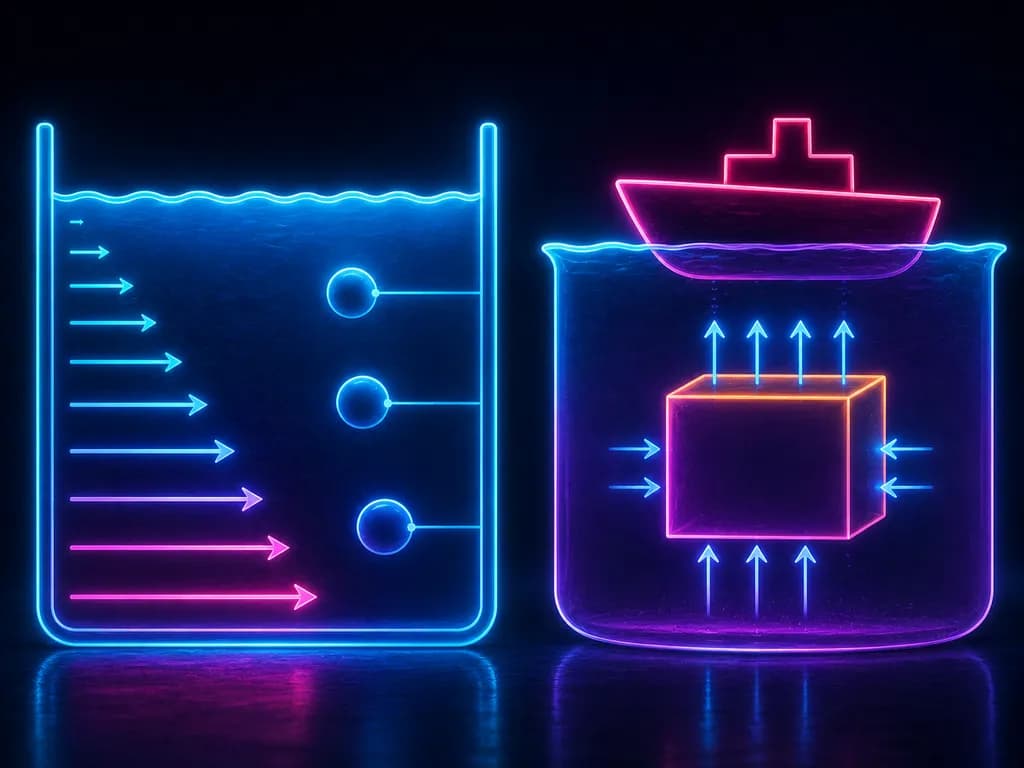
p = ρ·g·h (g = 9.81 m/s²). Hydrostatic pressure does not depend on the shape of the container — only on the depth (the hydrostatic paradox). 1 atm ≈ 101 325 Pa.
Two pillars of hydrostatics. Hydrostatic pressure increases with depth:
where is the density of the fluid, , and — the depth. Importantly, it does not depend on the shape of the container (the hydrostatic paradox).
Archimedes' principle describes the buoyant force acting on a submerged body:
equal to the weight of the displaced fluid ( — volume of the submerged part). A body floats when the buoyancy balances its weight. The calculator has presets for the density of common fluids.
Examples
Frequently asked questions
Does the pressure depend on the shape of the container?+
No — hydrostatic pressure depends only on the density of the fluid and the depth, not on the amount of water or the shape of the container. This is the so-called hydrostatic paradox.
When does a body float and when does it sink?+
It floats when its average density is lower than the density of the fluid (buoyancy exceeds weight). It sinks when it is denser. With equal densities it stays suspended.
Teaching? Embed this calculator on your site.
Free widget — paste it on your school site, blog or notes. It links to the full version.