Magnetic field of a coil
B = μ₀·n·I · field inside a solenoid
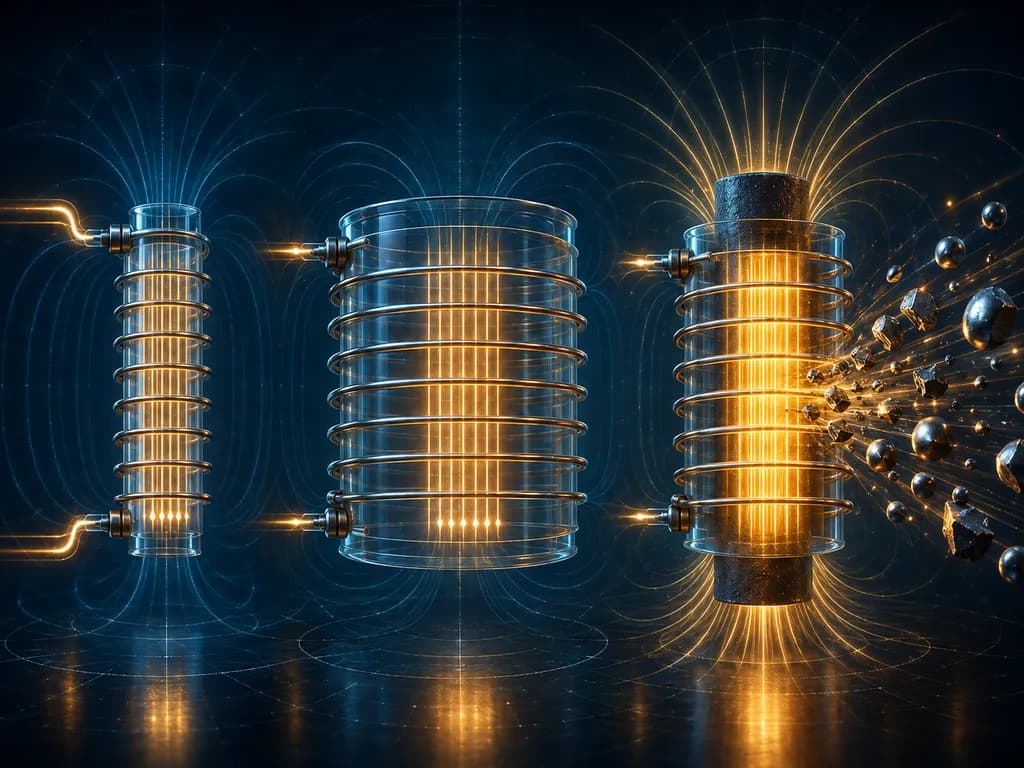
Inside a long coil the field is uniform: B = μ₀·n·I, where n = N/L (turns per metre) and μ₀ = 4π·10⁻⁷ T·m/A. It does not depend on the coil radius — more turns or a larger current gives a stronger field (the principle of the electromagnet).
Inside a long current-carrying coil (solenoid) a uniform magnetic field is created:
where is the turn density (number of turns per metre), the current and the permeability of free space.
Interestingly, the field does not depend on the radius of the coil — only on the turn density and the current. To strengthen the field we increase the number of turns or the current, or insert a ferromagnetic core (the principle of the electromagnet).
Examples
Frequently asked questions
Why doesn't the coil's field depend on its radius?+
Because for a long solenoid what matters is the turn density (turns per metre), not their size. The field inside is uniform: B = μ₀·n·I, regardless of the diameter.
How do you strengthen an electromagnet?+
Increase the number of turns or the current, or insert a core of ferromagnetic material (such as iron), which multiplies the field many times over.
Teaching? Embed this calculator on your site.
Free widget — paste it on your school site, blog or notes. It links to the full version.