Torque and the lever
Torque M = F·r · lever balance
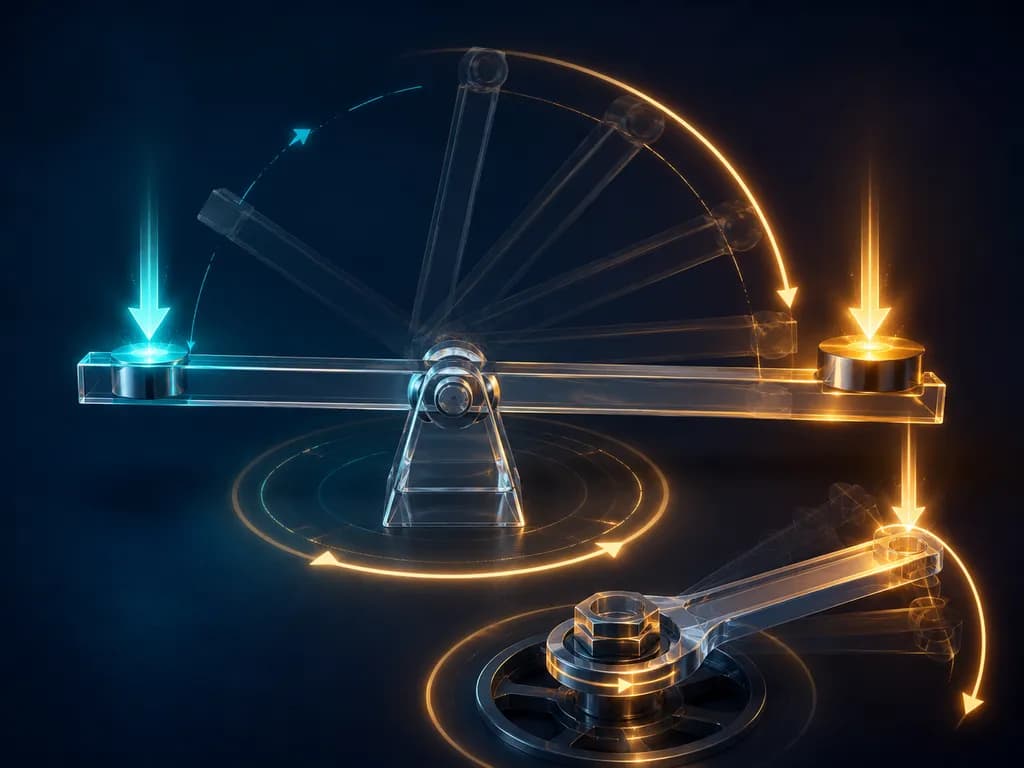
The lever arm is the perpendicular distance from the axis of rotation to the line of action of the force.
Torque is a measure of a force's ability to rotate a body about an axis:
where is the force and — the lever arm, that is, the perpendicular distance from the axis of rotation to the line of action of the force. The unit is the newton-metre (N·m).
A lever is in balance when the torques on both sides cancel out:
This is the principle of the lever — a small force on a long arm balances a large force on a short one (hence "give me a place to stand and I will move the Earth").
Examples
Frequently asked questions
What is the lever arm of a force?+
The perpendicular distance from the axis of rotation to the line along which the force acts. The longer the arm, the larger the torque for the same force — which is why a longer wrench makes a bolt easier to undo.
How does a lever work?+
It balances torques: a small force on a long arm produces the same torque as a large force on a short one. This way we gain force at the cost of distance.
Teaching? Embed this calculator on your site.
Free widget — paste it on your school site, blog or notes. It links to the full version.