Transformer
Turns ratio · voltages and currents
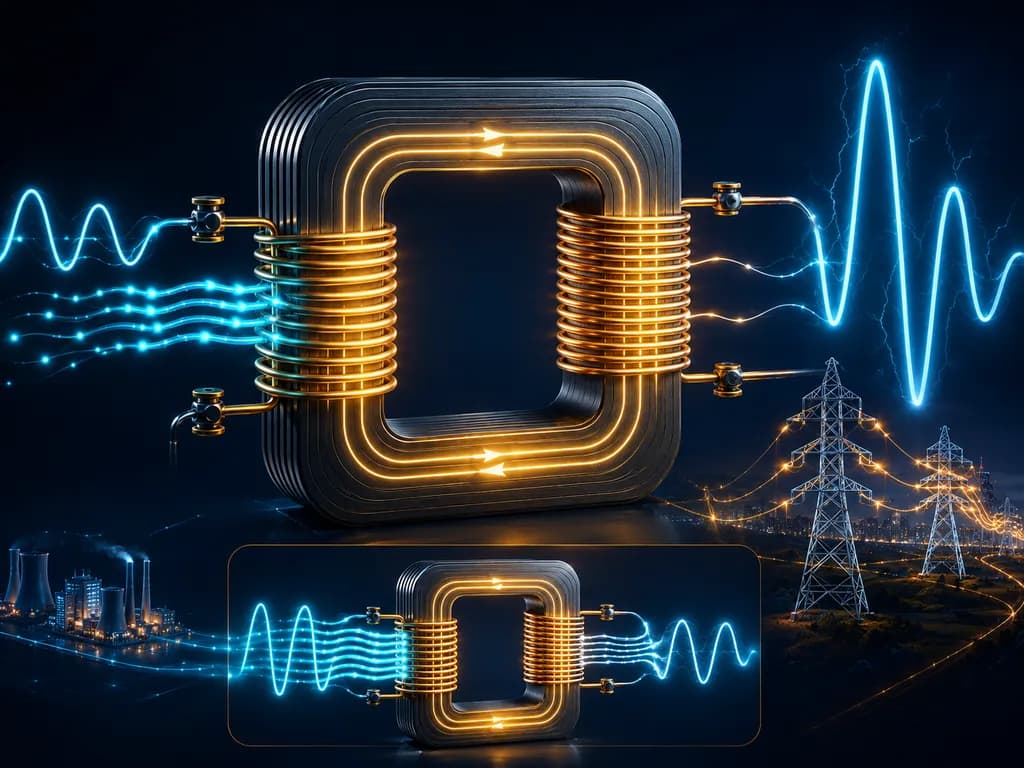
Ideal transformer: U₁/U₂ = n₁/n₂ = I₂/I₁. Stepping the voltage up lowers the current (and vice versa) — the power P = U·I stays constant (lossless).
A transformer changes the voltage of an alternating current thanks to electromagnetic induction. In an ideal transformer:
where are the numbers of turns of the primary and secondary windings. The ratio is the turns ratio. When , the transformer steps the voltage up; when — it steps it down.
Key point: by stepping the voltage up, a transformer steps the current down by the same factor (and vice versa), because the power stays constant (in the ideal, lossless case). This is why energy is transmitted over high-voltage lines — a small current means small losses.
Examples
Frequently asked questions
Why does a transformer step voltage up and current down?+
Because power is conserved (P = U·I). If the voltage rises 4×, the current must drop 4× so that the product — the power — stays the same.
Why is energy transmitted at high voltage?+
Because line losses are proportional to I²·R. A transformer raises the voltage and lowers the current, so losses shrink — and near the consumer another transformer brings the voltage back down.
Teaching? Embed this calculator on your site.
Free widget — paste it on your school site, blog or notes. It links to the full version.