Quadratic inequality — sign of the trinomial
The sign of a quadratic trinomial follows from the shape of the parabola. Change a, b, c and watch Δ — see when the inequality holds for all x.
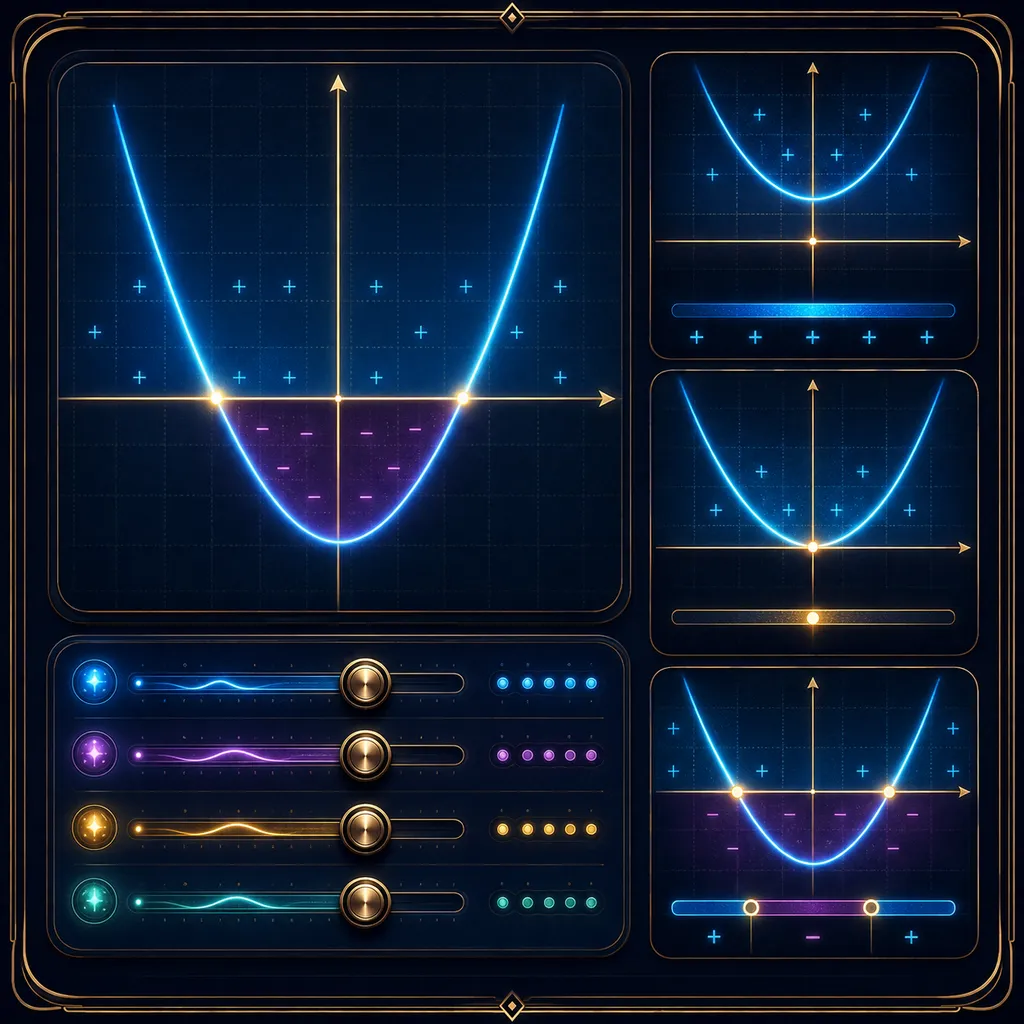
I will give you a trinomial — judge the number of real roots from the sign of Δ = b² − 4ac (in your head, no sliders).
What determines the sign of the trinomial?
For the quadratic function with coefficient , the graph is an upward-opening parabola. Whether it crosses the x-axis is decided by the discriminant:
The discriminant tells you the number of roots: — two roots, — one (double), — no real roots.
Sign when a > 0:
When there are roots , the trinomial is negative between them and positive outside them:
The key case — no roots:
If , the parabola never touches the x-axis, and with it lies entirely above it. Then:
Why this matters for the exam:
You solve quadratic inequalities by a routine: compute , find the roots, sketch the parabola and read off the sign. When the answer is the empty set or the whole line — depending on the sign of and the direction of the inequality.
Remember: the sign of the trinomial depends on the sign of and the value of . Rule: for every x.
Theory & formulas
Trinomial and parabola
The sign of depends on the direction the arms open (the sign of ) and on the number of zeros (the sign of ), where .
Zeros
For : . For there is one double root, and for there are no real roots.
When the sign is constant
- for every ⟺ and
- for every ⟺ and
When , the trinomial has the sign of outside the roots and the opposite sign between them.
Notation: are the coefficients, is the discriminant, are the zeros.
Frequently asked questions
›When is ax²+bx+c>0 for all x?
When a>0 and Δ<0 — an upward-opening parabola lies entirely above the x-axis.
›What does the sign of Δ tell you?
Δ>0 two roots, Δ=0 one (double), Δ<0 no real roots.
Teaching? Embed this experiment on your site.
Free widget — paste it on your school site, blog or notes. It links to the full version.