The multiplication rule
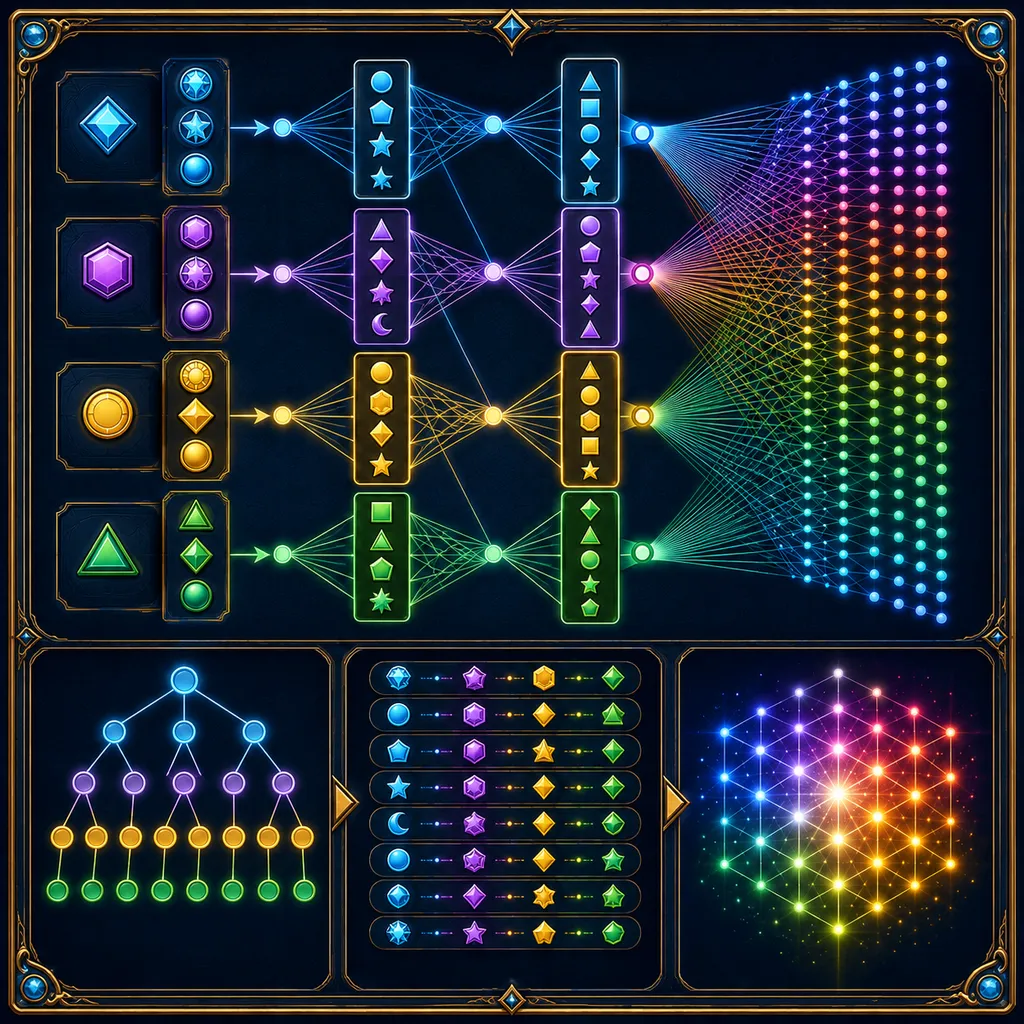
When a choice consists of several independent stages, the total number of outcomes is counted by multiplying the option counts. Set the stages and options, and see how the number of possibilities grows.
I’ll give you a target number of outcomes — pick n and k so that N = nᵏ hits it.
What just happened?
Every choice stage branches the tree. To each of the outcomes so far we add new possibilities — that is why with each stage the number of paths through the tree gets multiplied, rather than merely growing by a few.
The multiplication rule:
If a choice consists of independent stages, and at stage there are possibilities, then the number of all outcomes is the product:
When the number of options is the same at every stage () this simplifies to .
A worked example:
3 starters, 4 main courses, 2 desserts — how many different dinner sets?
Not — because each of the 3 starters goes with each of the 4 mains, and each of those 12 pairs with each of the 2 desserts.
When do we ADD? (the addition rule)
We sum only when the cases are mutually exclusive — we carry out one stage “or” the other, not both at once:
A decision shortcut: you combine choices “and–and” → you multiply; you pick “either–or” → you add.
Why this matters for your exams:
The multiplication rule is the foundation of counting: variants of passwords, licence plates, codes, arrangements and permutations. Break the problem into successive independent stages, count the options at each and multiply.
Remember: independent choice stages — the number of outcomes is computed as the product of the options at the successive stages: .
Theory & formulas
The multiplication rule
When a choice has independent stages with option counts , the number of all outcomes is:
Example
shirts and trousers give outfits.
Multiply or add
- stages one after another (and…, and…): we multiply,
- disjoint cases (either…, or…): we add.
Notation: the number of options at the -th stage, the number of outcomes.
Frequently asked questions
›How do you count the outcomes of several independent choices?
By multiplying the option counts at the successive stages: N = n₁·n₂·…·n_k (the multiplication rule).
›When do you add and when do you multiply?
We multiply stages that follow one another; we add disjoint cases (the addition rule).
Teaching? Embed this experiment on your site.
Free widget — paste it on your school site, blog or notes. It links to the full version.