Rubik's Cube — the mathematics of groups
Beyond the school syllabus — permutations and group theory (a “wow” factor). A Rubik's Cube has ~43 quintillion (4.3·10¹⁹) arrangements, yet every one can be solved in at most 20 moves (“God's number”, proved by computation in 2010). The set of arrangements forms a group: moves compose, have inverses and an identity element.
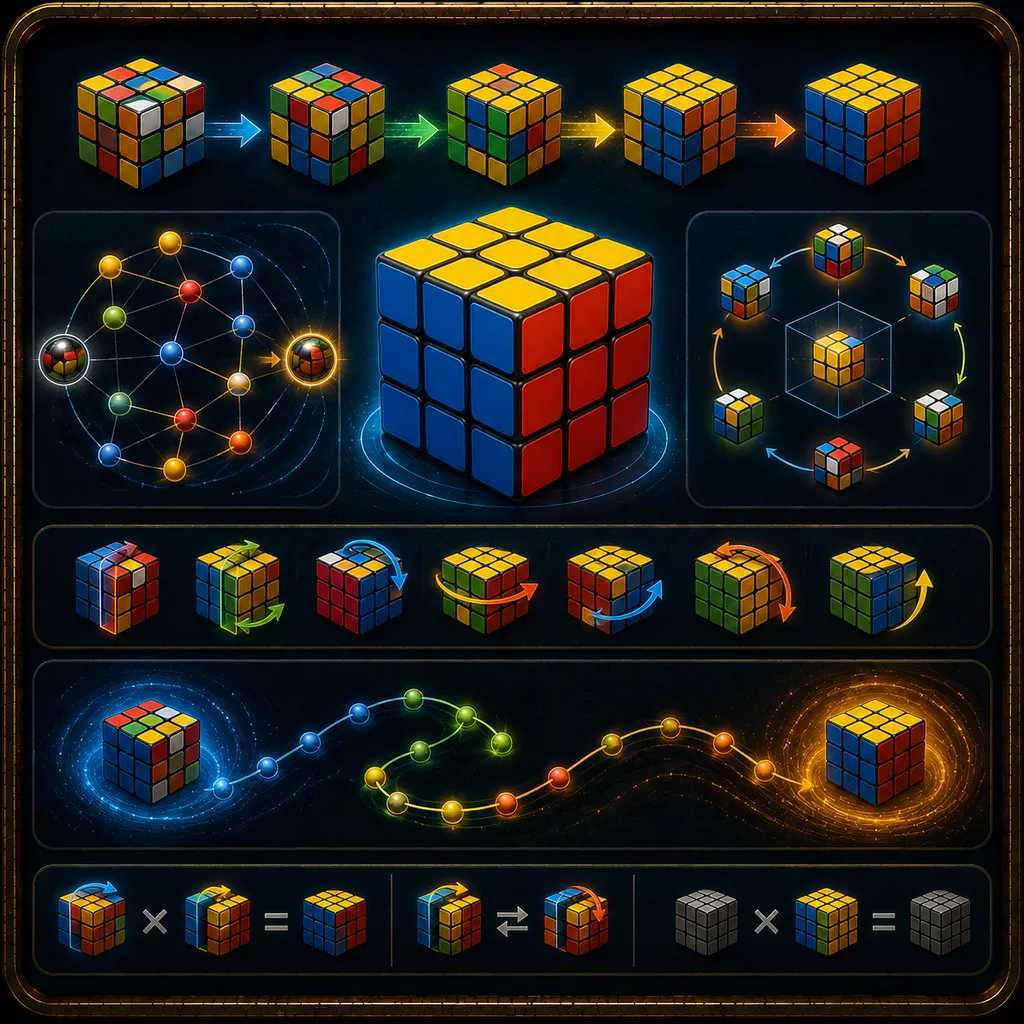
I’ll give you a statement about the cube and group theory — decide whether it is true. Key: 4.3·10¹⁹ arrangements, but “God’s number” = 20.
The Rubik’s Cube is an object of group theory
The Rubik’s Cube is not just a toy but a beautiful object of group theory — the branch of algebra that studies symmetries and invertible operations. A 3×3×3 cube has an astronomical number of arrangements: exactly 43 252 003 274 489 856 000, that is about 43 quintillion.
If you set out one arrangement per second, you would need many times the age of the Universe to go through them all.
“God’s number” = 20
And yet — and this is astonishing — it was proved in 2010 (thanks to enormous computer calculations by Tomas Rokicki’s team) that EVERY arrangement, however tangled, can be solved in at most 20 moves. That number was called “God’s number”.
The set of arrangements forms a group
Mathematically, the set of all cube arrangements forms a group: moves can be composed with one another, every move has an inverse (which undoes it), and “doing nothing” is the identity element.
“God’s number” 20 is the diameter of this group — the longest of the shortest paths back to the solved state. A move and its inverse always cancel to the identity element .
Why it is “wow”:
The Rubik’s Cube is today a classic example of how abstract group theory describes concrete puzzles and symmetries. It goes beyond the school syllabus (permutations, group theory), but shows that even 4.3·10¹⁹ possibilities fit into an order of diameter just 20.
Remember: 4.3·10¹⁹ arrangements — and every one solvable in ⩽ 20 moves. The arrangements form a group: composition, an inverse move, an identity element.
Theory & formulas
Number of arrangements
The group of moves
The arrangements form a group: moves can be composed (the operation), each has an inverse move, and “do nothing” is the identity element. The order of moves matters — the group is non-abelian.
God's number
Despite the huge number of states, each can be solved in at most moves (proved by computation in 2010).
Notation: the number of arrangements, the maximum number of moves.
Frequently asked questions
›In how many moves can a Rubik's Cube be solved?
Every arrangement — in at most 20 moves; this is the so-called “God's number”, proved in 2010.
›How many arrangements does a Rubik's Cube have?
Exactly 43 252 003 274 489 856 000 — about 43 quintillion (4.3·10¹⁹).
›What does group theory have to do with a Rubik's Cube?
The set of arrangements forms a group: moves can be composed, each has an inverse move, and “do-nothing” is the identity element.
Teaching? Embed this experiment on your site.
Free widget — paste it on your school site, blog or notes. It links to the full version.