The Banach–Tarski Paradox
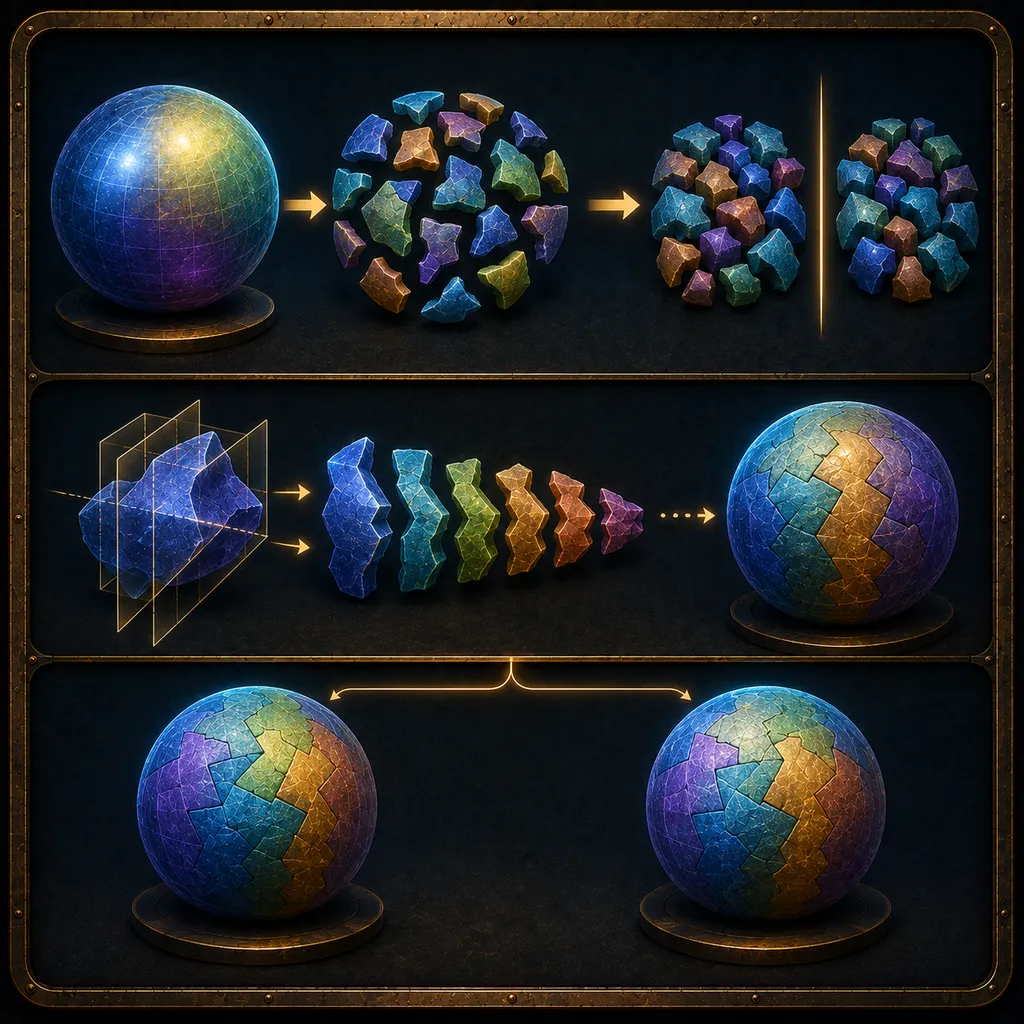
An extension of the topic of set theory and volume (beyond the curriculum; a Polish highlight). Assuming the axiom of choice, a ball can be decomposed into finitely many "pieces" and reassembled into two balls identical to it. The paradox is possible only for non-measurable sets (sets with no defined volume) — it does not work in the physical world. It was proved by the Polish mathematicians Stefan Banach and Alfred Tarski in 1924.
I will give you a statement about the Banach–Tarski paradox — judge whether it is true or false.
What just happened?
From one solid ball "arose" two — each the same size as the original. This sounds like creating something from nothing and an apparent violation of volume conservation. And yet it is a mathematically correct theorem, proved in 1924.
The Banach–Tarski paradox:
Two Polish mathematicians — Stefan Banach and Alfred Tarski (members of the famous Lwów and Warsaw schools of mathematics) — proved that a solid ball in three-dimensional space can be decomposed into finitely many pieces and then — using only rotations and translations (no stretching or deformation!) — reassembled into two identical copies of the original ball:
The volume is "not conserved" — one solid becomes two of the same size.
Where is the catch?
The paradox uses the axiom of choice — a controversial, though standard, assumption of set theory that allows you to "choose" one element from each of infinitely many sets. With it one constructs "pieces" that are non-measurable sets — so pathologically "jagged" that no sensible volume can be assigned to them. That is why the volume is "not conserved" — because for these pieces it is not defined at all. We are not claiming 1 = 2; we are measuring something that simply has no volume.
Why does it NOT work in the physical world?
The paradox concerns an ideal continuum — an infinitely divisible set of points. Real matter consists of a finite number of atoms, which cannot be cut into non-measurable pieces. So you cannot double a gold ball or an apple — it is a purely mathematical property of abstract infinity, not a recipe for free matter.
Why this matters (a topic beyond the curriculum):
This is a curiosity from set theory — it will not appear on the exam. But it shows something important: intuition about volume and "common sense" fail when we enter the world of infinity and non-measurable sets. It is also a reason for debate over the axiom of choice in the foundations of mathematics, and a beautiful example of the achievements of the Polish school of mathematics.
Remember: the Banach–Tarski paradox (1924, Banach and Tarski — Poles) says that a solid ball can be mathematically decomposed and reassembled into two of the same size — but only thanks to the axiom of choice and non-measurable sets (without volume). Physical matter made of atoms does not behave this way.
Theory & formulas
The statement
Assuming the axiom of choice, a ball can be decomposed into finitely many "pieces" and then — using only rotations and translations (isometries) — reassembled into two balls identical to the original.
Why it does not break physics
The "pieces" of the decomposition are non-measurable sets — they have no defined volume, so the principle of volume conservation does not apply to them. Such sets cannot be built out of matter.
The role of the axiom of choice
It is precisely the axiom of choice that guarantees the existence of the required sets; the construction is non-constructive — the sets cannot be exhibited explicitly. This was proved by Banach and Tarski (1924).
Frequently asked questions
›Can one ball be mathematically reassembled into two identical ones?
Yes — paradoxically, assuming the axiom of choice, using only rotations and translations.
›Why does the paradox not break the principle of volume conservation?
Because the "pieces" of the decomposition are non-measurable sets — they have no defined volume.
›Who proved the Banach–Tarski paradox?
The Polish mathematicians Stefan Banach and Alfred Tarski, in 1924.
Teaching? Embed this experiment on your site.
Free widget — paste it on your school site, blog or notes. It links to the full version.