Hilbert's Hotel — infinity in practice
An extension of the topic of infinity and sets (beyond the curriculum). The hotel has infinitely many rooms, all occupied — and yet it can still accommodate new guests: just move every guest from room n to room n+1 (or to 2n for infinitely many new ones). David Hilbert devised this thought experiment (around 1924) to illustrate the strange arithmetic of infinity: ∞+1=∞.
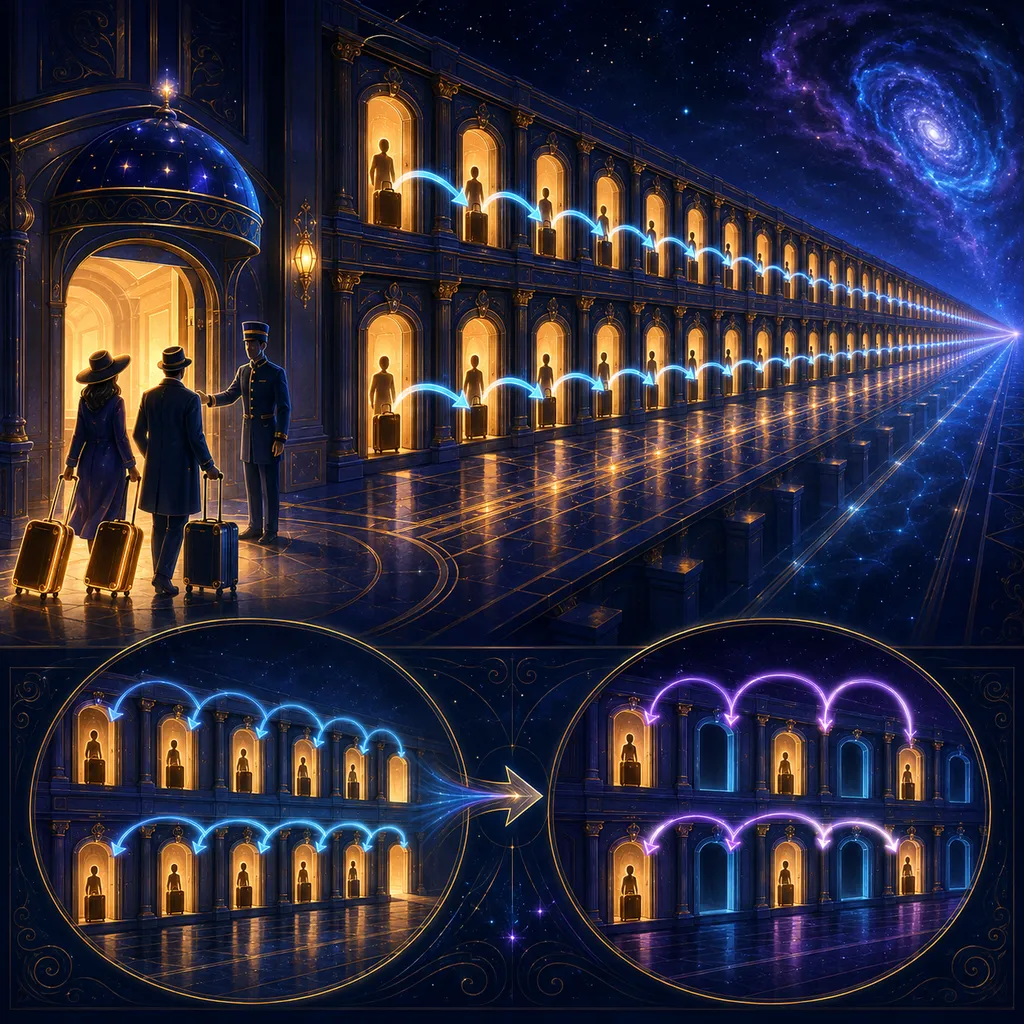
The hotel has ℵ₀ rooms and they are all occupied. I'll give you an influx of new guests — decide whether they can be accommodated.
What just happened?
The hotel has infinitely many rooms (numbered ) and they are all occupied. In a finite hotel “full” means “no room”. But here it is enough to ask every guest to move one room further: the guest in room goes to room . No one is left without a room — and room 1 has just been freed for the new guest.
The arithmetic of infinity:
Adding one element (or even infinitely many) to a countable infinity still gives the same countable infinity — denoted (“aleph-null”, the smallest infinite cardinal number).
And if infinitely many new guests arrive?
They still fit. Every existing guest moves from room to room — occupying only the even-numbered rooms. All the odd-numbered rooms (, and there are infinitely many of them) now stand empty, ready for infinitely many new guests:
Where does this idea come from?
This thought experiment was devised by David Hilbert (lecture “Über das Unendliche”, around 1924) to illustrate the counterintuitive properties of infinite sets. It is a practical picture of what Georg Cantor had earlier proved formally: the set of natural numbers, of the even numbers alone, or of the natural numbers plus one element — all have the same cardinality (countable infinity).
Why this matters for your exam:
Hilbert's Hotel is the clearest way to understand that infinity does not behave like an ordinary number — key to the notion of the cardinality of a set, countable sets, and the difference between and .
Remember: in a hotel with countably infinitely many rooms room can always be made — because “plus one”, or even “plus infinity”, is still .
Theory & formulas
One new guest
The hotel has rooms (all occupied). We move the guest from room to room — room becomes free.
Infinitely many new guests
We move the guest from room to room — all the odd-numbered rooms become free (there are infinitely many of them).
The arithmetic of infinity
For countable sets: and — adding elements does not change the cardinality.
Notation: the room number, the cardinality of the set of natural numbers.
Frequently asked questions
›Can a new guest fit into a full infinite hotel?
Yes — just move every guest from room n to room n+1, freeing up room 1.
›How do you fit in infinitely many new guests?
By moving every guest from room n to room 2n — all the odd-numbered rooms become free.
›What does Hilbert's Hotel illustrate?
That adding elements to a countable infinity still gives the same infinity: |ℕ|+1=|ℕ|.
Teaching? Embed this experiment on your site.
Free widget — paste it on your school site, blog or notes. It links to the full version.