The Brouwer fixed-point theorem
An extension of the topic of topology and transformations (beyond the curriculum). Every continuous map of a disk into itself has a fixed point (f(x)=x) — when you stir coffee, some point returns to its place; a map of an area laid on that area has a "you are here" point. Luitzen Brouwer proved it in 1911.
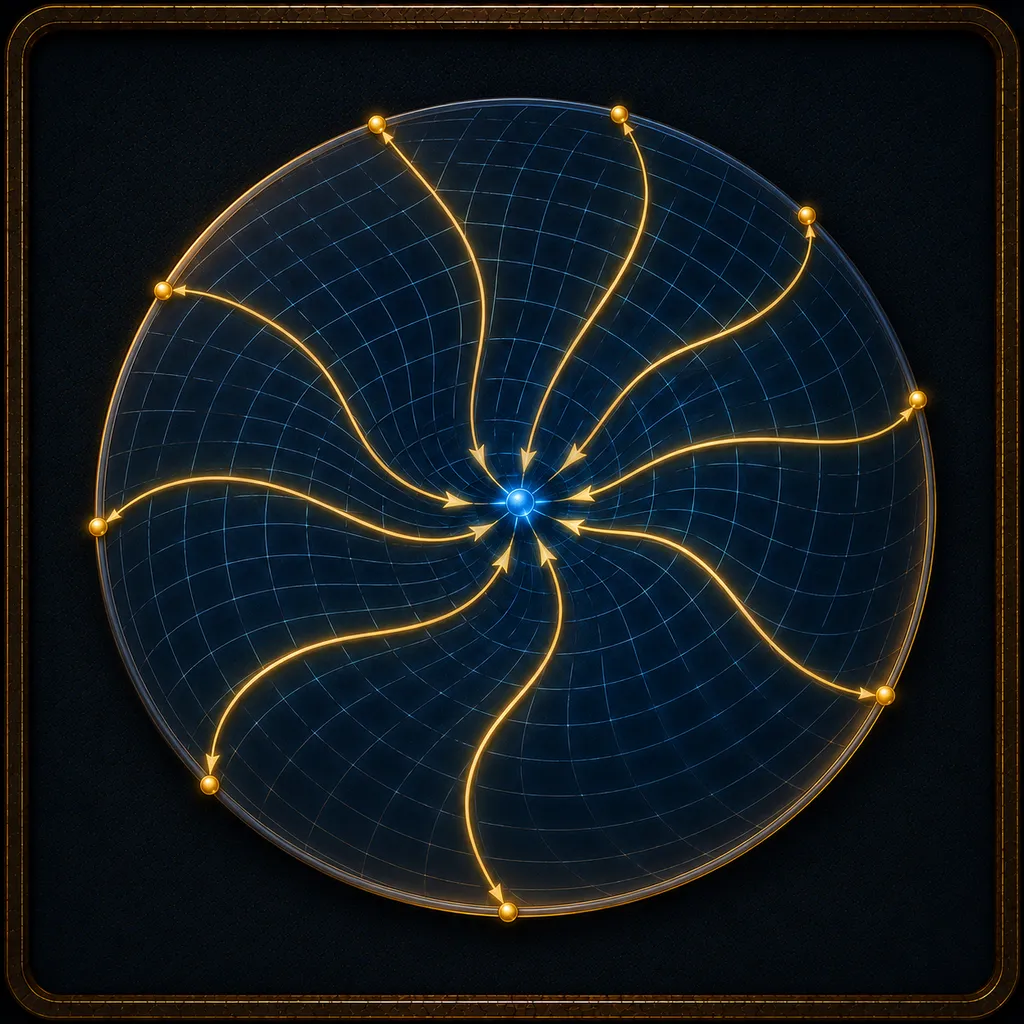
I’ll give you a set — decide whether EVERY continuous self-map must have a fixed point. The decider: compact and convex?
What just happened?
You “stirred” the disk — continuously mapping the circle into itself (a rotation plus squeezing, like a swirl in a coffee cup). However you turn the slider, in the shift field there always remains one point where the vector is zero: this is the fixed point , which maps to itself. That is exactly what Brouwer’s theorem guarantees.
The Brouwer fixed-point theorem:
Every continuous map of a disk — and more generally of any compact, convex figure — into itself has at least one fixed point. Formally: for every continuous there is a point such that
The full proof was given by the Dutch mathematician Luitzen E. J. Brouwer in 1911. It is one of the fundamental results of topology.
Tangible illustrations:
When you stir coffee in a cup (any way, as long as it is continuous, without “tearing” the liquid), there is always at least one point of the fluid that, after stirring, returns exactly to its original place. Similarly: if you lay a map of an area flat anywhere within that area, there will always be exactly one “you are here” point on it — lying precisely over the corresponding spot in the terrain.
Why it matters:
The theorem is of enormous theoretical importance: it is key in economics (the proof of the existence of market equilibrium — Arrow, Debreu), in game theory (the existence of a Nash equilibrium!), in differential equations and analysis. It is a beautiful example of how abstract topology guarantees the existence of something (a fixed point) without indicating where exactly it is — a “proof of existence” without a “construction”.
Why this matters for the exam:
The topic goes beyond the core curriculum — it is topology and transformations. It is worth knowing as a model example of a proof of existence: the condition for a continuous always has a solution, although the theorem does not say which point it is.
Remember: every continuous map of a disk into itself has at least one fixed point — no matter how it “stirs”.
Theory & formulas
Theorem
Every continuous map of a closed disk (or ball) into itself has a fixed point:
Vivid examples
Stirred coffee in a cup — some point of the liquid returns to its place. A map of an area laid on that area has a "you are here" point.
Applications
Proofs of the existence of equilibrium: market equilibrium (economics) and the Nash equilibrium (game theory). The theorem guarantees that a fixed point exists, but does not locate it.
Notation: a continuous map, a fixed point.
Frequently asked questions
›When you stir coffee, will some point return to its place?
Yes — every continuous map of a disk into itself has at least one fixed point (Brouwer's theorem).
›What is a fixed point?
A point that maps to itself: f(x)=x — it stays in place despite the transformation.
›Where is Brouwer's theorem used?
In economics (the existence of market equilibrium) and game theory (the existence of a Nash equilibrium).
Teaching? Embed this experiment on your site.
Free widget — paste it on your school site, blog or notes. It links to the full version.