The hairy ball theorem
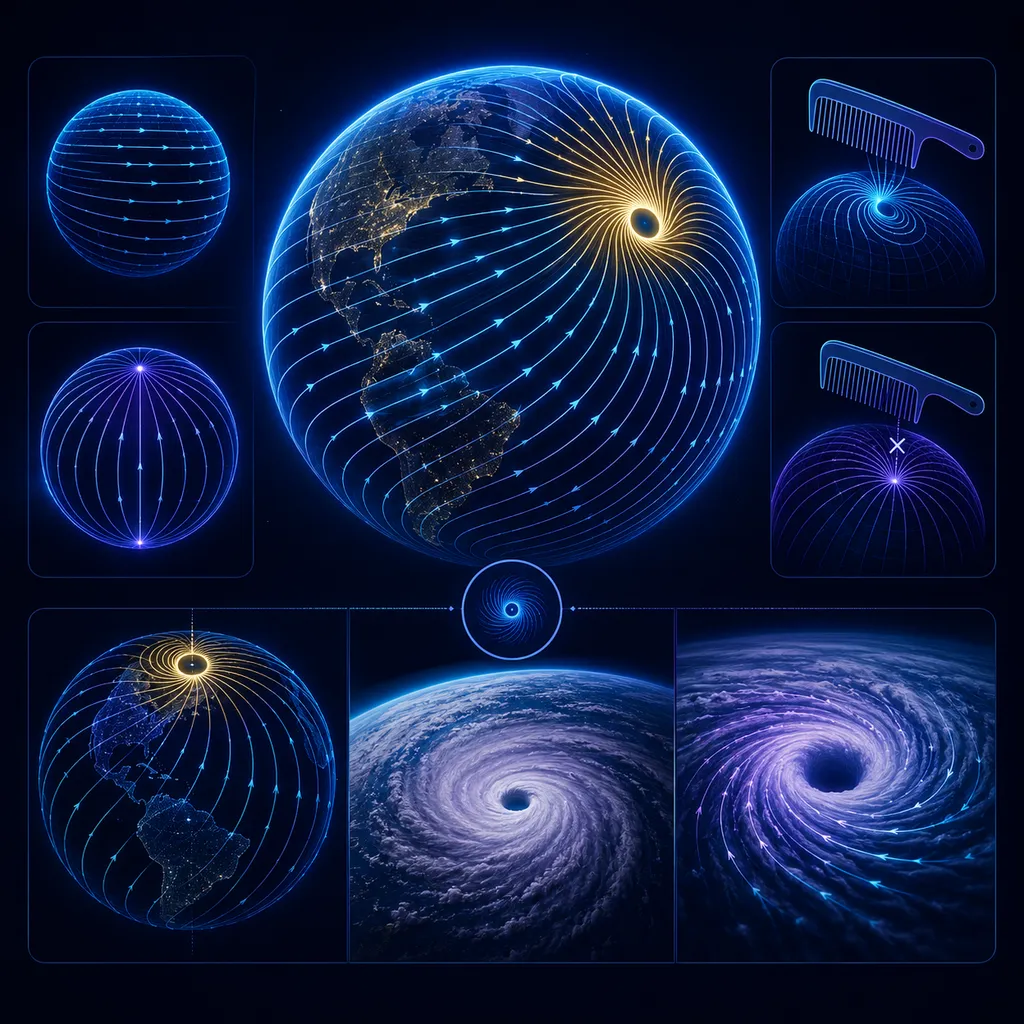
An extension of the topic of topology and vector fields (beyond the curriculum; touching on geography). You cannot "comb" a ball so that there is no cowlick anywhere — on a sphere every continuous tangent vector field must have a zero. That is why on Earth there is always a point where the horizontal wind = 0 (e.g. the eye of a cyclone). Luitzen Brouwer proved it in 1912.
I’ll give you a surface — decide whether a tangent vector field can be laid out smoothly (with no cowlick). χ decides.
What just happened?
You tried to “comb” the hairs on a ball — to lay the tangent vectors so they lie flat everywhere. However you turn the slider, at least one cowlick always remains: a point where the hair must stand up, i.e. the tangent vector is zero. That is exactly the hairy ball theorem.
The theorem (hairy ball theorem):
On a sphere there is no continuous, nowhere-zero tangent vector field. Formally: for every continuous tangent field on there is a point where
The full proof was given by Luitzen E. J. Brouwer in 1912; for the two-dimensional sphere the result had been shown earlier by Henri Poincaré (1885).
The invariant — the Euler characteristic:
The Poincaré–Hopf theorem says that the sum of the indices of a field’s zeros equals the Euler characteristic of the surface:
For the sphere , so the sum of indices is non-zero — the field must have a zero. For the torus , so the torus (doughnut) can be combed smoothly, with no cowlick. The shape of the surface (its topology) decides what is possible on it.
A beautiful meteorological consequence:
Horizontal wind on Earth is a tangent vector field on a sphere. The theorem therefore guarantees that at every moment there is at least one point on Earth where the horizontal wind is zero — somewhere there is always the “eye of a cyclone” or a windless spot. Abstract topology gives a concrete prediction about the physical world here.
Why this matters for the exam:
The topic goes beyond the core curriculum — it is where topology meets geography and meteorology. It is worth knowing as an example of how topology (shape) determines the properties of fields on a surface, and how a single number settles whether “combing” is possible at all.
Remember: on a sphere every continuous tangent vector field must have at least one zero — it cannot be combed without a cowlick, because .
Theory & formulas
Statement
On a sphere there is no continuous, nowhere-zero tangent vector field — "you cannot comb a ball" without a cowlick. Every attempt leaves a point where the vector is zero.
Weather consequence
Horizontal wind is a tangent vector field on the surface of the Earth — there is always a point where it blows zero (e.g. the eye of a cyclone).
Why not a torus
A torus (doughnut) has a different topology (Euler characteristic equal to ) and can be "combed" smoothly. The key lies in the shape of the surface, not its size.
Frequently asked questions
›Can a horizontal wind blow everywhere on the whole Earth?
No — there is always at least one windless point (e.g. the eye of a cyclone).
›What does the hairy ball theorem say?
That on a sphere there is no continuous, nowhere-zero tangent vector field — there is always a "cowlick".
›Does the theorem apply to a torus?
No — a torus (doughnut) can be "combed" smoothly, because it has a different topology than the sphere.
Teaching? Embed this experiment on your site.
Free widget — paste it on your school site, blog or notes. It links to the full version.