The Reuleaux triangle
Beyond the core curriculum — plane figures and the circle (a "wow" factor). There exist constant-width figures other than the circle: the Reuleaux triangle has the same width in every direction, so it can roll, and a drill bit of that shape bores (almost) square holes. Named after Franz Reuleaux (19th c.).
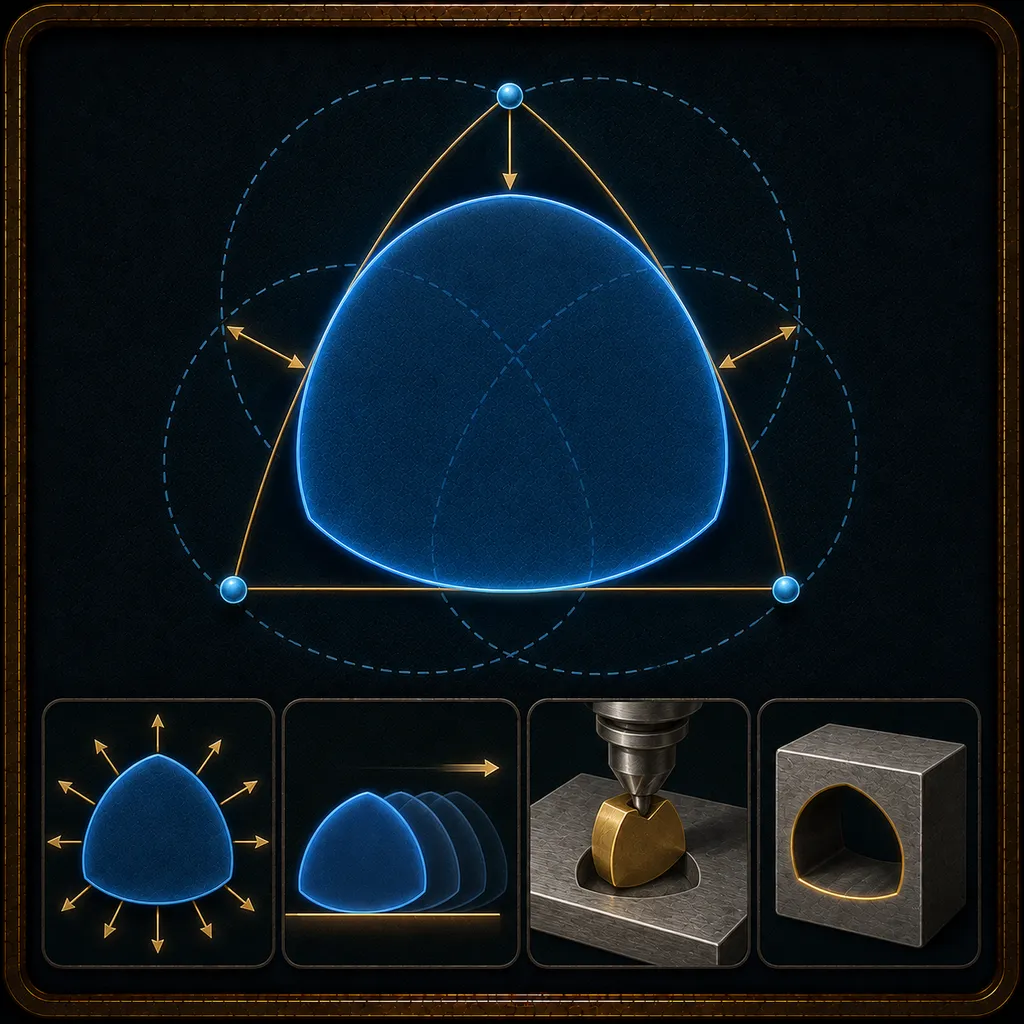
I’ll give you a figure — decide whether it has constant width (the same gap between tangents in every direction).
What just happened?
Intuitively it seems that only the circle has “constant width” — i.e. that the distance between two parallel tangent lines is the same regardless of direction. Not true! There is a whole family of constant-width figures, and the most famous of them is the Reuleaux triangle, named after the German engineer Franz Reuleaux (19th c.).
How is the Reuleaux triangle built?
We take an equilateral triangle with side and replace each side with an arc of a circle drawn from the opposite vertex with radius . Such a figure has the same width in every direction:
where is the distance from the centre to the tangent with normal . The sum of widths in two opposite directions always equals — which is why the upper rail does not budge while rolling.
Why can it roll like a circle?
Thanks to its constant width an object placed on rollers with a Reuleaux cross-section moves smoothly, without bobbing — the top plate stays at the same height the whole time. The difference from a circle: the centre of the figure does not move in a straight line — the centroid of the Reuleaux triangle bobs gently (the centre-path plot shows a wave, a straight line for the circle).
Barbier’s theorem:
Every figure of constant width has the same perimeter — exactly that of a circle of diameter . Surprising, because the Reuleaux triangle looks “thinner” than a circle, yet the perimeter is identical.
Applications:
Reuleaux-shaped drill bits drill (almost) square holes, the shape appears in mechanisms (the Wankel engine), and even in coins and manhole covers. It is a striking example that an “obvious” geometric intuition can be wrong.
Why this matters for the exam:
It is a “wow” beyond the core curriculum (the curriculum: plane figures, the circle), but it is great training in thinking: not every “obvious” geometric property is true — it is worth looking for counterexamples before you take something for granted.
Remember: the circle is not the only constant-width figure — the Reuleaux triangle also has in every direction, can roll, and its perimeter is .
Theory & formulas
A constant-width figure
The Reuleaux triangle is built from an equilateral triangle with side : each side is replaced by an arc of a circle of radius centred at the opposite vertex. The width (the distance between parallel tangents) is constant and equal to in every direction.
Perimeter (Barbier's theorem)
Every figure of constant width has perimeter: — the same as a circle of diameter .
Properties
It rolls like a circle (without bobbing), and as a drill bit it bores an almost-square hole. Its area is smaller than that of a circle of the same width.
Notation: the width (the side of the starting triangle), the perimeter.
Frequently asked questions
›Is the circle the only figure of constant width?
No — there exist other constant-width figures, e.g. the Reuleaux triangle.
›What can the Reuleaux triangle do?
Roll like a circle (without bobbing), and as a drill bit bore an almost-square hole.
›How is the Reuleaux triangle built?
From an equilateral triangle in which each side is replaced by an arc of a circle from the opposite vertex.
Teaching? Embed this experiment on your site.
Free widget — paste it on your school site, blog or notes. It links to the full version.
Related experiments