The Brachistochrone
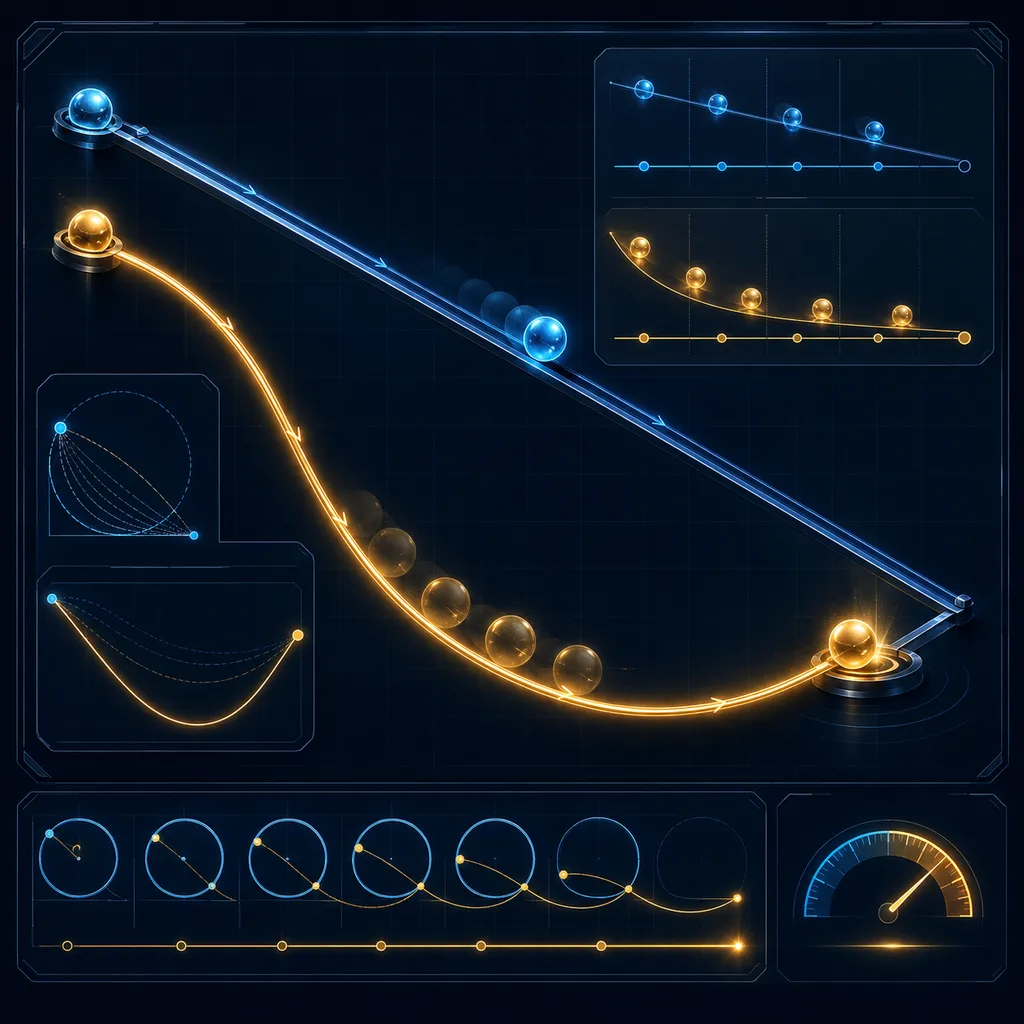
An extension of the topic of functions and optimization (meeting physics). A ball rolling without friction reaches B from A fastest not along a straight line, but along a cycloid — a longer path, but one that lets it build up speed sooner. Johann Bernoulli posed the problem as a challenge in 1696; it gave rise to the calculus of variations.
I’ll give you a description — pick the matching path (straight line, circular arc, cycloid). Note: the shortest path is not the same as the shortest time.
What just happened?
Three balls set off simultaneously from point and roll frictionlessly (gravity only) to point , which lies lower and to the side. The ball on the cycloid arrives first — even though its path is the longest. The intuitive “straight line” loses.
The famous challenge of 1696:
The brachistochrone (Gr. brachistos — shortest, chronos — time) is one of the most famous problems in the history of mathematics, posed as a challenge by Johann Bernoulli. The question: along which path should a ball slide (without friction) to travel from to in the shortest possible time? Intuition suggests the shortest path — a straight line — but the answer is surprising.
The answer: the cycloid
The fastest path has the shape of a cycloid — the curve traced by a point on the rim of a rolling circle. Its parametric equations (rolling angle , circle radius ):
Although the cycloid is longer than the straight line, its steep start lets the ball gain speed quickly — making the total time shorter.
Why it works — energy and time:
By conservation of energy (starting from rest), the speed depends only on the vertical drop :
The total travel time is the integral over the path length — the sooner grows, the smaller its contribution to the time:
The cycloid drops almost vertically at the start, so grows immediately and the integral comes out smallest. In the simulation we computed this integral numerically for each path — the cycloid wins deterministically.
The birth of the calculus of variations:
The problem was solved independently by, among others, Newton, Leibniz, Jakob and Johann Bernoulli, and de l’Hôpital. It gave rise to the calculus of variations — a field that seeks not a number but an entire function (here: the shape of the path) that minimizes some quantity.
A curiosity — the tautochrone:
The cycloid is also a tautochrone (Gr. “same time”): a ball released from any point of such a curve reaches the bottom in the same time, no matter how high we place it.
Invariant:
The cycloid minimizes the travel TIME — not the path length. The shortest path (straight line) and the shortest time (cycloid) are two different curves.
Why this matters for your exam:
This is a textbook example of optimization: we ask not “how much” but “what shape” gives the smallest value. It combines functions, derivatives and integrals with physics (gravity, energy). Remember the mechanism: the speed depends on the drop, while the time rewards a fast, steep start.
Remember: the fastest descent from to is the cycloid, not the straight line — a longer path but a shorter time, because the steep start speeds the ball up sooner.
Theory & formulas
The problem
We are looking for the path along which a ball (frictionless, under gravity alone) slides from to in the shortest time.
The solution: the cycloid
The fastest path is an arc of a cycloid — the curve traced by a point on a rolling circle:
Why not a straight line
A steep start lets the ball build up speed faster; despite the longer path, the time is shorter. This minimizes time, not length — the beginning of the calculus of variations.
Notation: radius of the generating circle, angle of rotation, the start and end points.
Frequently asked questions
›Which path gives the fastest descent from A to B?
The cycloid — even though it is longer than a straight line, its steep start lets the ball build up speed faster.
›Is the shortest path the fastest descent?
No — the brachistochrone minimizes TIME, not path length.
›Where did the brachistochrone problem come from?
From a challenge posed by Johann Bernoulli (1696); it was solved by Newton and Leibniz among others, giving rise to the calculus of variations.
Teaching? Embed this experiment on your site.
Free widget — paste it on your school site, blog or notes. It links to the full version.
Related experiments