The halting problem (Turing) — the limits of computers
An extension of the topic of computability (computer science). No program exists that, for any other program, decides whether it will halt or run forever — some things are fundamentally uncomputable. Alan Turing proved this in 1936, defining a model of the computer (the Turing machine) along the way.
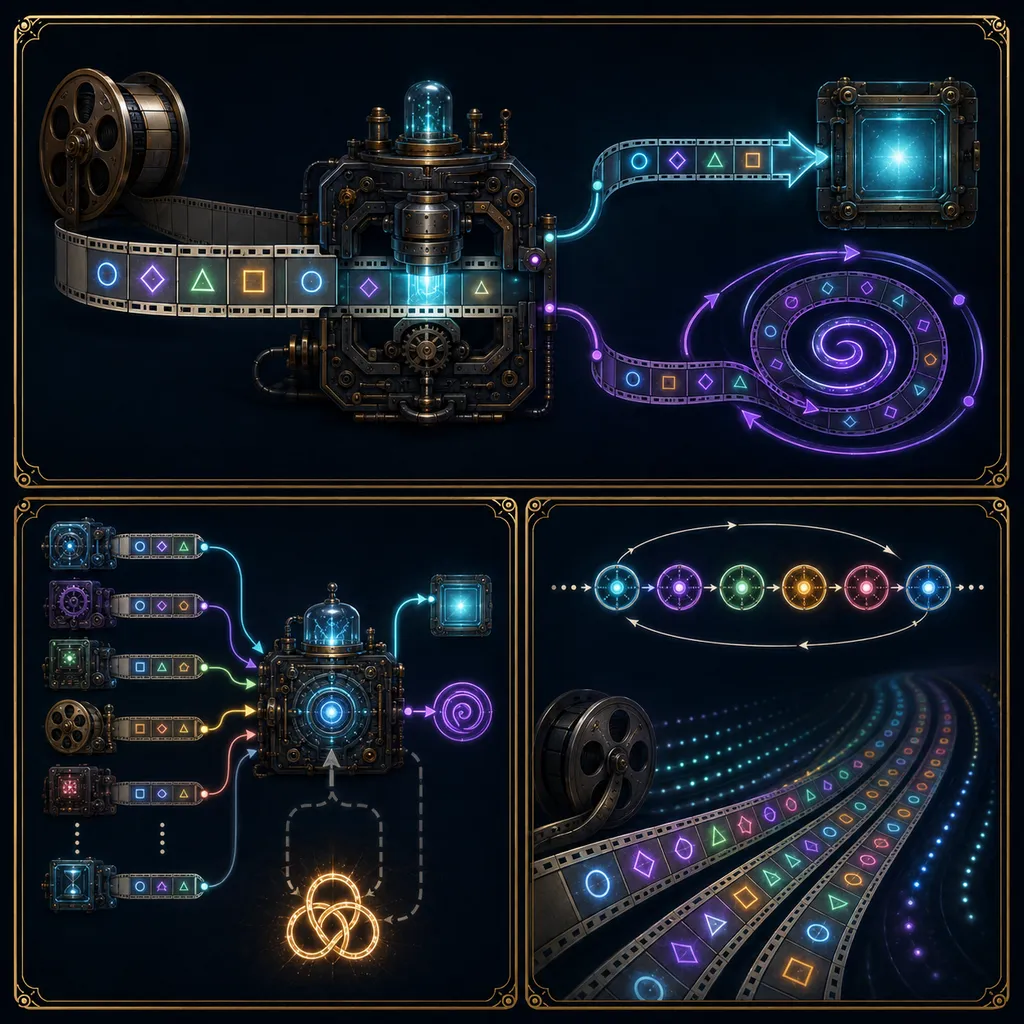
I’ll give you a statement about the halting problem — decide whether it is true. Key: a general halting detector CANNOT be built.
What just happened?
For program A (“count to 100”) you can see at once that it halts. For program B (“while true”) — that it runs forever. But for program C (“search for a counterexample to some hypothesis”) it is unknown: if a counterexample exists, the program finds it and stops; if none exists — it searches forever. And we cannot tell in advance which case holds.
The halting problem
This is a fundamental result of theoretical computer science, proved by Alan Turing in 1936 — in the very paper that defined the Turing machine, a mathematical model of a computer. The question is: can you write a single universal program (a detector ) that, for ANY other program and its input, decides whether ever halts or runs forever?
Proof by contradiction (self-reference)
Turing proved that such an does not exist. The proof is ingenious and contrarian — in the spirit of Russell’s paradox. Suppose exists. Let us build from it a contrarian program that does the OPPOSITE of what the detector claims:
Now let us run on itself — :
We obtain a self-contradiction: if the detector claims that halts, then deliberately enters a loop (does not halt) — and vice versa. Since the assumption that exists leads to a contradiction, such a program cannot exist. The halting problem is UNDECIDABLE (undecidable).
What does it mean in practice?
The consequence is profound: there are problems that are fundamentally uncomputable — that no computer, however infinitely fast, will ever solve. It is not a matter of “too little power”, but a fundamental limit on what algorithms can achieve. That is why you cannot write a program that perfectly detects all viruses, all bugs in someone else’s code or all infinite loops.
Why this matters for your exams:
Turing’s discovery — alongside Gödel’s incompleteness theorems — mapped out the limits of mathematics and computer science, and at the same time laid the foundations of all computing (Turing is regarded as its father). This extends the topic of computability: the very scheme of proof by contradiction and the diagonal argument (self-reference) are classic tools of logic and set theory.
Remember: there are algorithmically undecidable problems — no program solves the halting problem for all possible programs. It is not a lack of computing power, but a hard, mathematical limit of computability.
Theory & formulas
The halting problem
There is no algorithm that, for an arbitrary program and its input, decides whether halts or runs forever.
Proof by contradiction
If existed, you could build a program that does the “opposite” of what predicts for run on itself — a contradiction (self-reference, as in Gödel).
Conclusion
There are uncomputable problems — no algorithm solves them, regardless of the computer's power (Turing, 1936).
Notation: a hypothetical halting detector, the program under test, a program that fools .
Frequently asked questions
›Can you check, for every program, whether it will halt?
No — the halting problem is undecidable, as Alan Turing proved in 1936.
›What does the undecidability proof rest on?
On a contradiction: if a halting detector existed, you could build a program that fools it (self-reference).
›What does “uncomputable” mean?
That there are problems no algorithm will solve, regardless of the computer's power.
Teaching? Embed this experiment on your site.
Free widget — paste it on your school site, blog or notes. It links to the full version.