Ramsey's theorem — order out of chaos
An extension of combinatorics, graphs and colouring. In any group of 6 people you will always find 3 who all know one another, or 3 who are all strangers — complete chaos cannot be sustained (the Ramsey number R(3,3)=6). For 5 people this is not always so. Frank Ramsey proved it in 1930.
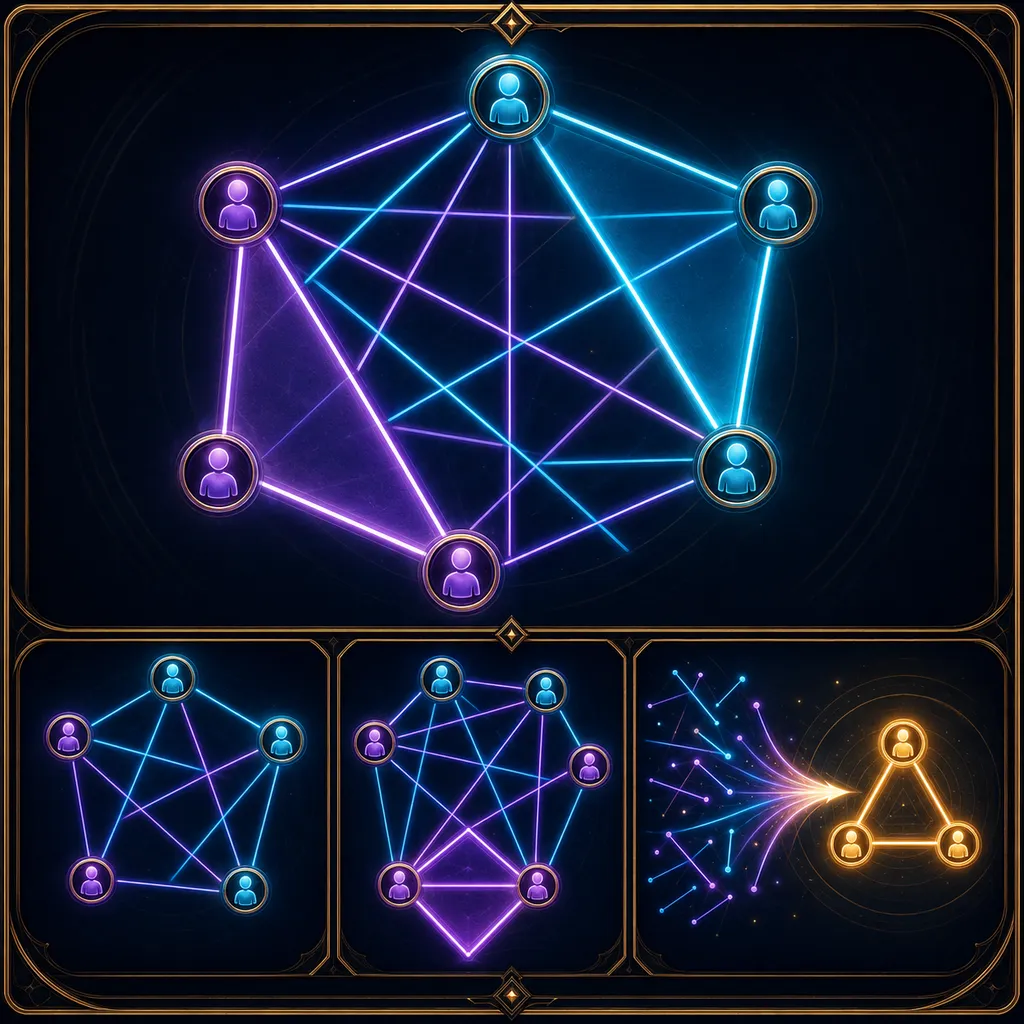
I’ll give you a number of people n — decide whether a monochromatic triangle (3 mutual acquaintances or 3 mutual strangers) is unavoidable. The threshold is the Ramsey number R(3,3) = 6.
What just happened?
We joined every pair of people with a line and coloured it in two colours: blue = “they know each other”, red = “they don’t know each other”. For 6 people — no matter how we arrange the acquaintances — a monochromatic triangle always arises: either three people who all know one another, or three who are all strangers. For 5 people this can be avoided (the “pentagon + star” arrangement above).
Ramsey’s theorem (the party problem)
This is one of the most beautiful results in combinatorics, proved by the British mathematician Frank Ramsey in 1930 (in the paper “On a problem of formal logic”). Its most famous case: in any group of at least 6 people you will always find either 3 people who all know one another, or 3 who are all strangers — no matter who knows whom. Mathematically: colouring all edges of the complete graph in two colours always produces a monochromatic triangle ().
This value “6” is the Ramsey number — the smallest number of people guaranteeing a monochromatic triangle. We write the rule briefly as:
Why 6, and not 5?
For 5 people it is not guaranteed: the edges of the graph can be coloured so as to avoid a monochromatic triangle. The famous example is the “pentagon + star”: we set the acquaintances along a pentagon (a 5-cycle) and the non-acquaintances along the inscribed star (pentagram) — neither 5-cycle contains a triangle. This is exactly the arrangement you see on the stage for . Only the sixth person breaks the symmetry: they have 5 connections, so at least 3 of them are the same colour — and among those three people a monochromatic triangle always closes up.
A deeper idea: chaos is impossible
The whole of Ramsey theory says something astonishing: complete chaos does not exist. In a sufficiently large structure some ordered pattern always appears, however hard we try to avoid it. Theodore Motzkin put it as: “complete disorder is impossible”. Ramsey theory has applications in computer science, number theory and logic.
A curiosity
Computing larger Ramsey numbers is so hard that the mathematician Paul Erdős joked: if aliens demanded the value of under threat of destroying Earth, we should throw all the planet’s resources at the computation — but if they wanted , we had better try to destroy them first.
Why this matters for your exams:
The Ramsey number itself is a curiosity beyond the syllabus, but the move “people → vertices, acquaintances → colouring the edges of the complete graph ” is a textbook example of modelling in graph theory. Reasoning about an invariant (here: the unavoidable monochromatic triangle) and the pigeonhole argument at the “sixth person” are useful in advanced-level combinatorics problems.
Remember: in any group of at least 6 people there are always 3 who are mutual acquaintances or 3 who are mutual strangers — . Order cannot be eliminated entirely: a sufficiently large structure is always accompanied by some pattern.
Theory & formulas
The Ramsey number
: in every two-colouring of the connections between people (know each other / do not), a monochromatic triangle appears — a trio of mutual acquaintances or of mutual strangers.
Why 6, and not 5
For people there is a colouring with no monochromatic triangle (a pentagon plus its diagonals). For , the pigeonhole principle forces such a triangle.
Meaning
“Complete chaos is impossible” — in a sufficiently large structure some ordered pattern always appears. In general, the numbers can be very hard to compute.
Notation: the Ramsey number; here .
Frequently asked questions
›In a group of 6 people, is there always a trio of acquaintances or of strangers?
Yes — it is the Ramsey number R(3,3)=6; a monochromatic triangle always appears.
›Does this also hold for 5 people?
Not always — there is a colouring of the connections between 5 people with no monochromatic trio.
›What does Ramsey theory say?
That complete chaos is impossible — in a sufficiently large structure some ordered pattern always appears.
Teaching? Embed this experiment on your site.
Free widget — paste it on your school site, blog or notes. It links to the full version.