The Birthday Paradox
An extension of the topic of probability and complementary events. The probability that at least two people in a group share a birthday is found through the complementary event: $P=1-\dfrac{365!}{365^n(365-n)!}$. Against intuition, it already exceeds 50% with just 23 people — because what matters is every possible pair of people, not single people against a fixed date. The problem was first published by Richard von Mises in 1939.
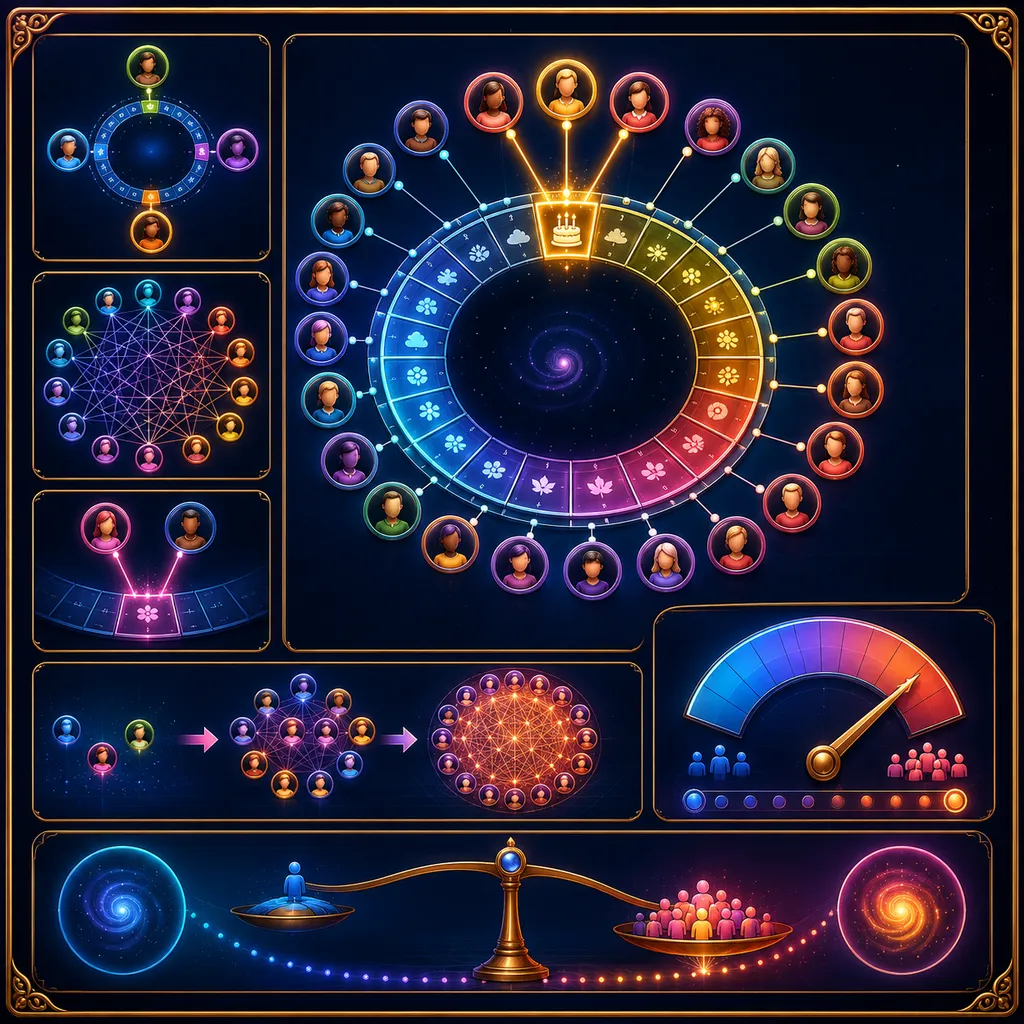
I’ll give you a target chance of a shared date — tune the number of people n with the slider to reach it.
What just happened?
In a group of 10 people the probability that at least two of them share a birthday is 11.7%. Most people’s intuition suggests you need half of 365 days — about 183 people — to exceed 50%. That is wrong: just 23 people are enough.
The complementary event — the key to the calculation:
It is easier to compute the probability that everyone has a different birthday, and subtract it from 1:
which is equivalent to a product of decreasing fractions:
Why does it work? (the invariant)
P(n) grows monotonically with n and approaches 100%. The secret does not lie in single people against one fixed date — what counts is every possible pair of people. With n people there are pairs: with n=23 that is already 253 pairs, each with a small 1/365 chance of a date match, but together giving more than 50%. With n=70 the probability already exceeds 99.9%.
History of the paradox
The problem was first published by Richard von Mises in 1939 — it was probably known informally even earlier, e.g. to Harold Davenport around 1927, but it was von Mises who first presented it in print. Today it is a classic example of how intuition fails in probability — also used to illustrate “collisions” in computer science, e.g. in hash functions.
Why you need this for the exam:
The complementary event is one of the most useful tricks in combinatorics and probability — when “at least one/two” is hard to count directly, count “none” and subtract from 1. The trick: always check whether you are counting single elements or pairs/combinations — these most often “drive” surprisingly high results.
Remember: just 23 people are enough for the chance of a shared birthday to exceed 50% — because what counts is the number of pairs, not the number of people. P = 1 − 365!/(365ⁿ·(365−n)!).
Theory & formulas
Complementary event
It is easier to compute the probability that everyone has a different birthday:
Result
For this comes out to about — more than .
Why so few people
What counts is the number of pairs, not of people: For people that is already pairs — hence the high chance of a collision.
Notation: number of people, number of pairs.
Frequently asked questions
›Why are 23 people already enough?
Because what counts is the number of pairs of people (n(n-1)/2), not the number of people — with 23 people that is already 253 pairs.
›How is this probability computed?
Through the complementary event — it is easier to compute the chance that EVERYONE has a different birthday and subtract it from 1.
›Where is this paradox used beyond birthdays?
To illustrate collisions in computer science, for example in hash functions.
Teaching? Embed this experiment on your site.
Free widget — paste it on your school site, blog or notes. It links to the full version.