The Gambler's Fallacy
Exam topic — independence of events and probability. For independent events (a coin, a roulette wheel) previous outcomes do not change the next one — after five reds the chance of black is still ~½. The most famous case: the roulette wheel in Monte Carlo on 18 August 1913, when the ball landed on black 26 times in a row.
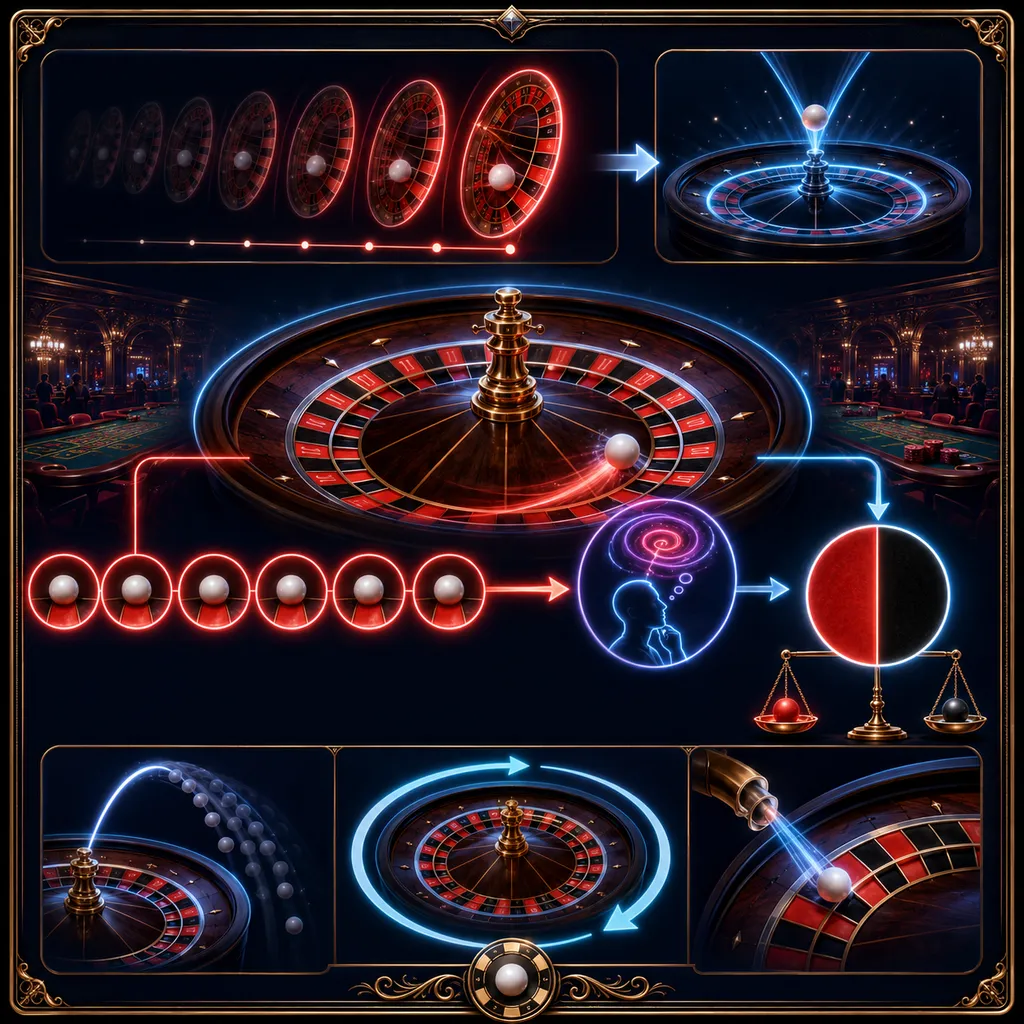
I’ll give you two streaks of reds — judge after which one the chance of black on the next spin is greater. The events are independent.
What is the gambler’s fallacy?
The gambler’s fallacy (gambler’s fallacy) is one of the most common cognitive biases about probability. It is the false belief that if a random event has not occurred for a long time (or, conversely, has repeated many times), then it is now “more likely”, because it “has to even out”. In reality, for independent events — such as a coin toss or a roulette wheel — previous outcomes have no influence on the next one.
A coin has no memory:
After five (or even twenty) heads in a row, the probability of tails on the next toss is still exactly . History changes nothing — every toss starts “from scratch”.
Monte Carlo, 18 August 1913
The most famous example happened at the casino in Monte Carlo, when the roulette ball landed on black 26 times in a row. Players lost fortunes betting on red, convinced that “it surely has to come up now” — yet every successive spin still had the same, constant chance.
The key distinction
The probability of a whole streak fixed in advance (e.g. 6 blacks) is small:
BUT the probability of a single next outcome, GIVEN that the earlier ones have already happened, is always . This distinction is the heart of the paradox: an “unlikely streak fixed in advance” is something entirely different from “the next spin once a streak is already running”. Understanding the independence of events protects you from this error (and from losing at the casino).
Why this matters for your exam:
This is a classic topic on the independence of events and probability. The trick: always ask whether you are computing the probability of a whole streak in advance — then you multiply successive together — or of a single next draw with independent events, where history plays no role and the outcome is simply .
Remember: with independent events the next outcome always has probability — the roulette wheel does not remember what came up before.
Theory & formulas
Independence of events
For independent events the outcome does not depend on the history: A roulette wheel and a coin do not “remember” previous outcomes.
The gambler's fallacy
The false belief that a streak “has to even out” — that after a streak of reds, black becomes more likely.
A streak vs. the next spin
A whole streak fixed in advance is unlikely: . But once the streak has already occurred, the next single spin is still .
Notation: probability, length of the streak.
Frequently asked questions
›Does the chance of black increase after five reds?
No — for independent events it is still ~½; a roulette wheel and a coin do not “remember” the history.
›What exactly is the gambler's fallacy?
On the false belief that a streak “has to even out” — that after a streak of one outcome, the other becomes more likely.
›What is the difference between the chance of a streak and of the next spin?
A whole streak fixed in advance is unlikely ((½)ⁿ), but a single next outcome — once the streak has already occurred — is still ½.
Teaching? Embed this experiment on your site.
Free widget — paste it on your school site, blog or notes. It links to the full version.