The Secretary Problem — The 37% Rule
An extension of the topic of probability and the number e. To maximize the chance of choosing the best candidate seen one at a time (without recall), you should reject the first ~37% (1/e), and then pick the first candidate better than all those seen so far. The optimal threshold tends to 1/e, and the chance of success is also ~1/e. The problem was popularized by Martin Gardner in 1960.
I’ll give you a number of candidates to reject — set the slider n so that the optimal threshold round(n/e) gives exactly that.
What just happened?
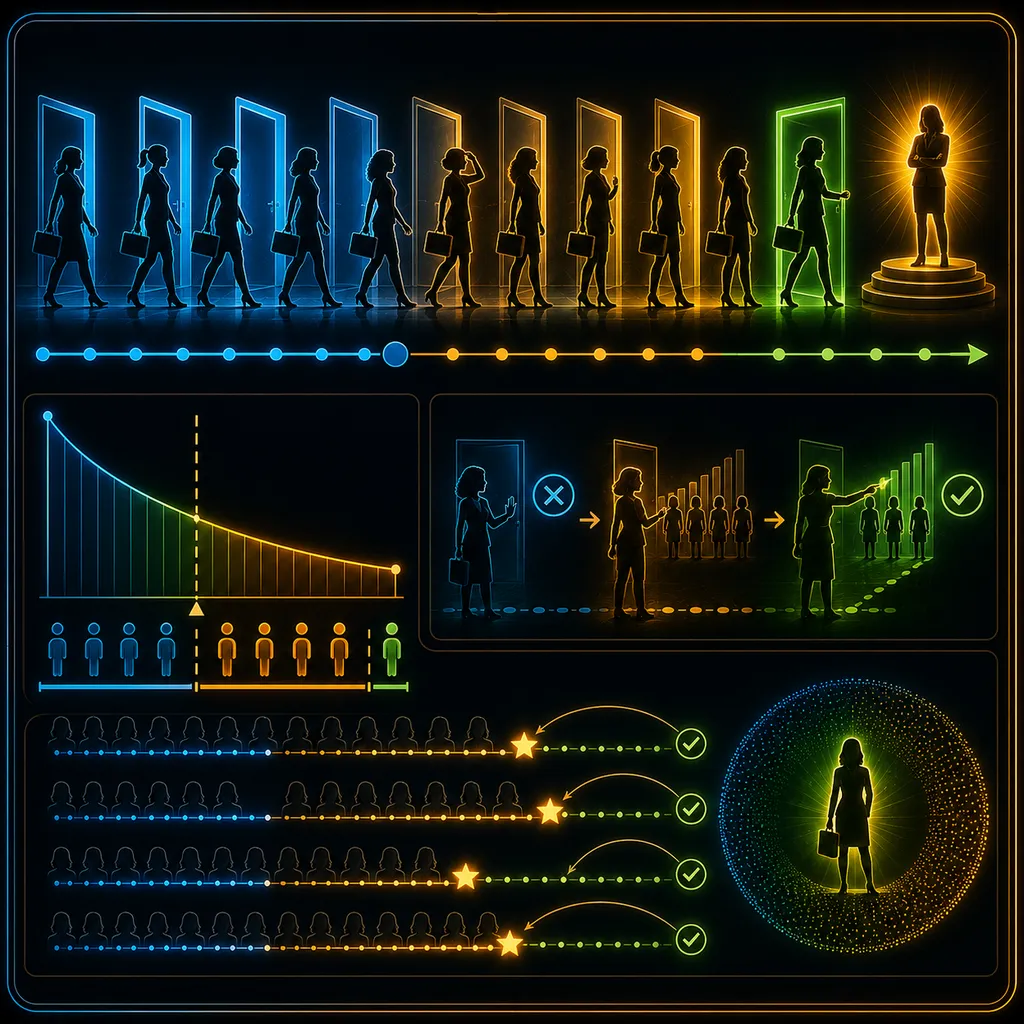
You review candidates one at a time, in random order, and after each you must immediately decide “take” or “reject forever” — with no going back. You want to pick the best. A surprisingly simple and elegant optimal strategy: reject the first ~37% of candidates, merely observing them and remembering the best one as a “benchmark”, and then pick the first one who surpasses all seen so far. The scene shows two phases — observation (rejection) and selection — split by a threshold, plus the success-probability curve with a clear maximum at 37%.
The optimal cutoff threshold:
— you reject the first candidates (where is Euler’s number), which for large gives a threshold converging to 37%.
The chance of choosing the best:
This strategy gives a ~37% chance (exactly ) of landing on the absolute best candidate — regardless of whether there are 10, 100, or a million of them! This is remarkable, because naively one would think that, seeing each only once, the chance should be negligible ().
Why exactly 1/e? (the invariant)
The magic number (the reciprocal of Euler’s number) appears here naturally from probability: maximizing over the threshold , we get a condition whose solution tends to . At that point the chance of success itself is also . The panel on the right shows both bars glued to the line — and that regardless of .
History and applications
The secretary problem (also known as the marriage problem, the sultan’s dowry problem, or the “best choice problem”) is a classic optimal-stopping problem, popularized by Martin Gardner in 1960. It has real applications in decision theory, economics, and even in life choices (hence the playful “37% rule” for dating — after seeing 37% of the options, pick the next better one). It is a beautiful example of how mathematics gives a concrete, optimal strategy in a seemingly hopeless situation.
Why this matters for your exam:
This is an extension of the topic of probability and the number . It shows that even with irreversible “live” decisions a simple threshold rule beats random choice — and that the constant pops up in places where you would never expect it.
Remember: observe and reject the first , then take the first one who is better. Chance of the best: .
Theory & formulas
The 1/e rule
Candidates are seen one at a time, without recall. Optimal strategy: reject the first (about ), remembering the best among them, and then pick the first candidate better than all those seen so far.
Chance of success
For large the threshold and the probability of choosing the best both tend to:
Where e comes from
Maximizing the chance leads to an equation whose solution is the threshold — hence the constant in this optimal-stopping problem.
Notation: number of candidates, .
Frequently asked questions
›How many candidates should you reject at the start?
About 37% (exactly n/e), merely observing them, and then pick the first candidate better than all seen so far.
›What is the chance of choosing the best candidate?
About 1/e ≈ 37% — independent of the number of candidates (for large n).
›Where does the number 1/e come from in this problem?
From the probability theory of optimal stopping — the optimal threshold and the chance of success both tend to 1/e.
Teaching? Embed this experiment on your site.
Free widget — paste it on your school site, blog or notes. It links to the full version.