The Monty Hall Problem — a famous paradox
An extension of the topic of conditional probability. In the classic three-door problem the player picks one door, the host (who knows where the prize is) opens one of the remaining doors to reveal a goat, and the player decides: stay or switch. Against intuition, switching gives a 2/3 chance of winning while staying gives only 1/3 — because the host's choice carries information. The problem was posed and solved by Steve Selvin in 1975 (a famous paradox, popularized by Marilyn vos Savant in 1990).
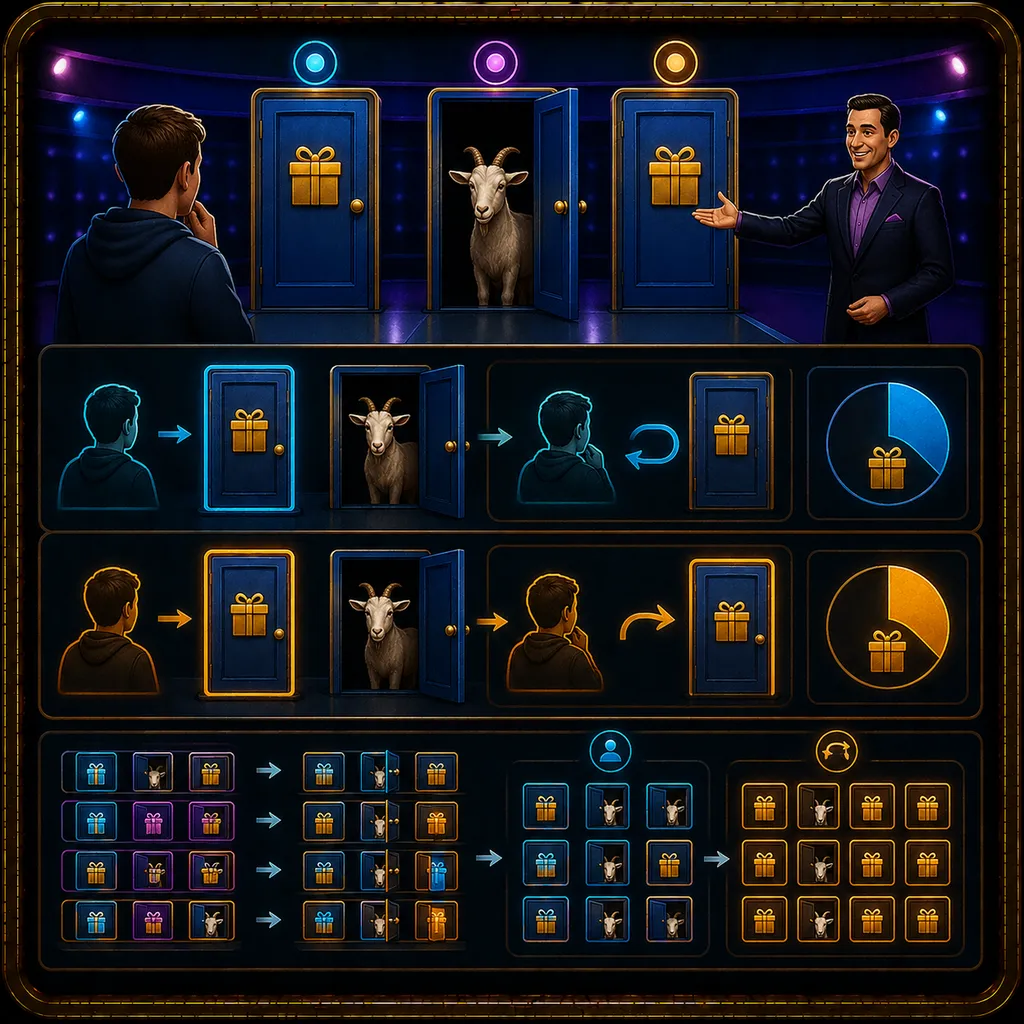
I’ll randomly place the prize behind a door (you always pick door 1, the host reveals a goat). Guess which strategy wins this round.
What just happened?
Three doors, a car behind one, a goat behind the other two. You pick door 1. The host — who KNOWS where the prize is — always opens one of the other two doors with a goat (never yours, never the prize). You are left with a choice: stay, or switch to the last unopened door. The grid of 30 games shows the outcome of the same, repeatable situation: with the “stay” strategy you win 10 of 30 games, with “switch” — 20 of 30.
Conditional probabilities:
Switching doors doubles the chance of winning — from 1/3 to 2/3. This is not an arithmetic error or a trick: it follows directly from the fact that the host’s action is not random.
Why does it work? (the invariant)
The “switch” strategy wins exactly when your original pick was a miss — and that happens in 2/3 of cases (two of the three doors hide a goat). The “stay” strategy wins exactly when the original pick was correct — that is, in 1/3 of cases. By opening a door with a goat, the host does not change the chance of your first pick (it stays 1/3) — but shifts the entire remaining 2/3 of probability onto the single, last unopened door.
History of the paradox
The problem was formulated and correctly solved mathematically by Steve Selvin in a letter to the journal “The American Statistician” in 1975 — it was he who coined the name “Monty Hall Problem”, after the host of the popular American game show “Let’s Make a Deal”. Despite the correct solution, the problem stayed little known until 1990, when Marilyn vos Savant popularized it in her column in “Parade” magazine — sparking huge controversy: the editors received thousands of letters, including from mathematics professors, mistakenly convinced she was wrong.
Where does the intuitive error come from?
Most people assume that after one door is opened there are “just two possibilities” left, so the odds must be 50/50. This ignores a key fact: the host KNOWS where the prize is and deliberately avoids opening it. Their choice carries information you did not have at the moment of your first pick — and it is worth using that information by switching doors.
Why you need this for the exam:
This is a classic example of conditional probability — it tests whether you distinguish random events from a decision made deliberately on the basis of knowledge. The trick: always ask whether the extra information (here: which door was opened) could have arisen at random or from a conscious choice — this changes the whole probability.
Remember: switching doors gives a 2/3 chance of winning, staying — only 1/3. Always switch.
Theory & formulas
Three doors
You pick of doors (a chance of the prize). The host — who knows the layout — opens one of the remaining doors, revealing a goat.
Why switching pays off
- staying: you win when your first pick was correct → ,
- switching: you win when your first pick was wrong → .
The key idea
The host's choice is not random — it carries information, shifting the probability onto the door you did not pick.
Notation: probability of winning.
Frequently asked questions
›Why is it worth switching doors in the Monty Hall problem?
Because switching gives a 2/3 chance of winning, whereas staying with your first pick gives only 1/3.
›Why does the host's choice carry information?
Because the host always knows where the prize is and deliberately opens a door with a goat — this is not random.
›Who formulated this problem?
Steve Selvin in 1975; it was popularized by Marilyn vos Savant in 1990.
Teaching? Embed this experiment on your site.
Free widget — paste it on your school site, blog or notes. It links to the full version.