Coulomb's law — the force between charges F = k·q₁q₂/r²
What we'll do: We'll change the magnitudes and signs of two charges and the distance between them, and watch when they attract, when they repel, and how strongly.
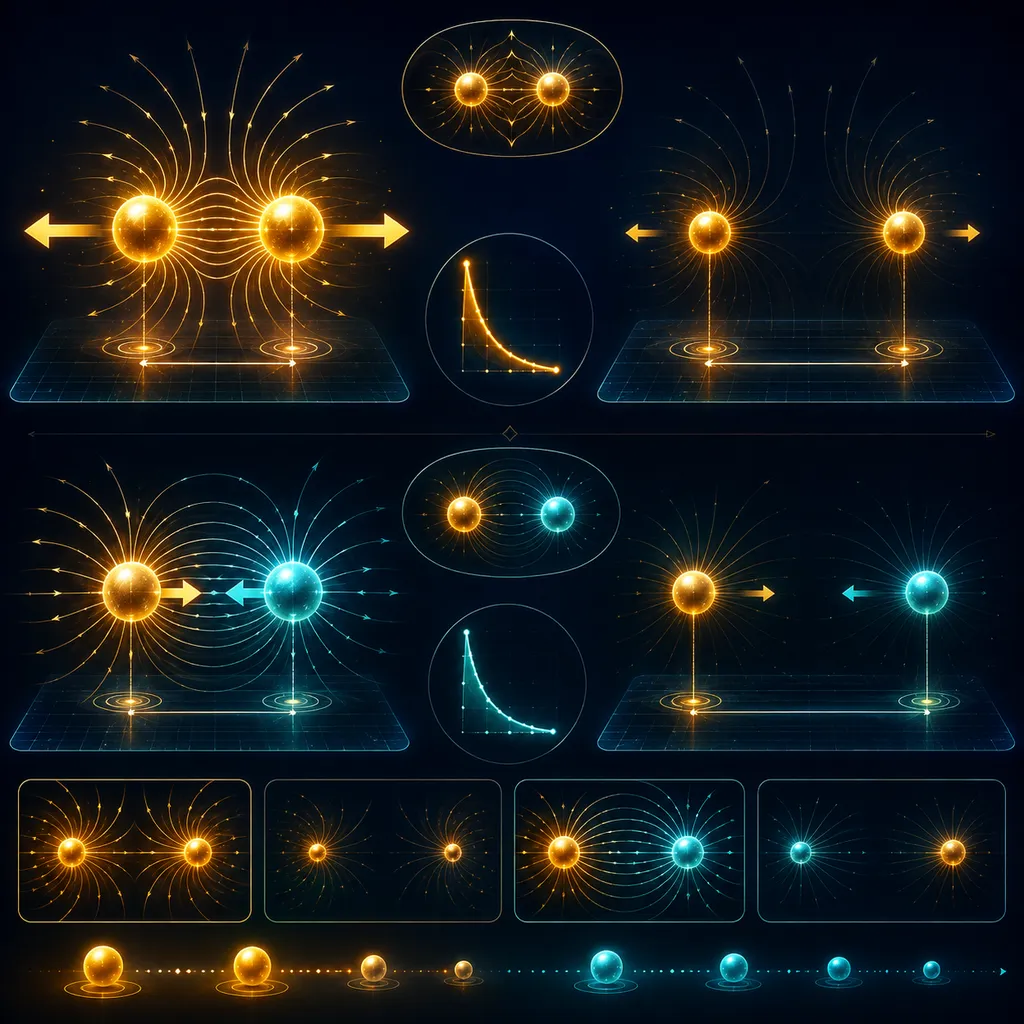
What you see on screen: Two charges with signs (+/−), sliders for their magnitudes and the distance, and force vectors — pointing away from each other (repulsion) or toward each other (attraction). The force readout falls with the square of the distance. Readouts: charges, distance, force and the type of interaction.
I’ll give you a target force — set the charges and distance to reach it. F = k·|q₁q₂|/r² (signs do not affect the value).
What just happened?
Two positive charges repelled each other. After flipping the sign of one, they began to attract, and moving them apart weakened the force with the square of the distance.
Coulomb’s law:
the interaction force of two point charges is directly proportional to the product of their magnitudes and inversely proportional to the square of the distance:
The signs determine the direction: LIKE charges (same sign) repel, UNLIKE ones attract.
Gravity’s twin:
this is also an inverse-square law, like the law of universal gravitation. The difference: gravity only attracts (masses are “of one sign”), whereas charges can both attract and repel.
Scale:
the electric force is enormous compared with the gravitational one — that is why even a small charge produces a clear effect.
Why you need this for the exam:
, computing the force and the electric field strength of a point charge is the foundation of electrostatics. Trick: magnitude from the formula, direction from the signs.
Remember: like charges repel, unlike charges attract, and the force falls with the square of the distance ().
Theory & formulas
Coulomb force
Proportional to the product of the charges, inversely to the square of the distance.
The sign decides the direction
- unlike charges (different signs) → attraction
- like charges (same signs) → repulsion
Analogy to gravity
Both laws have the form . The difference: gravity only attracts, whereas the electric force can attract and repel.
Symbols: — force, — charges, — distance, — Coulomb constant.
Frequently asked questions
›How is Coulomb's law stated?
The force between two charges is F = k·|q₁q₂|/r² — proportional to the product of the charges and inversely proportional to the square of the distance.
›When do charges attract and when do they repel?
Unlike charges (opposite signs) attract, like charges (same signs) repel.
›How does Coulomb's law resemble the law of gravitation?
Both fall with the square of the distance; the difference: gravity only attracts, whereas the electric force can attract and repel.
Teaching? Embed this experiment on your site.
Free widget — paste it on your school site, blog or notes. It links to the full version.