Electric field strength and field lines
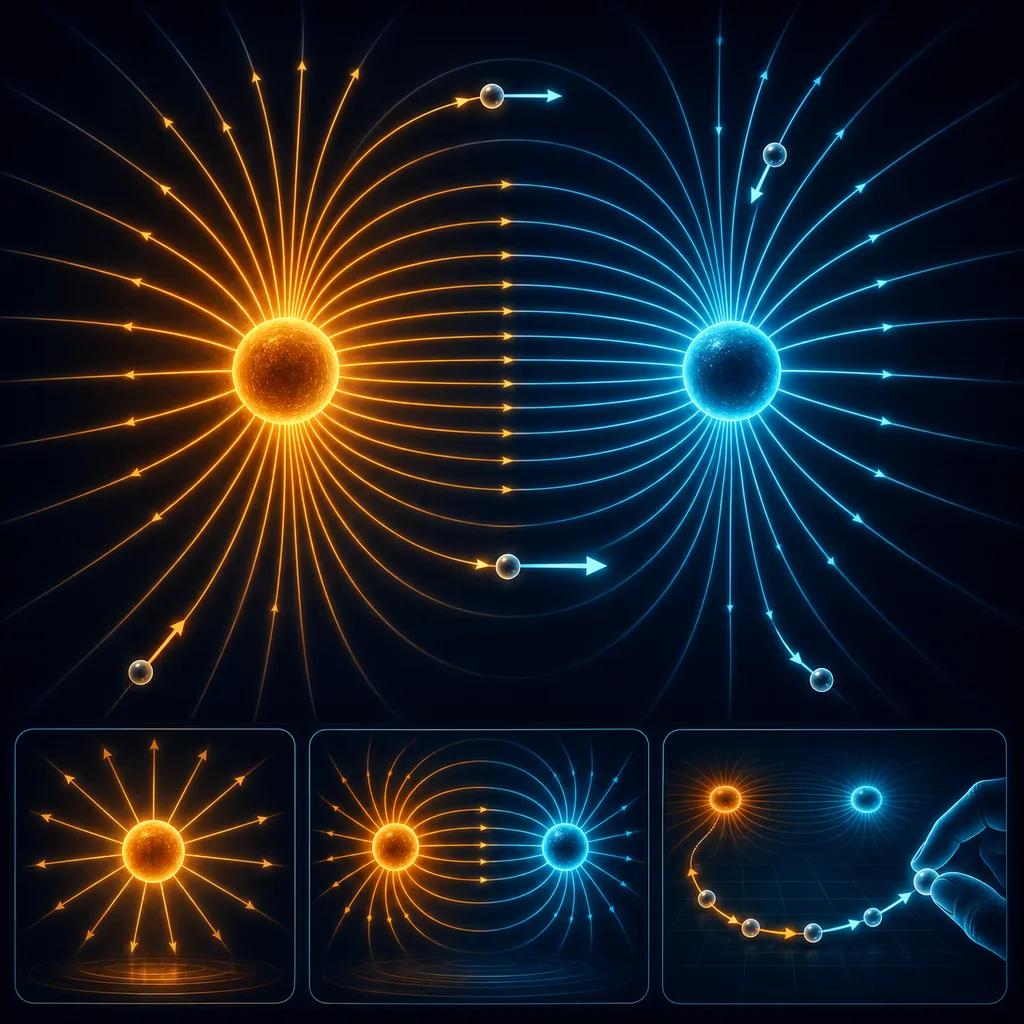
A charge creates an electric field around itself with strength E=kQ/r² — strongest close to the charge (it drops with the square of the distance). The field direction is shown by field lines: they run from the positive charge to the negative one, and their density shows the field strength. Change the charges and place the test charge.
I will give you a field-strength threshold — set the charges and the test-charge position to reach it. E = kQ/r².
What is field strength?
The electric field strength is the force acting on a unit test charge — it tells you how “strong” the field is at a given point:
Q — source charge (C), r — distance from it (m), k ≈ 9·10⁹. Field strength drops with the square of the distance: 2× farther ⇒ 4× weaker field.
How to read field lines?
Line direction = direction of the force on a positive charge. Line density = field strength: where lines are dense, the field is strong. Field lines start on the positive charge (+) and end on the negative one (−), and they never cross — at each point the field has one, well-defined direction. Like charges repel, so their lines diverge.
Where is the field zero?
Between two equal charges of the same sign there is a point (in the middle) where the fields cancel and — set of the same sign and move the test charge to the middle.
Why you need this for the exam:
E = kQ/r² plus superposition (adding vectors) solves most problems about the field of point charges. The trick: compute E from each charge separately, then add them as vectors — and remember the 1/r² relation.
Remember: field strength E = kQ/r² — grows with the charge, drops with the square of the distance; lines run from + to − and never cross.
Theory & formulas
Field strength
The field acts on a test charge with a force ; the field strength is: Strongest close to the charge (it drops with the square of the distance).
Field lines
- the tangent to a line = field direction (force on a positive charge),
- line density = field strength (denser = stronger),
- lines run from “+” to “−” and never cross.
The field can be zero where the fields from different charges cancel.
Symbols: — field strength, — force, — test charge, — source charge, — distance, — Coulomb constant.
Frequently asked questions
›What is field strength?
The force acting on a unit test charge at a given point: E=F/q=kQ/r². A vector pointing in the direction of the force on a positive charge.
›How to read field lines?
The direction of the tangent to a line = field direction (force on +); line density = field strength (denser = stronger field). Lines do not cross.
›Where is the field zero?
For example, at a point between two identical charges of the same sign — their fields cancel each other out.
Teaching? Embed this experiment on your site.
Free widget — paste it on your school site, blog or notes. It links to the full version.