Lenz's law — direction of the induced current
Push the magnet into the coil and pull it back out. The induced current always flows so as to oppose the change in flux: on insertion it repels the magnet, on withdrawal it attracts it. This is a direct consequence of the conservation of energy.
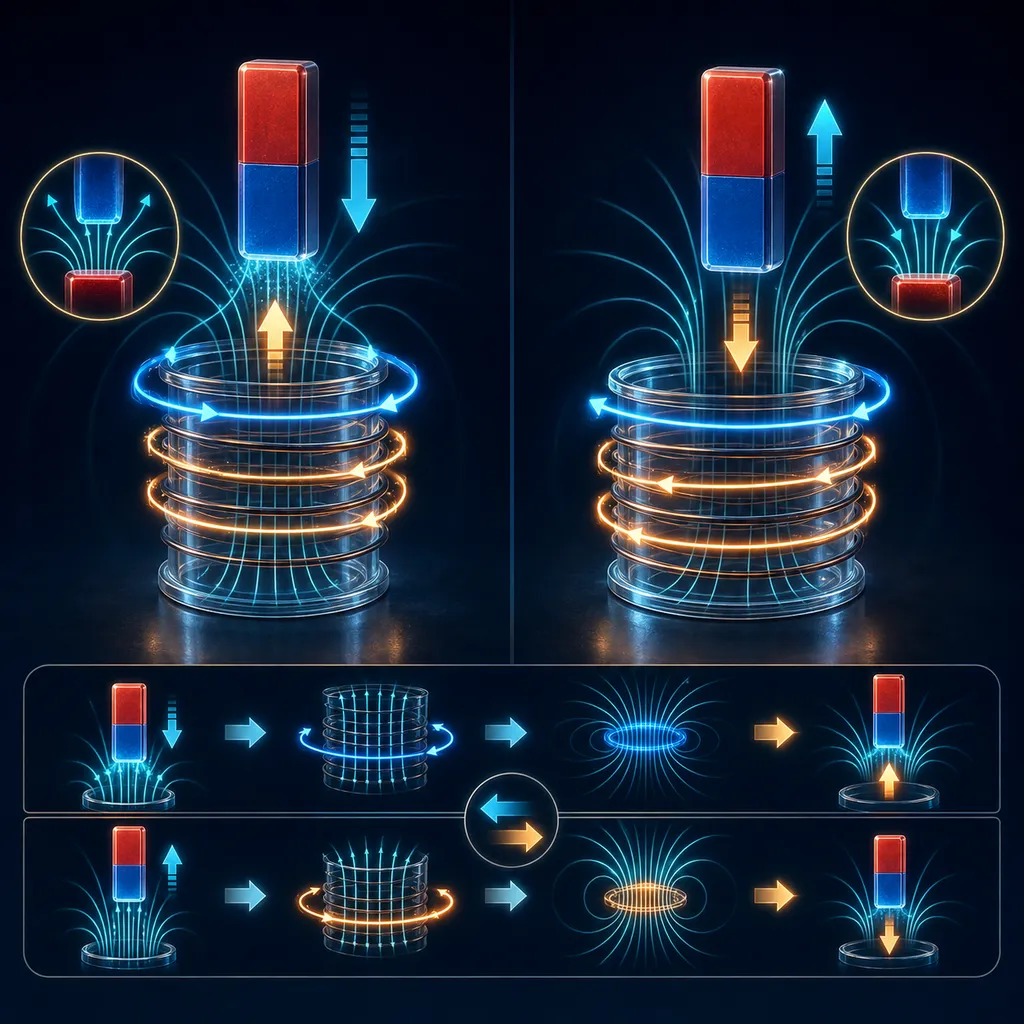
I’ll give you a direction of flux change — guess how the coil behaves toward the magnet (no controls). Lenz’s law.
What just happened?
When the magnetic flux through the coil increases, the induced current creates an opposing field — the coil “defends itself” against the rise and repels the magnet. When the flux decreases, the current flows the other way and the coil attracts the receding magnet. It always opposes the change.
Lenz’s law and Faraday’s law:
The minus sign is exactly Lenz’s law: the induced EMF is directed so that the current it drives opposes the change in flux . The faster the change, the larger and the larger the current.
Where does the minus sign come from?
From conservation of energy. If the current aided the change, it would amplify it, and that would amplify the current — we would get energy from nothing. That is why moving the magnet requires work against a retarding force, and that work is converted into electrical energy.
Why this matters on the exam:
You solve induction problems in two steps: (1) determine whether the flux is increasing or decreasing, (2) choose the current direction so that the coil’s field opposes that change. The sign in tells you the rest.
Remember: the induced current always opposes the change that caused it — this is Lenz’s law, a consequence of conservation of energy: ε = −dΦ/dt.
Theory & formulas
Lenz's law
The induced current always flows in such a direction that its own magnetic field opposes the change in flux that produced the current.
Practical consequence
- when the magnet is inserted, the coil repels it,
- when it is withdrawn — it attracts it.
Because of this, work must always be done against a force — otherwise a self-sustaining motion and free energy would arise.
Link with Faraday's law
Lenz's law is the content of the minus sign in the law of induction: It is a direct consequence of the conservation of energy.
Symbols: — induced EMF, — magnetic flux, — time of the flux change.
Frequently asked questions
›What does Lenz's law say?
The induced current flows in such a direction that its magnetic field opposes the change in flux that produced the current.
›Why does the current "oppose" the change?
Because otherwise a self-sustaining motion and free energy would arise — Lenz's law is the conservation of energy in practice.
›How does it connect with Faraday's law?
The minus sign in ε=−dΦ/dt is the mathematical statement of Lenz's law.
Teaching? Embed this experiment on your site.
Free widget — paste it on your school site, blog or notes. It links to the full version.