Electromagnetic induction — Faraday's law and Lenz's law
What we will do: We will push a magnet in and out of a coil, changing the speed, the number of turns and the magnet strength, and watch when and how strong a current flows.
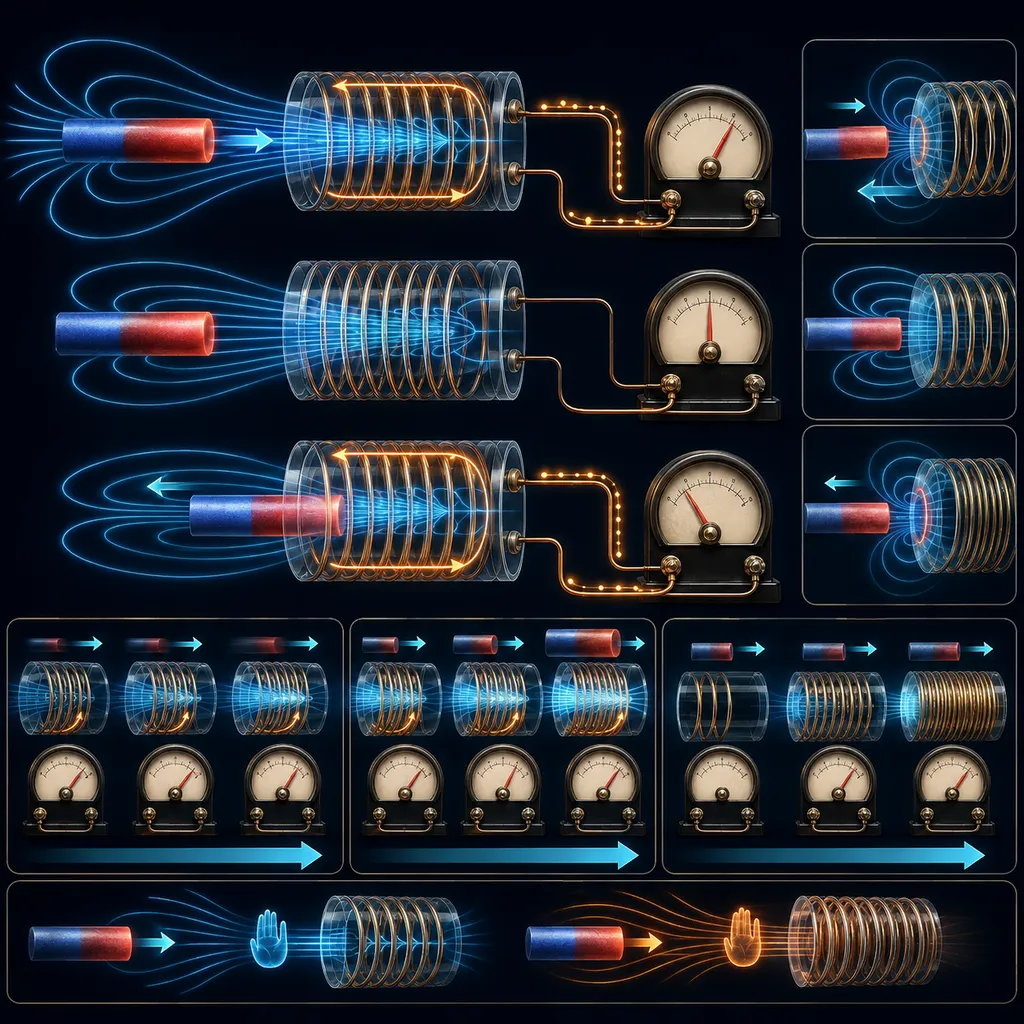
What you see on screen: A coil with a galvanometer and a magnet that you push in and pull out, plus sliders for speed, number of turns and magnet strength. The galvanometer needle deflects during motion (and the faster the motion, the more it deflects), and sits at zero when the magnet is stationary. Readouts: speed, turns, magnet strength, EMF and current direction.
I'll give you a target induced EMF — tune the magnet speed, number of turns and magnet strength to reach it. ε ∝ v·N·B.
What just happened?
A stationary magnet in the coil produced no current. Current appeared ONLY during motion — and was larger the faster you moved the magnet.
Electromagnetic induction:
a changing magnetic flux through the coil produces a voltage (an electromotive force) in it, and therefore a current. The key is the CHANGE — a static field does nothing.
Faraday's law:
The induced EMF equals the rate of change of the magnetic flux:
That is why the EMF grows when: you move the magnet faster (larger ΔΦ/Δt), increase the number of coil turns, or use a stronger magnet.
Lenz's law (the minus sign):
the induced current flows so as to OPPOSE the change that caused it — e.g. to repel an approaching magnet. This is a consequence of conservation of energy.
Where does this work?
Generators (turning motion into current), transformers, inductive chargers, electromagnetic brakes — the whole power industry rests on induction.
Why you need this for the exam:
Faraday's law, Lenz's law and the factors affecting the EMF are the core of the induction topic. The trick: what matters is the rate of change of flux, not the field itself.
Remember: a current is induced only when the magnetic flux CHANGES (ε = −ΔΦ/Δt), and Lenz’s law says it opposes that change.
Theory & formulas
Magnetic flux
The flux of the field through the coil depends on the field, the area and the angle:
Faraday's law
The induced electromotive force equals the rate of change of the flux (for turns): A current flows only when the flux changes — for example when the magnet is moving. Faster motion and a stronger magnet give a larger .
Lenz's law
The minus sign: the induced current flows so as to oppose the change in flux that caused it (conservation of energy).
Symbols: — magnetic flux, — magnetic field, — area, — angle between and the normal, — induced EMF, — number of turns, — time of the change.
Frequently asked questions
›When is a current induced in the coil?
Only when the magnetic flux through the coil changes — for example when the magnet is moving.
›What does Faraday's law state?
The induced electromotive force equals the rate of change of the magnetic flux: ε = −ΔΦ/Δt.
›What does Lenz's law say?
The induced current flows so as to oppose the change in flux that caused it (hence the minus sign).
Teaching? Embed this experiment on your site.
Free widget — paste it on your school site, blog or notes. It links to the full version.
Related experiments