Newton's third law — action and reaction
What we will do: We will release a compressed spring between two carts of different masses and check how strong a force they push each other with and how fast they move apart.
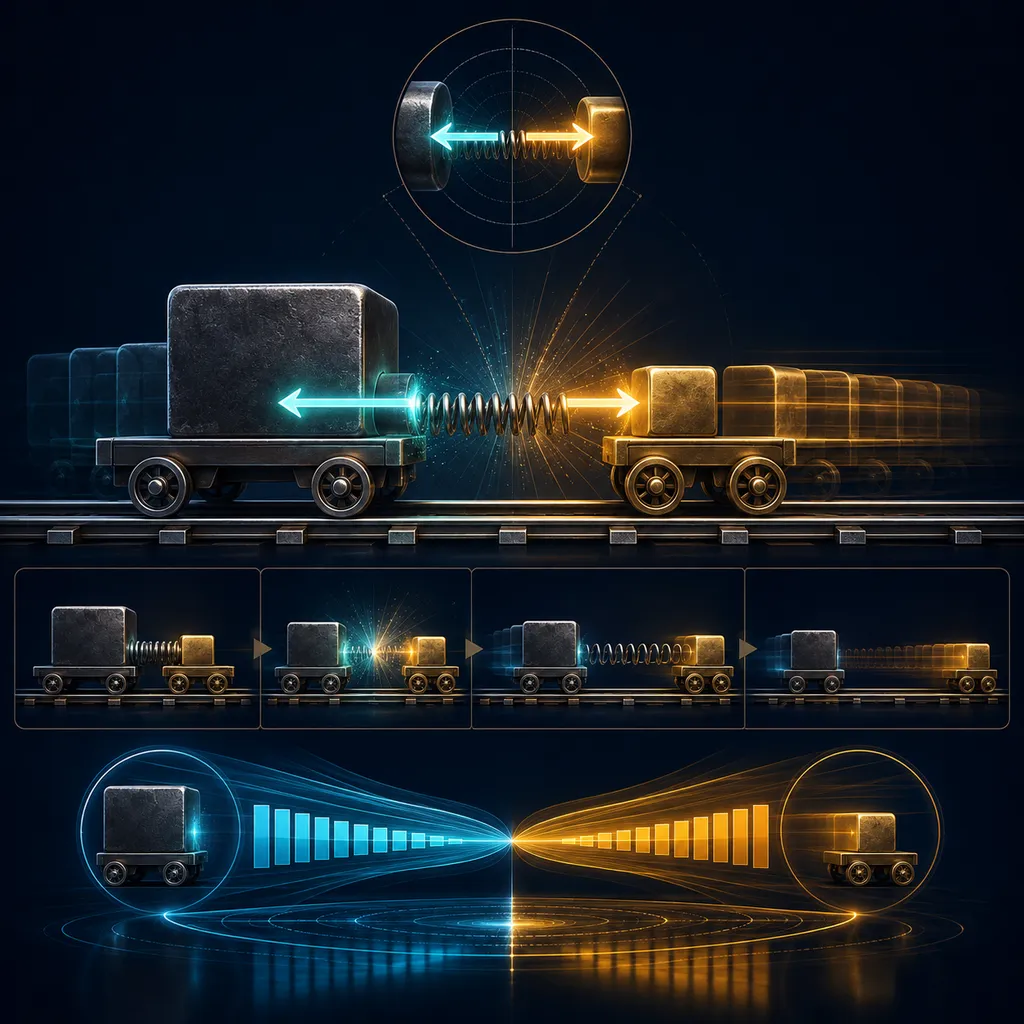
What you see on screen: Two carts with a spring, sliders for their masses, and the action and reaction force arrows — equal in length and opposite in direction. The lighter cart moves off faster. Readouts: the masses, the action = reaction force, the speeds after the push, and the momentum of the system.
What just happened?
The spring pushed both carts apart with a force of the same magnitude — despite their different masses. The lighter one moved off faster, but the force on each was the same.
Newton's third law:
when body A acts on body B with some force, body B acts on A with a force EQUAL in magnitude and OPPOSITE in direction:
Key point: these forces act on TWO DIFFERENT bodies, so they do not cancel (they would cancel only if they acted on the same body).
Why does the light one move off faster?
Because for the same force a smaller mass gives a larger acceleration (). Equal forces — different effects.
Where do you see this?
Gun recoil, rocket propulsion (it throws gas backward and flies forward), pushing off a wall on skates, swimming. Always "you push something, and it pushes you back".
Why you need this for the exam:
identifying action–reaction pairs and telling them apart from forces that balance on a single body. Trick: an action–reaction pair is always two bodies and two equal-and-opposite arrows.
Remember: the action and reaction forces are equal in magnitude and opposite, but act on different bodies — that is why they do not cancel but instead cause recoil.
Theory & formulas
Newton's third law
When body A acts on body B with some force, body B acts on A with a force equal in magnitude and opposite in direction:
Why the forces do not cancel
Action and reaction act on two different bodies — not on the same one — so they cannot balance each other.
Recoil of the carts
The spring pushes both carts with the same force. From the lighter cart gets a larger acceleration and moves off faster, while the total momentum of the system stays zero:
Notation: — force of A on B, — force of B on A, — the carts' masses, — their speeds after the push.
Frequently asked questions
›What does Newton's third law state?
If body A acts on B with a force, then B acts on A with a force equal in magnitude and opposite in direction (action and reaction).
›Why do the action and reaction forces not cancel?
Because they act on two different bodies, not on the same one.
›Why does a lighter body bounce off faster?
Because for the same force it has a larger acceleration (a = F/m).
Teaching? Embed this experiment on your site.
Free widget — paste it on your school site, blog or notes. It links to the full version.