Neural networks — the physics behind artificial intelligence
Explainer card (beyond the core syllabus) — John Hopfield (1982) used the physics describing how the magnetic moments of atoms arrange themselves in solids to build a neural network that stores and reproduces patterns (the Hopfield network). Geoffrey Hinton (1983–1985) used tools from statistical physics to create the Boltzmann machine, which learns to recognize features in data sets. Their work from the 1980s laid the foundations for the machine-learning revolution that began around 2010 — a Nobel Prize in physics awarded for the foundations of artificial intelligence (Physics Nobel 2024).
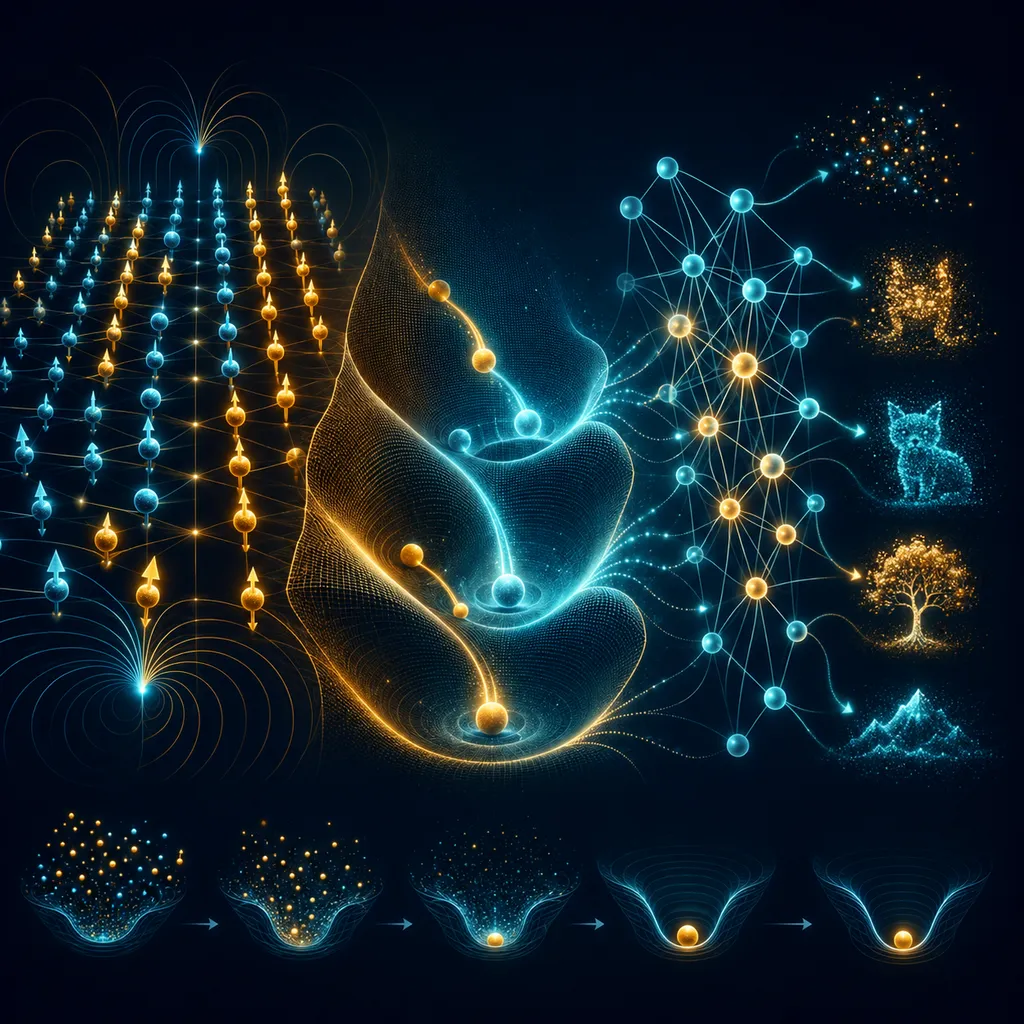
I'll give you a coupling strength J — guess what state the network is in (without the slider).
What are you seeing in the simulation?
The dots are the network's nodes (neurons), and the lines are the connections between them (couplings). At low coupling the node states look random — that is noise, although in this simulation it is fully deterministic. As you increase successive nodes "lock" into a state consistent with the stored pattern, and the whole network converges to an ordered shape — the visual counterpart of a system settling into a low-energy state.
Physics of magnetism → the Hopfield network (1982)
John Hopfield used the physics describing how the magnetic moments of atoms arrange themselves in solids — the so-called spin model, known from the physics of magnetism — to build a neural network able to store and reproduce patterns (the Hopfield network). Each neuron, like a spin in a magnet, takes one of two states, and the network "searches" for the configuration of lowest energy, which corresponds to the stored pattern:
where is the state of a node (neuron), and is the coupling strength between nodes and (set by the Hebbian rule, based on the stored patterns). Such a network is used, among others, in image analysis.
Statistical physics → the Boltzmann machine (Hinton, 1983–1985)
Geoffrey Hinton went a step further and used the tools of statistical physics (which describes systems made of an enormous number of particles at a given temperature) to create the Boltzmann machine — a network that learns on its own to recognize characteristic features in a data set. This found use, among others, in image classification and generation.
A surprising Nobel — in physics, for the foundations of artificial intelligence
In 2024 Hopfield and Hinton received the Nobel Prize in PHYSICS (not in computer science!) "for foundational discoveries and inventions that enable machine learning with artificial neural networks". It is a surprising union of fields: their work from the 1980s, rooted in the physics of magnetism and statistical physics, laid the foundations for the machine-learning revolution that only truly began around 2010.
Why this matters for your exam:
It is a good example of how the same mathematical tools — statistical physics, the energy of a system, the drive toward an equilibrium state — describe both purely physical systems (spins in a magnet) and complex systems seemingly far from physics, such as neural networks. If a problem brings up a spin model or asks about the equilibrium state (energy minimum) of a system of many interacting elements — this is exactly the same conceptual apparatus.
Remember: Hopfield (1982) used the spin model from the physics of magnetism to build a network that stores patterns; Hinton (1983–1985) used statistical physics to create the Boltzmann machine that recognizes patterns in data. For this work both received the 2024 Nobel Prize — in physics, not in computer science.
Theory & formulas
Physics at the root of AI
The 2024 Nobel Prize in Physics honored the use of tools from physics to describe artificial neural networks — the foundation of machine learning.
Two key ideas
- The Hopfield network (1982) — uses an analogy to how the magnetic moments (spins) of atoms arrange themselves in a solid; it stores and reproduces patterns by settling into the state of lowest “energy”.
- The Boltzmann machine (Hinton, 1980s) — uses tools from statistical physics so that the network learns to recognize characteristic features in a data set.
Why this is physics
Spin models and the Boltzmann distribution from statistical physics provided the mathematics describing how the network learns. The work from the 1980s laid the foundation for the AI revolution that took off around 2010.
Frequently asked questions
›Why is this a Nobel in physics and not in computer science?
Because Hopfield and Hinton used mathematical tools from physics (spin models, statistical physics) to describe neural networks.
›What does the Hopfield network do?
It stores and reproduces patterns, using an analogy to how the magnetic moments of atoms arrange themselves in solids.
›What is a Boltzmann machine?
A network that learns to recognize characteristic features in a data set, built using tools from statistical physics.
Teaching? Embed this experiment on your site.
Free widget — paste it on your school site, blog or notes. It links to the full version.