The second law of thermodynamics — the direction of heat flow and entropy
What we will do: We bring a hot body into contact with a cold one and check which way the stream of heat flows on its own — and whether it can be reversed without doing any work.
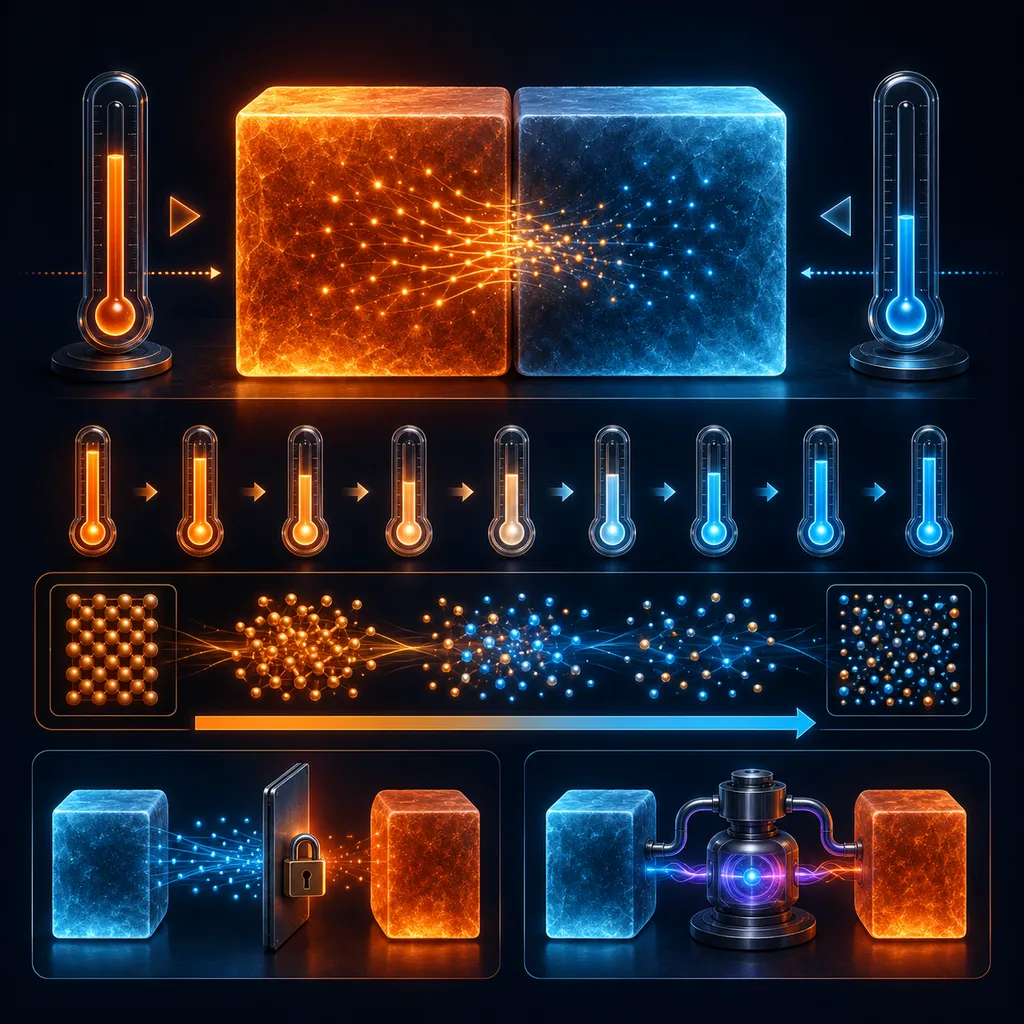
What you see on screen: Two blocks at different temperatures in contact, an arrow showing the heat flow and thermometers converging to a common temperature, as well as an entropy bar that keeps rising. An attempt to force an "uphill" flow is blocked. Readouts: temperatures, direction of heat flow, entropy and the state of the process.
I will give you two bodies and a heat direction — decide what the second law says (no sliders).
What just happened?
Heat flowed on its own from the hot body to the cold one, until the temperatures evened out. The other way — from cold to hot — it does not want to flow on its own.
The second law of thermodynamics:
sets the DIRECTION of processes. Heat passes spontaneously from a body at a higher temperature to one at a lower temperature, never the other way round (without external work).
Entropy:
a measure of the "disorder" of a system. In an isolated system, entropy INCREASES in spontaneous processes:
That is why events have an "arrow of time" — spilled tea cools and mixes, not the other way round.
Heat engines:
you cannot convert all the heat into work — every engine dumps part of the heat into a cold reservoir, so its efficiency is always less than 100%.
And a fridge?
Heat CAN flow from cold to hot, but not on its own — you have to put in work (a compressor).
Why you need this for the exam:
the direction of spontaneous processes, the concept of entropy and the efficiency limit of engines are the core of the second law. Trick: on its own, heat flows "downhill" in temperature, and entropy increases.
Remember: heat flows spontaneously from hotter to colder, and the entropy of an isolated system increases. Reversing it requires external work.
Theory & formulas
The direction of heat flow
Heat flows spontaneously from a hotter body to a colder one, until the temperatures even out. The reverse "uphill" flow does not happen on its own — it requires work to be done (as in a fridge).
Entropy
Entropy is the measure of the disorder of a system. In spontaneous processes in an isolated system, entropy increases: For a transfer of heat at a temperature , the change in entropy is .
The heat engine
You cannot convert all the absorbed heat into work — part of it must go to a cold reservoir. That is why the efficiency of a heat engine is always less than 100%.
Notation: — change in entropy, — heat, — absolute temperature (in kelvins).
Frequently asked questions
›What does the second law of thermodynamics say?
Heat flows spontaneously from a hotter body to a colder one, and the entropy of an isolated system increases.
›What is entropy?
A measure of the disorder of a system; in spontaneous processes in an isolated system it increases (ΔS > 0).
›Why does a heat engine not have 100% efficiency?
Because part of the absorbed heat must be given up to a cold reservoir — you cannot convert all of the heat into work.
Teaching? Embed this experiment on your site.
Free widget — paste it on your school site, blog or notes. It links to the full version.