Gas processes — what stays constant
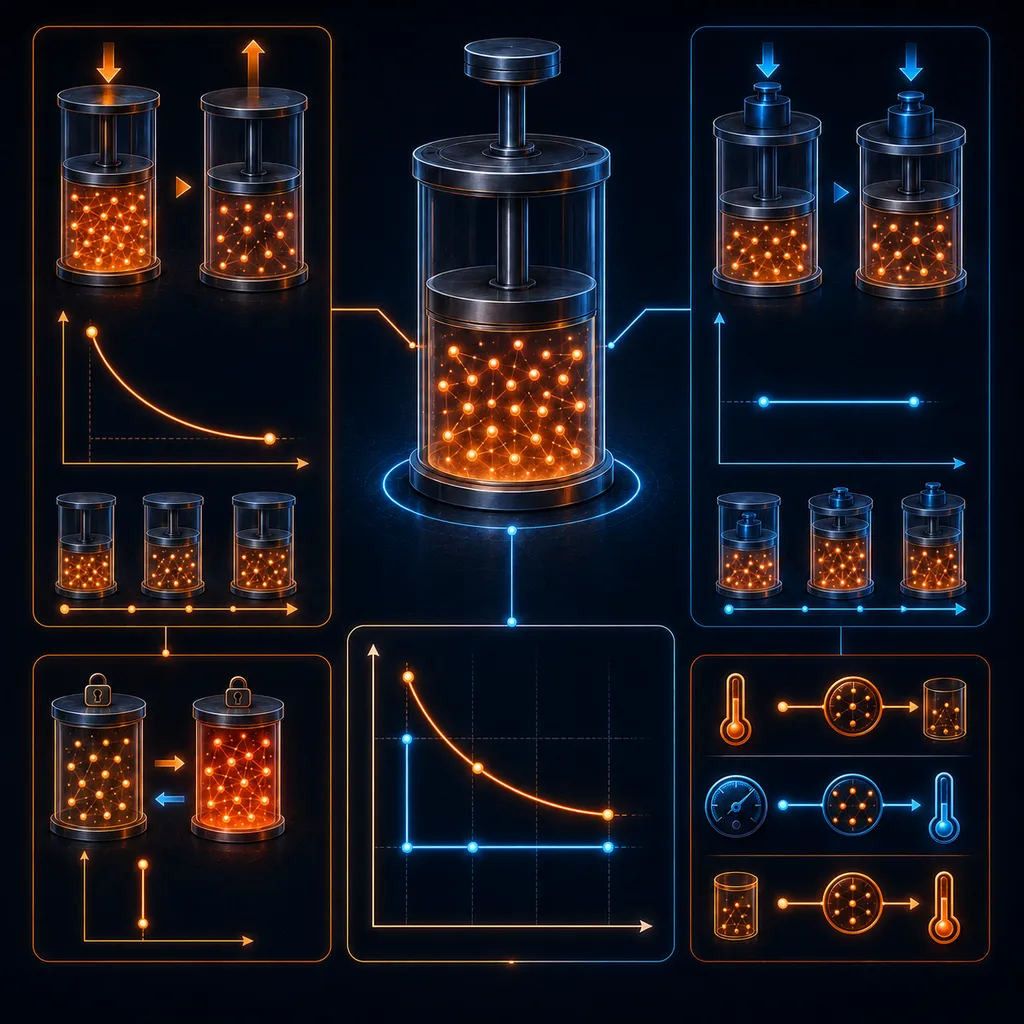
Pick a type of gas process and vary a parameter. Watch the p-V diagram and check what stays constant: temperature (isotherm), pressure (isobar) or volume (isochore). All of them satisfy the equation of state pV/T=const.
I will give you a target pressure — choose the process and parameter (slider) to reach it. pV/T = nR.
What just happened?
Every ideal-gas process satisfies the same equation of state: the ratio does not change. You fix one quantity as constant, and the other two change together so that the ratio is preserved.
Ideal-gas equation of state:
— p is pressure (Pa), V is volume (m³), T is absolute temperature (K), n is the number of moles, R is the gas constant. For two states of the same gas: .
Three special processes:
On the p–V diagram the isotherm is a hyperbola, the isobar is a horizontal line, and the isochore is a vertical line. Always write down first what is constant — that quantity dictates the shape of the curve.
Why must the temperature be in kelvins?
The ratio works only for absolute temperature. If you plugged in degrees Celsius, at 0 °C you would divide by zero — that is why always .
Why you need this for the exam:
The equation solves almost any gas problem. Trick: mark which quantity is constant (cross it out on both sides), and a simple proportion between the other two remains.
Remember: pV/T = const for every ideal-gas process. Isothermal → T constant, isobaric → p constant, isochoric → V constant. Temperature always in kelvins.
Theory & formulas
Equation of state of a gas
Every ideal-gas process satisfies:
Three special processes
- isothermal (): — Boyle-Mariotte law; the - diagram is a hyperbola,
- isobaric (): , i.e. ,
- isochoric (): , i.e. .
Common origin
Each of these processes is a special case of the ideal-gas equation of state (Clapeyron): .
Notation: — pressure, — volume, — absolute temperature (in kelvins), — number of moles, — gas constant.
Frequently asked questions
›What stays constant in an isothermal process?
Temperature; then pV=const (Boyle-Mariotte law), and the p-V diagram is a hyperbola.
›How do an isobar and an isochore differ?
In an isobar the pressure is constant (V∝T), in an isochore — the volume (p∝T).
›Where does the equation pV/T=const come from?
It is the ideal-gas equation of state (Clapeyron) — it unifies all three processes as special cases.
Teaching? Embed this experiment on your site.
Free widget — paste it on your school site, blog or notes. It links to the full version.