Euler's identity — the most beautiful formula
An extension of the topic of complex numbers and the constants e and π. Euler's formula e^(iφ)=cos φ + i·sin φ describes a point on the unit circle; for φ=π we get e^(iπ)=−1, that is Euler's identity e^(iπ)+1=0 — a single equation linking the five most important constants in mathematics. Euler published the formula in 1748.
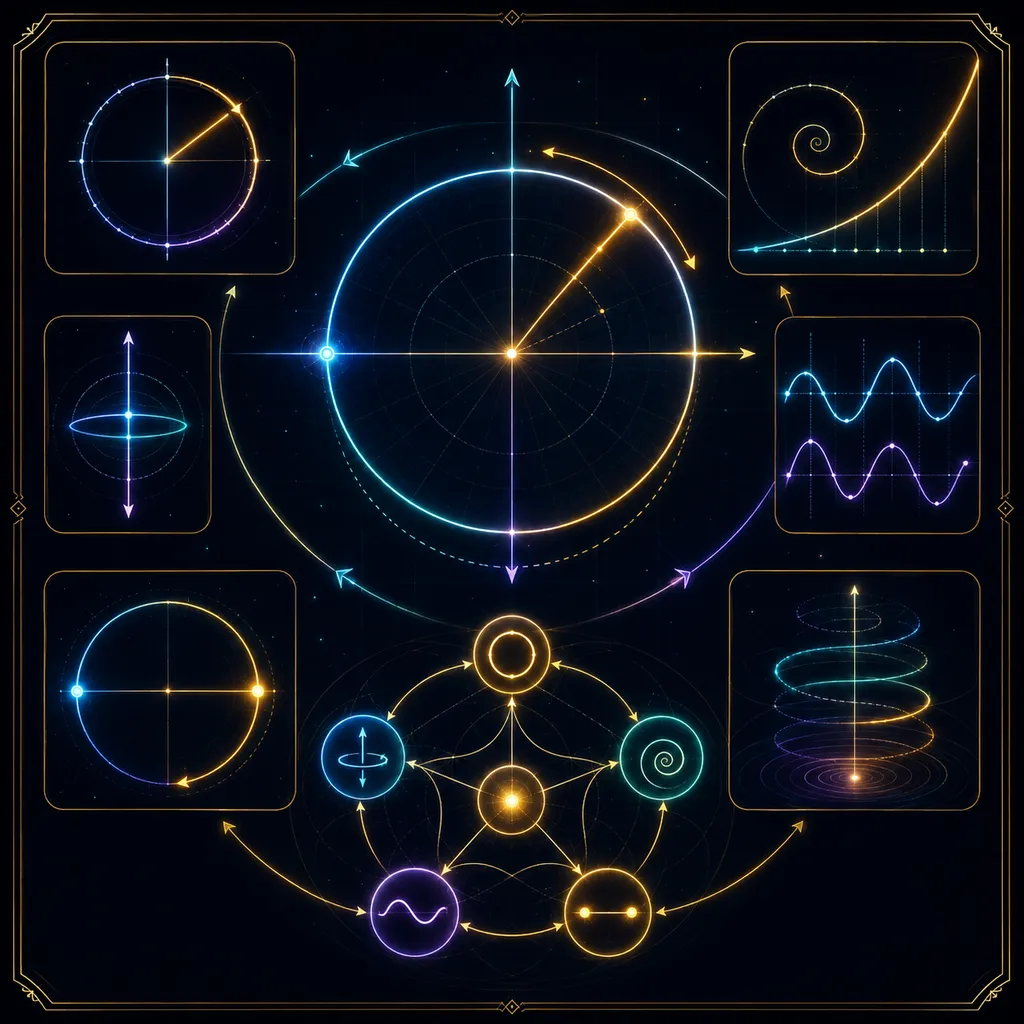
I will give you a point on the unit circle — set the slider φ so that e^(iφ) lands on it. φ is the angle at which the point lies.
The most beautiful formula in mathematics
Euler’s identity is widely regarded as the most beautiful formula in mathematics — in one short equation it ties together the five most important constants: (the base of the natural logarithm), (the imaginary unit), (the circle constant) as well as and (the basic numbers), plus three fundamental operations: exponentiation, multiplication and addition.
It follows from Euler’s formula:
This formula (published by Leonhard Euler in “Introductio in analysin infinitorum”, 1748) links the exponential of an imaginary number with the trigonometric functions. Geometrically: is a point on the unit circle of the complex plane at angle , with coordinates .
Where the identity comes from:
For (a half turn, 180°) we land exactly on the point on the real axis:
The invariant — the point is always on the circle:
— for every the point lies at distance 1 from the center. The slider rotates the vector around the circle, but its length never changes.
Why this matters:
Euler’s formula is one of the pillars of mathematics and physics — it links analysis (the function ), complex numbers and trigonometry, and is indispensable for describing wave phenomena, alternating current, quantum mechanics and signal processing. It reveals a deep, unexpected unity among seemingly distant areas of mathematics.
Remember: places a point on the unit circle; for gives , hence . (Extension topic — complex numbers, and .)
Theory & formulas
Euler's formula
For any angle (in radians): The point lies on the unit circle at angle .
Euler's identity
For we have and , so , from which:
Why "the most beautiful"
A single equation ties together five constants () and three operations: exponentiation, multiplication and addition.
Notation: , the imaginary unit (), , an angle in radians.
Frequently asked questions
›What is the value of e^(iπ)?
−1 — hence Euler's identity e^(iπ)+1=0.
›Which constants does Euler's identity connect?
The five most important ones: e, i, π, 1 and 0 — together with three operations (exponentiation, multiplication, addition).
›What does e^(iφ) mean geometrically?
A point on the unit circle at angle φ; for φ=π we land on the point −1.
Teaching? Embed this experiment on your site.
Free widget — paste it on your school site, blog or notes. It links to the full version.