Complex numbers on the plane
An extension of the topic of complex numbers. We picture the number $a+bi$ as a point in the plane (a real axis and an imaginary axis); $i^2=-1$, multiplication by $i$ is a 90° rotation, and multiplication by any number is a rotation combined with scaling. This geometric interpretation was given by Jean-Robert Argand (1806, the "Argand plane") and popularized by Carl Friedrich Gauss (1831) — it made the once "imaginary" numbers tangible.
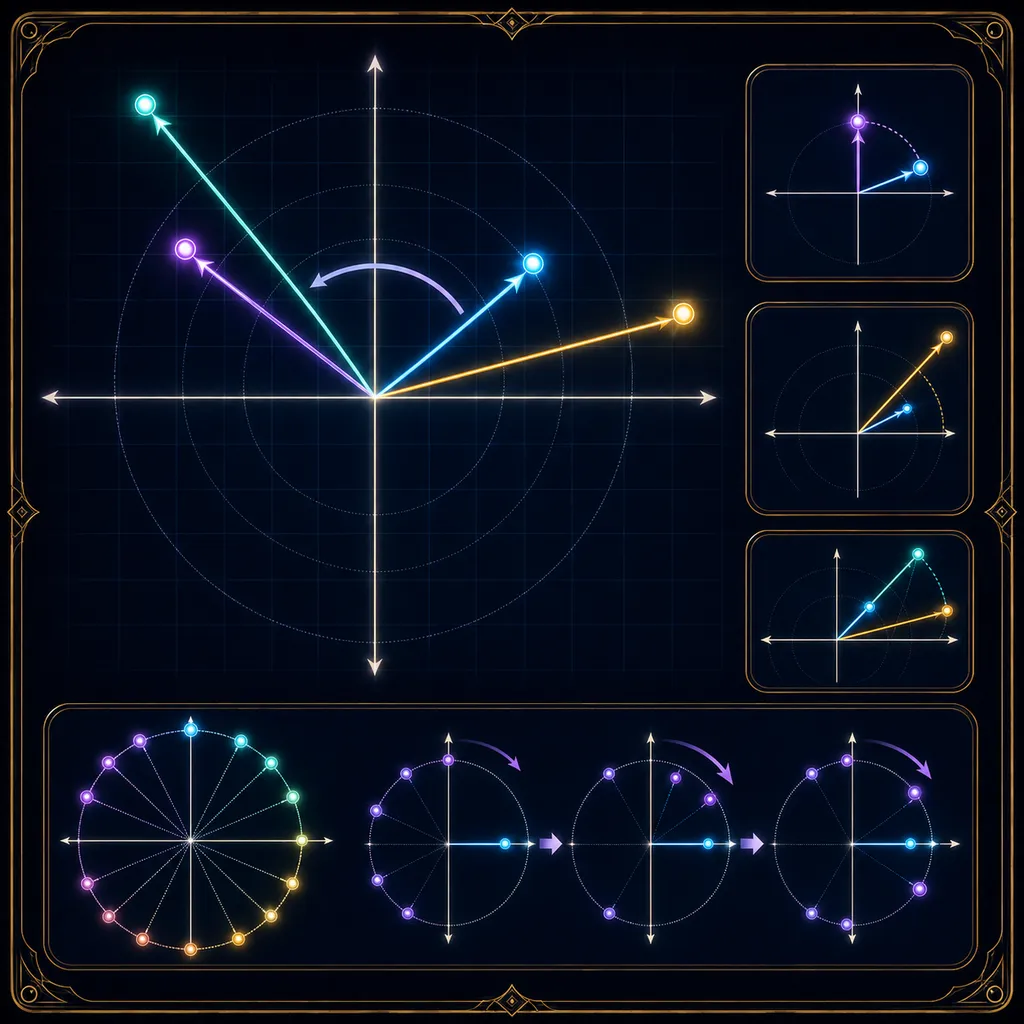
I will give you a multiplier w — guess by how many degrees it rotates the vector. When multiplying, angles add: the rotation angle = arg(w).
Complex numbers become tangible
Numbers of the form , where , were long considered “imaginary” and suspect — until a geometric interpretation made them tangible. Jean-Robert Argand in 1806 (and earlier, unnoticed, Caspar Wessel in 1799) showed that a complex number can be represented as a point in the plane — hence the name “Argand plane”. Carl Friedrich Gauss popularized this interpretation (1831).
A point in the complex plane:
The horizontal axis is the real part , the vertical axis the imaginary part . We treat as a vector from the origin to the point .
The operations have simple geometry:
Addition is a translation of vectors. Multiplication is a rotation combined with scaling — and multiplying by is a pure 90° rotation, because , i.e. the point maps to .
The invariant of multiplication:
— when multiplying, the moduli multiply, and the arguments (angles) add. That is why multiplying by (modulus 1, argument 90°) rotates without changing length, while multiplying by (modulus , argument 45°) rotates by 45° and stretches the vector by times.
Why this matters for exams and beyond:
Thanks to this interpretation, complex numbers became a powerful tool in geometry, physics (alternating current, quantum mechanics), engineering and signal processing. They are an extension of the real numbers in which every operation has a geometric meaning.
Remember: in the plane, addition is a translation and multiplication is a rotation + scaling — multiplying by is a 90° rotation.
Theory & formulas
A complex number as a point
We represent the number as the point in the plane: the horizontal axis is the real part and the vertical axis the imaginary part. The imaginary unit satisfies .
Modulus and argument
- modulus (distance from ):
- the argument is the angle the ray makes with the real axis
- trigonometric form:
Multiplication = rotation and scaling
Under multiplication the moduli multiply and the arguments add: Multiplication by (modulus , argument ) is a pure rotation.
Notation: a complex number, the real part, the imaginary part, the imaginary unit (), the modulus, the argument.
Frequently asked questions
›What does multiplying a complex number by i correspond to geometrically?
A 90° rotation of the point about the origin of the coordinate system.
›How do we represent a complex number in the plane?
As the point (a,b): the horizontal axis is the real part a and the vertical axis the imaginary part b.
›What happens when complex numbers are multiplied?
Their moduli multiply and their arguments (angles) add: |z₁z₂|=|z₁||z₂|.
Teaching? Embed this experiment on your site.
Free widget — paste it on your school site, blog or notes. It links to the full version.