Fibonacci and the golden angle in nature
An extension of the topics of sequences and the golden ratio. The seeds of many plants are arranged at the golden angle (~137.5°), which gives the densest packing — which is why the numbers of spirals in a sunflower head are usually consecutive Fibonacci numbers. The golden angle follows from the golden ratio φ (the most irrational proportion). The Fibonacci sequence was introduced by Leonardo of Pisa in 1202.
I’ll give you a number — decide whether it belongs to the Fibonacci sequence (1, 1, 2, 3, 5, 8, 13, 21, 34, 55, 89, 144, …).
What just happened?
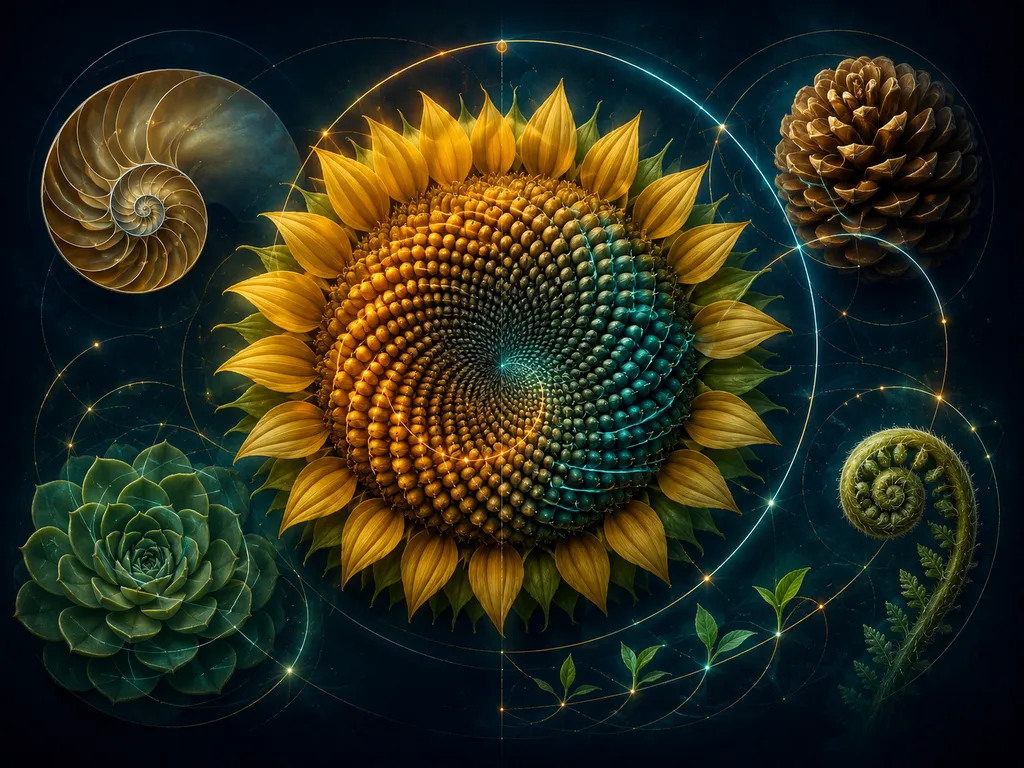
One of the most astonishing examples of mathematics in nature is phyllotaxis — the arrangement of seeds, leaves and scales in plants. Sunflower seeds, the scales of pine cones and pineapples, the placement of leaves along a stem — they all often follow the golden angle (~137.5°), linked to the golden ratio .
The golden ratio and the golden angle:
Each successive seed is rotated by an angle relative to the previous one and pushed outward from the center (a Fermat spiral: ). As a result, the numbers of spirals (parastichies) visible in these arrangements are usually consecutive Fibonacci numbers: 1, 1, 2, 3, 5, 8, 13, 21, 34, 55, 89, …
Why the golden angle in particular?
Because is the “most irrational” number — its continued-fraction expansion converges most slowly, so successive seeds never line up into straight lines or overlap. The packing leaves no empty gaps, giving the plant optimal access to light and the densest possible seed arrangement. Move the slider away from 137.5° and empty “spokes” and gaps appear at once — the packing indicator in the panel drops.
Not mysticism, but optimization:
The Fibonacci sequence () was introduced to Europe by Leonardo of Pisa, known as Fibonacci, in his work “Liber Abaci” (1202). The golden ratio tied to it appears in nature wherever nature “seeks” the most efficient packing — it is evolutionary optimization described by mathematics, not coincidence.
Why you need this for the exam:
It is a spectacular bridge between the topic of sequences and nature: the recursive Fibonacci sequence leads to the golden ratio , which in turn sets the golden angle . Remember the definition of the sequence and the fact that consecutive Fibonacci numbers describe the number of spirals in a sunflower, pine cone or pineapple.
Remember: the golden angle arises from the golden ratio (the “most irrational” proportion) and ensures the densest, non-overlapping packing — which is why the numbers of spirals in nature are consecutive Fibonacci numbers.
Theory & formulas
The golden angle
Each successive seed lands rotated by the golden angle:
Why Fibonacci in particular
Because is the “most irrational” number — the seeds never line up into straight rays, which gives the densest packing. The numbers of visible spirals are adjacent terms (e.g. and ).
The sequence
Notation: the golden angle, the golden ratio, the Fibonacci terms.
Frequently asked questions
›How many spirals are usually visible in a sunflower head?
Consecutive Fibonacci numbers (e.g. 34 and 55, or 55 and 89) — not random numbers.
›Where does the golden angle ~137.5° come from?
From the golden ratio φ: 360°/φ² ≈ 137.5° — it gives the densest, non-overlapping packing.
›Why the golden ratio in particular?
Because φ is the most irrational — the packing never forms straight lines or empty gaps.
Teaching? Embed this experiment on your site.
Free widget — paste it on your school site, blog or notes. It links to the full version.