The Golden Ratio
An extension of the topic of proportions and quadratic equations. The golden ratio divides a segment so that the ratio of the whole to the longer part equals the ratio of the longer part to the shorter: (a+b)/a = a/b = φ ≈ 1.618. The first written definition was given by Euclid (c. 300 BC). The golden number φ satisfies φ² = φ + 1 and appears in art, architecture and nature.
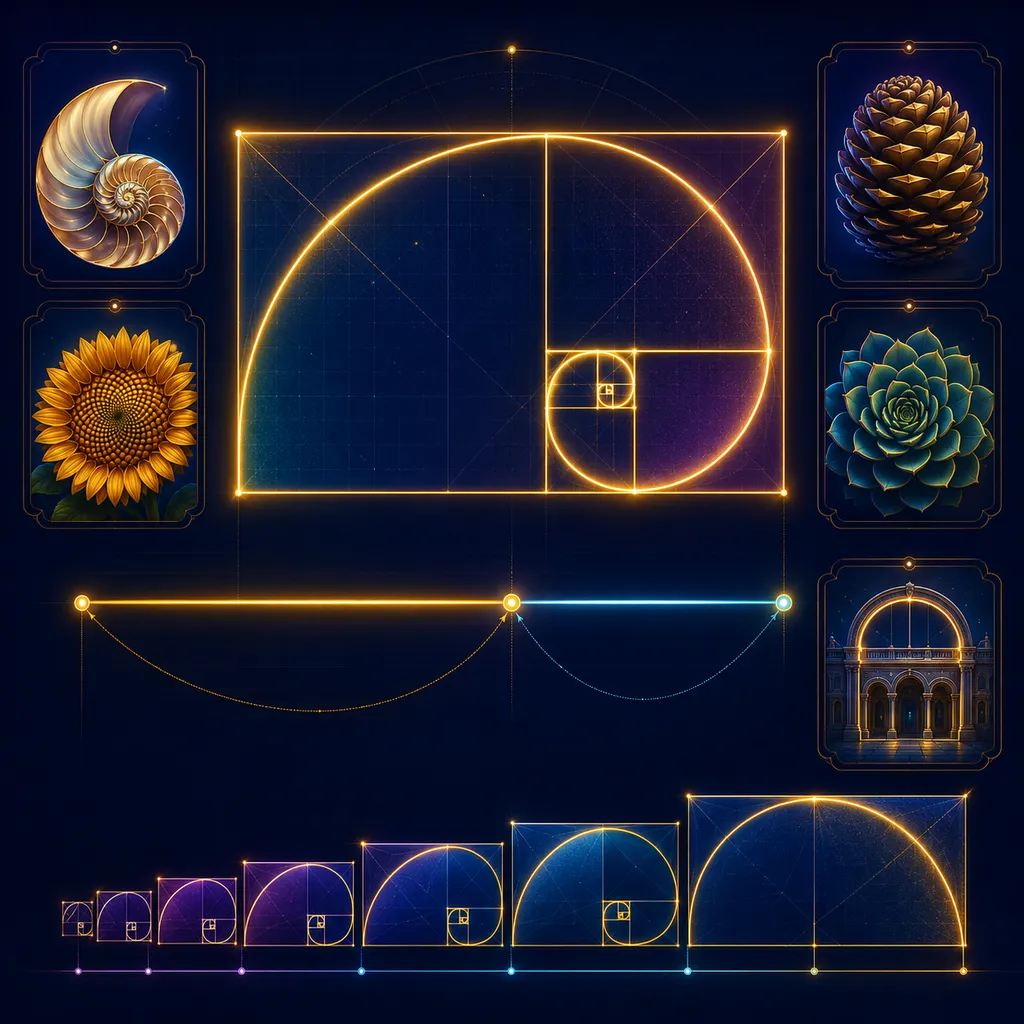
I will give you a target side ratio of the rectangle (a+b)/a — set the slider to reach it. At φ ≈ 1.618 you get the golden rectangle.
What just happened?
You set the division point of the segment so that the longer part makes up about of the whole. Then — and only then — the two different ratios describing this division become equal. That is precisely the golden ratio.
Definition of the golden ratio:
We divide the segment into a longer part and a shorter part so that the ratio of the whole to the longer part equals the ratio of the longer part to the shorter:
The first known written definition was given by Euclid in his work "Elements" (c. 300 BC) as the "division of a segment in extreme and mean ratio".
The golden number φ:
The value of this ratio is the golden number — an irrational number. From the equality after substituting we get a quadratic equation whose positive solution is precisely .
The invariant — the equation of the golden number:
This short equation fully characterizes . The same number appears as the limit of the ratios of consecutive terms of the Fibonacci sequence (1, 1, 2, 3, 5, 8, 13…) — two seemingly distant worlds, geometry and sequences, lead to the same constant.
Where does it appear?
Associated with the golden ratio are the golden rectangle (with side ratio ) and the golden spiral. Since antiquity these proportions have been considered especially harmonious — they are found in art, architecture (proportions of buildings) and nature (leaf arrangement, shells, flowers), although their "ubiquity" is sometimes exaggerated.
Why you need this for the exam:
The golden ratio is a classic context for quadratic equations and proportions. Remember the definition and that it leads to , that is .
Remember: the golden ratio is a division of a segment in which ; the golden number satisfies .
Theory & formulas
Definition of the proportion
We divide a segment so that the whole is to the longer part as the longer part is to the shorter:
The equation and its value
Hence , so:
Properties
. The golden number appears in the golden rectangle, the golden spiral, and in the limit of the ratios of consecutive Fibonacci numbers.
Notation: — longer part, — shorter part, — golden number.
Frequently asked questions
›What is the value of the golden ratio?
The golden number φ = (1+√5)/2 ≈ 1.618.
›What equation does the golden number φ satisfy?
φ² = φ + 1, from which φ = (1+√5)/2.
›Where does the golden ratio appear?
In geometry (the golden rectangle, the golden spiral), in art, architecture and nature (leaf arrangement, shells).
Teaching? Embed this experiment on your site.
Free widget — paste it on your school site, blog or notes. It links to the full version.