The golden ratio and the Fibonacci sequence
An extension of the topic of number sequences. The Fibonacci sequence is one of the best-known examples of a recursive sequence: F(n)=F(n-1)+F(n-2). The ratio of consecutive terms F(n)/F(n-1) oscillates, but converges to the golden ratio φ=(1+√5)/2≈1.618 — a constant that also appears in geometry and in nature. Fibonacci introduced the sequence to Europe in his work "Liber Abaci" (1202) — a landmark discovery.
I will give you a target ratio — choose the term index n so that F(n)/F(n-1) equals it. For small n the ratio jumps around φ.
What just happened?
You moved the slider to a high term index of the Fibonacci sequence. You saw the ratio of consecutive terms stop wavering and settle very close to one specific irrational number — the golden ratio φ.
The Fibonacci sequence:
Each term is the sum of the two preceding ones: 1, 1, 2, 3, 5, 8, 13, 21, 34, 55, 89, 144… The Italian mathematician Leonardo of Pisa, known as Fibonacci, introduced the sequence to Europe in his work “Liber Abaci” (1202), while solving a problem about breeding rabbits — though the sequence itself had already been known to Indian mathematicians.
The golden ratio φ:
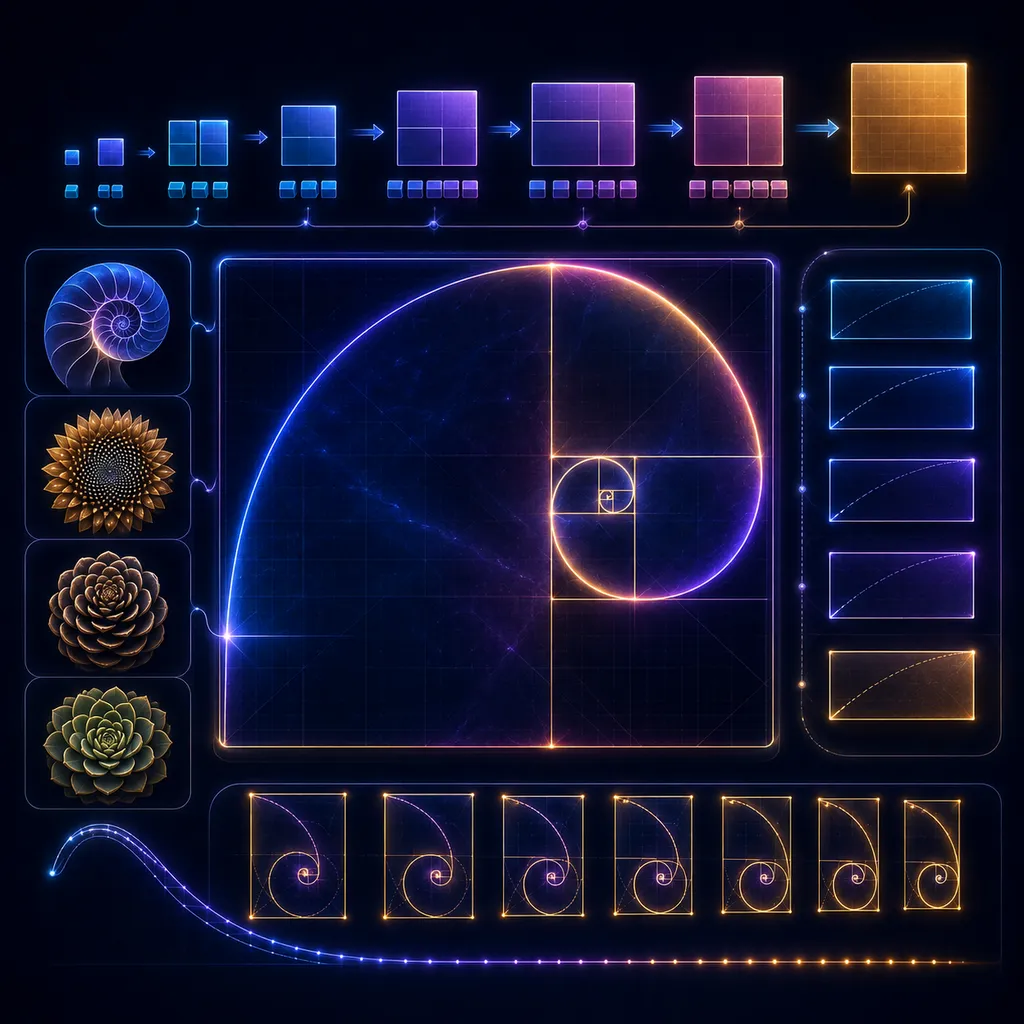
What is surprising is that a simple recursive sequence of integers leads, “all by itself,” to an irrational number that appears in entirely different areas: in geometry (the golden section of a segment), in art (proportions in architecture and painting) and in nature (the arrangement of sunflower seeds, snail shells, plant branching, spirals in flowers).
Why does the ratio oscillate rather than “hit” φ at once?
For small n the terms are still “immature” and the ratio is now above, now below φ (e.g. 1/1=1, 2/1=2, 3/2=1.5, 5/3≈1.667…). As n grows the difference steadily decreases — this is exactly the invariant you observe on the chart to the right of the scene.
Why this matters for the exam:
The Fibonacci sequence is a classic example of a recursively defined sequence — a problem type that appears in the chapter on sequences. Remember the definition F(n) = F(n-1) + F(n-2), and that the limit of the ratio of consecutive terms is the golden ratio φ.
Remember: F(n) = F(n-1) + F(n-2), and the ratio F(n)/F(n-1) tends to φ = (1+√5)/2 ≈ 1.618 — the golden ratio present in mathematics, art and nature.
Theory & formulas
The Fibonacci sequence
The successive terms:
Limit of the ratio
A property of the golden ratio
satisfies , that is — and this is the source of the convergence of the ratios of consecutive terms.
Notation: is the -th Fibonacci term, is the golden ratio.
Frequently asked questions
›How is the Fibonacci sequence defined?
Recursively: F(n)=F(n-1)+F(n-2), with F(1)=F(2)=1.
›What does the ratio of consecutive Fibonacci terms tend to?
To the golden ratio φ=(1+√5)/2≈1.618.
›Where else does the golden ratio φ appear?
In geometry (the golden section), in art and in nature (e.g. the arrangement of sunflower seeds, snail shells).
Teaching? Embed this experiment on your site.
Free widget — paste it on your school site, blog or notes. It links to the full version.