Gabriel's horn — finite volume, infinite surface area
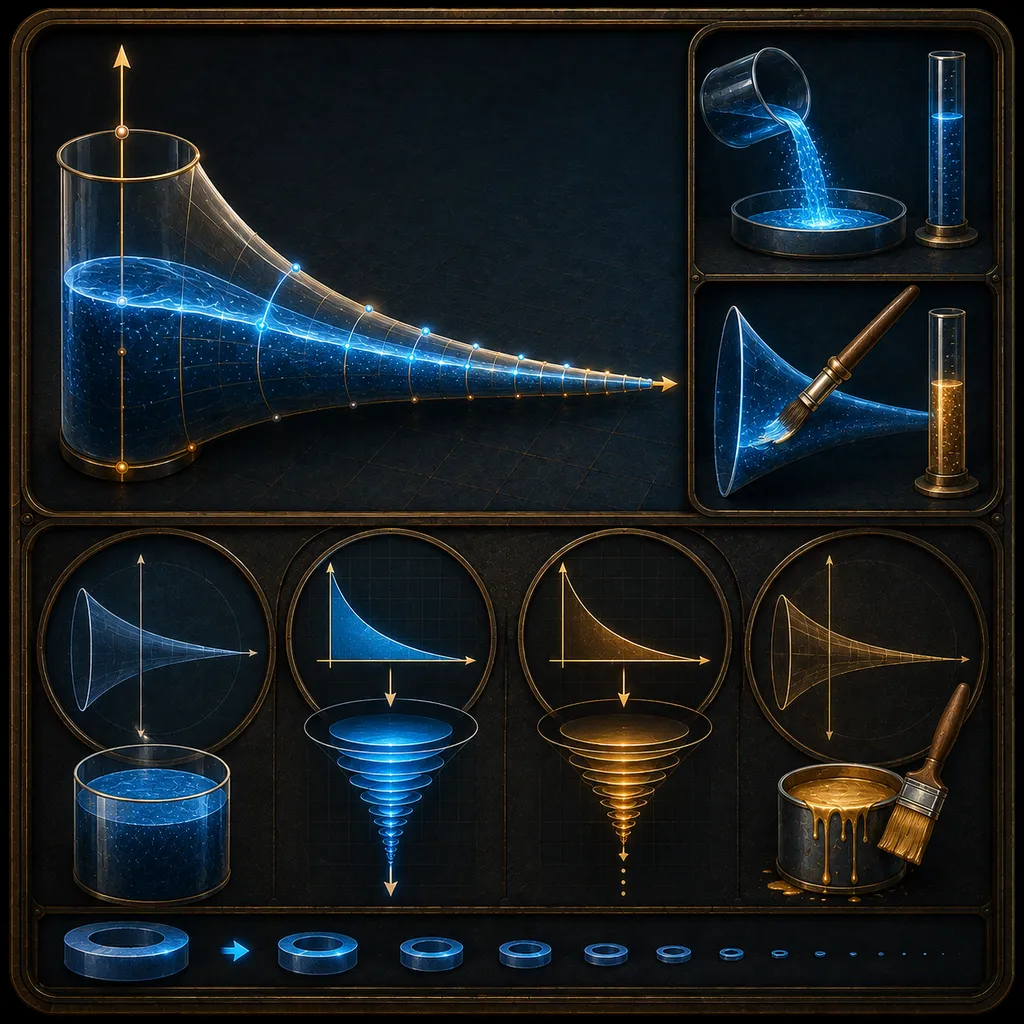
An extension of the topic of solids of revolution and integrals (a curiosity). The solid formed by rotating y=1/x has a finite volume (π) but an infinite surface area — a paradox: "you can fill it with paint, but you cannot coat it". The volume (the integral of 1/x²) converges, the surface area (the integral of 1/x) diverges. It was discovered by Evangelista Torricelli in 1643.
I’ll give you a quantity related to Gabriel’s horn — decide whether it is finite or infinite. Trick: ∫1/x² converges, ∫1/x diverges.
What just happened?
By rotating the curve (for ) about the X axis, you get an infinitely long horn — Gabriel’s horn. Astonishingly: although the solid is infinitely long, its volume is finite and equals exactly , yet its surface area is infinite.
Volume — a convergent integral:
The integral is convergent — the volume tends to the finite value .
Surface area — a divergent integral:
The integral is divergent (it grows like , exactly like the harmonic series) — the surface area has no limit at all.
The painter’s paradox:
Hence the famous question: you can fill the horn with a finite amount of paint (volume ), but the same paint would not be enough to paint its infinite inner surface. The resolution: “filling” and “painting” are different notions (volume vs area), and the paint layer has a thickness that also tends to zero as the horn narrows.
Torricelli’s discovery (1643):
The paradox was discovered by Evangelista Torricelli — even before the full development of differential calculus! He was astonished by his own result. It is a classic example of the difference between a convergent and a divergent integral and of how infinity breaks physical intuition.
Why you need this for the exam:
Gabriel’s horn is a flagship example of solids of revolution and improper integrals. Trick: you compute both quantities for the same solid, but check separately whether each integral converges. converges, diverges — which is why a finite volume and an infinite surface area coexist.
Remember: Gabriel’s horn has a finite volume and an infinite surface area — because converges while diverges. A finite volume does not guarantee a finite surface area.
Theory & formulas
Solid of revolution
We rotate the graph of for about the axis.
Volume (finite)
Surface area (infinite)
The integral of is convergent, while the integral of is divergent (like the harmonic series). Hence the paradox: finite volume, infinite surface area.
Notation: the volume, the surface area, the variable of integration.
Frequently asked questions
›Can a solid with a finite volume have an infinite surface area?
Yes — Gabriel's horn has volume π (finite), but an infinite surface area.
›Why is the volume finite but the surface area not?
Because the volume integral (1/x²) is convergent, while the surface integral (1/x) is divergent, like the harmonic series.
›What is the painter's paradox?
You can fill the horn with a finite amount of paint (volume π), but it is not enough to coat its infinite surface.
Teaching? Embed this experiment on your site.
Free widget — paste it on your school site, blog or notes. It links to the full version.