Koch snowflake — infinite length, finite area
An extension of the topic of geometric sequences and self-similarity. In each iteration every segment of the Koch snowflake turns into 4 shorter ones (×1/3), so the length is multiplied by 4/3 and tends to infinity — even though the whole figure fits inside a finite area. Helge von Koch described this curve in 1904 as an example of a curve that is continuous but nowhere differentiable — one of the first fractals.
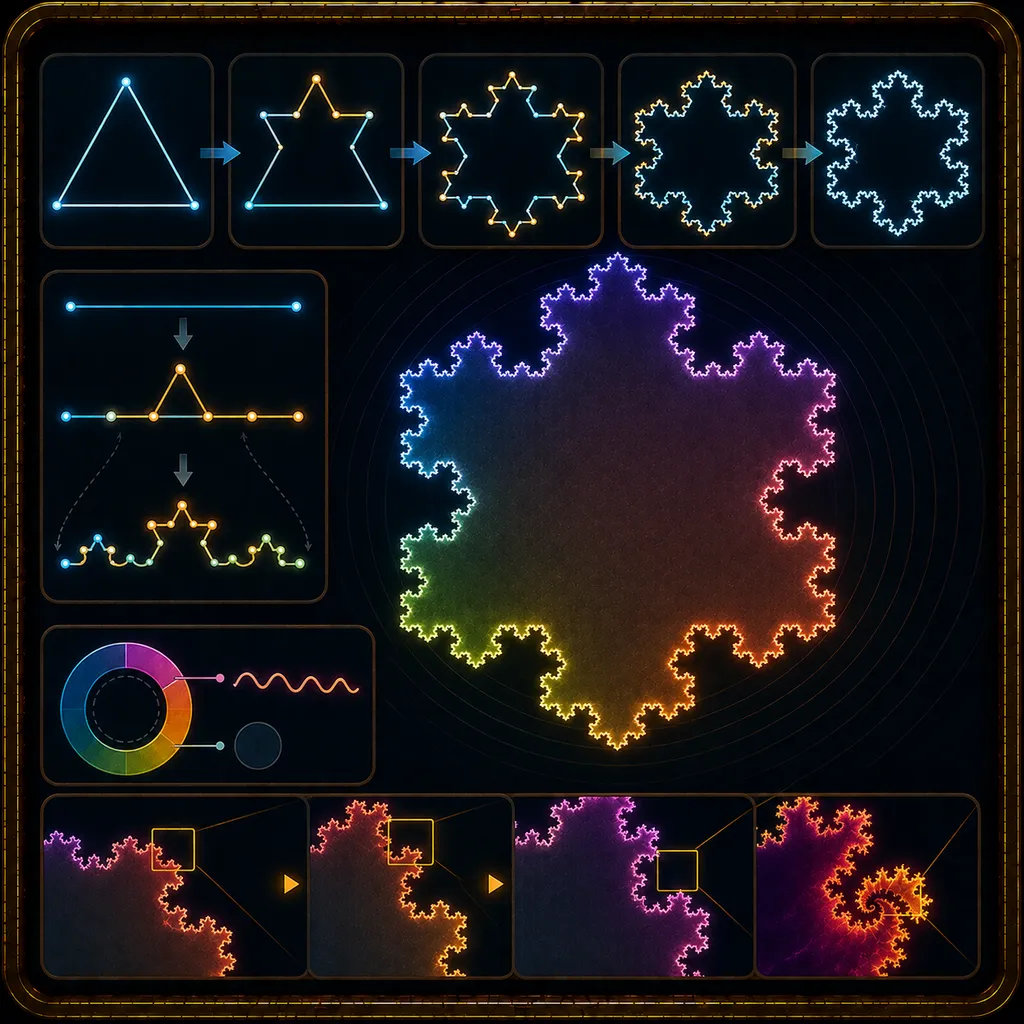
I’ll give you a number of iterations k — work out how many segments the snowflake boundary then has. Start: 3 segments, each → 4.
What just happened?
You started with an equilateral triangle. In each iteration every segment splits into 3 parts, and a smaller equilateral triangle “grows” over the middle one — a single segment turns into four, each 1/3 the length of the original. The boundary becomes more and more “jagged”, yet the whole figure still fits inside the same finite region (the dashed triangle is the starting figure).
The boundary length grows geometrically:
Since each segment turns into 4 segments of length 1/3, the perimeter is multiplied by per iteration. The ratio , so the sequence is divergent — after infinitely many steps the length tends to infinity.
Yet the area stays finite:
In each iteration we add ever smaller triangles, but their combined area forms a convergent geometric series (ratio 4/9 < 1). The sum tends to a constant value: the area of the whole snowflake is only of the starting triangle’s area. An infinitely long boundary encloses a finite area — the heart of this fractal.
Who discovered it?
The Swedish mathematician Helge von Koch described this curve in 1904 as an example of a curve that is continuous but nowhere differentiable — it has no tangent at any point, nothing but “corners”. The Koch snowflake is one of the first and simplest fractals: a self-similar figure — every fragment of the boundary, magnified, looks like the whole.
Why this matters for your exams:
It is a model example that the intuitions from the world of “smooth” figures (finite perimeter ⇒ finite area) fail in fractal geometry. It combines geometric sequences and series with limits: the divergent sequence alongside the convergent series of areas. Fractal geometry — later developed by Mandelbrot — describes the “jagged” shapes of nature: coastlines, snowflakes, blood vessels.
Remember: the perimeter of the Koch snowflake grows ×4/3 per iteration and tends to infinity, but the area stays bounded (→ 8/5·A₀). Infinite length, finite area.
Theory & formulas
Construction
We split each segment into parts and replace the middle part with two sides of a triangle: segment → segments of the length.
Length (infinite)
After steps the perimeter is:
Area (finite)
The area converges to of the area of the starting triangle. An infinite boundary with a finite area — fractal dimension:
Notation: initial perimeter, after steps, fractal dimension.
Frequently asked questions
›What is the length of the Koch snowflake after infinitely many iterations?
Infinite — the length is multiplied by 4/3 in each iteration, so it grows without bound.
›Is the area of the Koch snowflake infinite?
No — the area is finite (it converges to 8/5 of the starting triangle's area), despite the infinite length of the boundary.
›What does it mean that the Koch snowflake is self-similar?
Every magnified fragment of the boundary looks like the whole figure — this is a hallmark of fractals.
Teaching? Embed this experiment on your site.
Free widget — paste it on your school site, blog or notes. It links to the full version.