Newton's Method — Finding Roots
An extension of the topic of the derivative and the tangent line to a graph. Newton's method finds a root of a function by drawing tangent lines: x_(n+1)=x_n-f(x_n)/f'(x_n). It converges quadratically — the number of correct digits roughly doubles with each iteration, far faster than the bisection method. Isaac Newton developed it around 1669 (refined by Joseph Raphson, 1690).
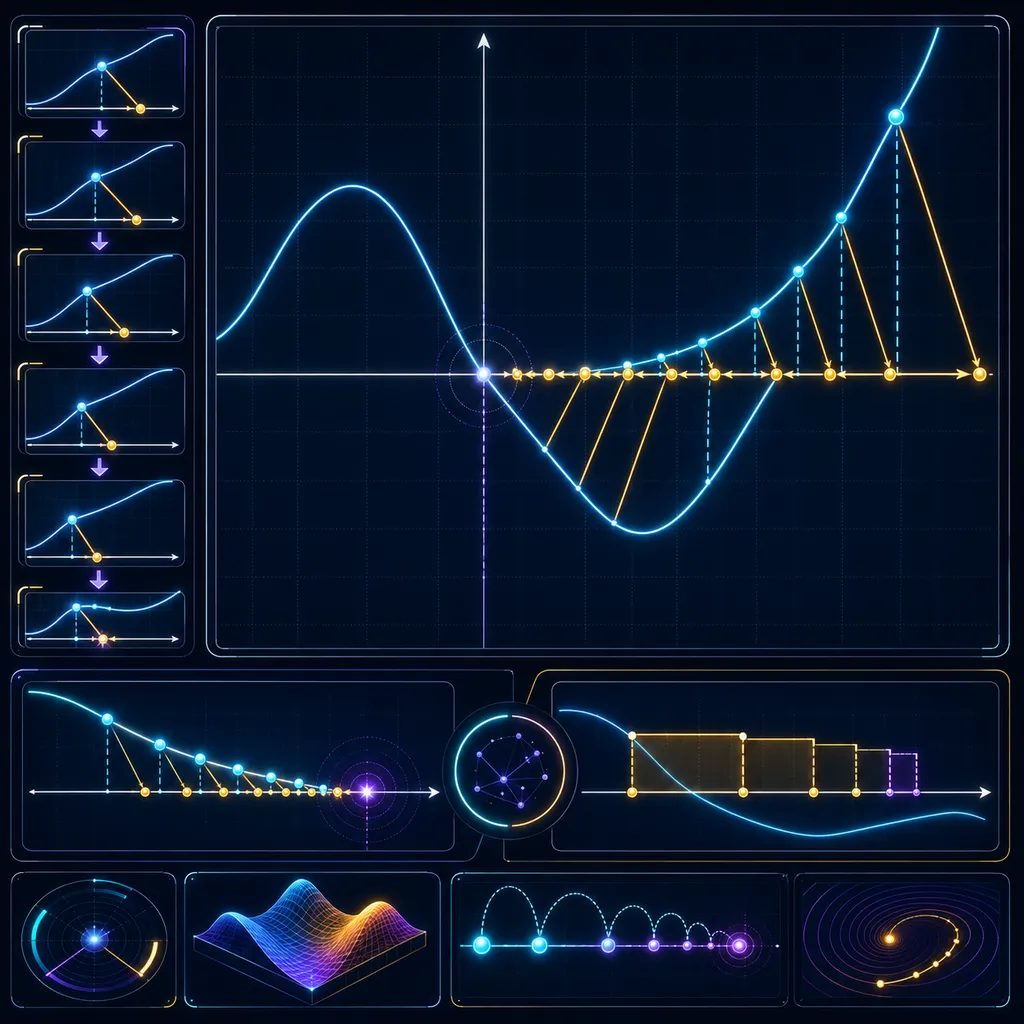
I will give you a target approximation of √2 — pick the iteration number n so that xₙ equals it. In order: x₀=2, x₁=1.5, x₂=1.4167, x₃≈1.41421.
What just happened?
We are looking for the root of the function — that is, the number . Starting from , we draw a tangent to the graph at that point and see where it crosses the x-axis. This gives a better approximation . We repeat — and after just a few steps we hit the root with enormous accuracy.
Newton's method (Newton–Raphson):
It is one of the most important numerical algorithms — it quickly finds approximate solutions of equations that cannot be solved exactly by a formula. Isaac Newton developed it around 1669 (in "De analysi"), and Joseph Raphson simplified its notation in 1690. The idea: at each step we replace the complicated function by its tangent (the best local linear approximation) and take the tangent's root as a better approximation of the root.
Iteration formula:
For we have , so . In order: , , , ,
The invariant — the tangent sets the direction:
Every step uses the slope of the tangent at the current point — that is what shows where the next, better approximation lies. The method converges quadratically: the number of correct digits roughly doubles with each iteration, so after only a few steps we reach enormous accuracy — far faster than, e.g., the bisection (halving) method.
Why this matters on the exam:
Newton's method is a practical application of differential calculus (the derivative as the slope of the tangent) and the basis of numerical computation — it works in calculators, computers, graphics and optimization. The trick: the derivative is the slope of the tangent, and its root is the next approximation .
Remember: the tangent method turns the hard equation into a sequence of simple steps , which converges to the root in a flash — digit by digit, faster and faster.
Theory & formulas
Iteration formula
Each step draws the tangent line to the graph at the point ; the root of that tangent gives the next approximation of the root.
Quadratic convergence
Near the root the error is squared at each step: — the number of correct digits doubles with each iteration.
Conditions
A good starting point is needed, together with ; otherwise the method may fail to converge.
Notation: a function, its derivative, an approximation, the error ( — the root sought).
Frequently asked questions
›How fast does Newton's method converge?
Very fast (quadratically) — the number of correct digits doubles with each iteration.
›What is each step of Newton's method based on?
On the tangent line (the derivative) at the current point — the tangent's root gives a better approximation of the root.
›Who developed Newton's method?
Isaac Newton (around 1669); Joseph Raphson simplified its notation (1690) — hence the "Newton-Raphson method".
Teaching? Embed this experiment on your site.
Free widget — paste it on your school site, blog or notes. It links to the full version.