The Newton fractal — basins of attraction
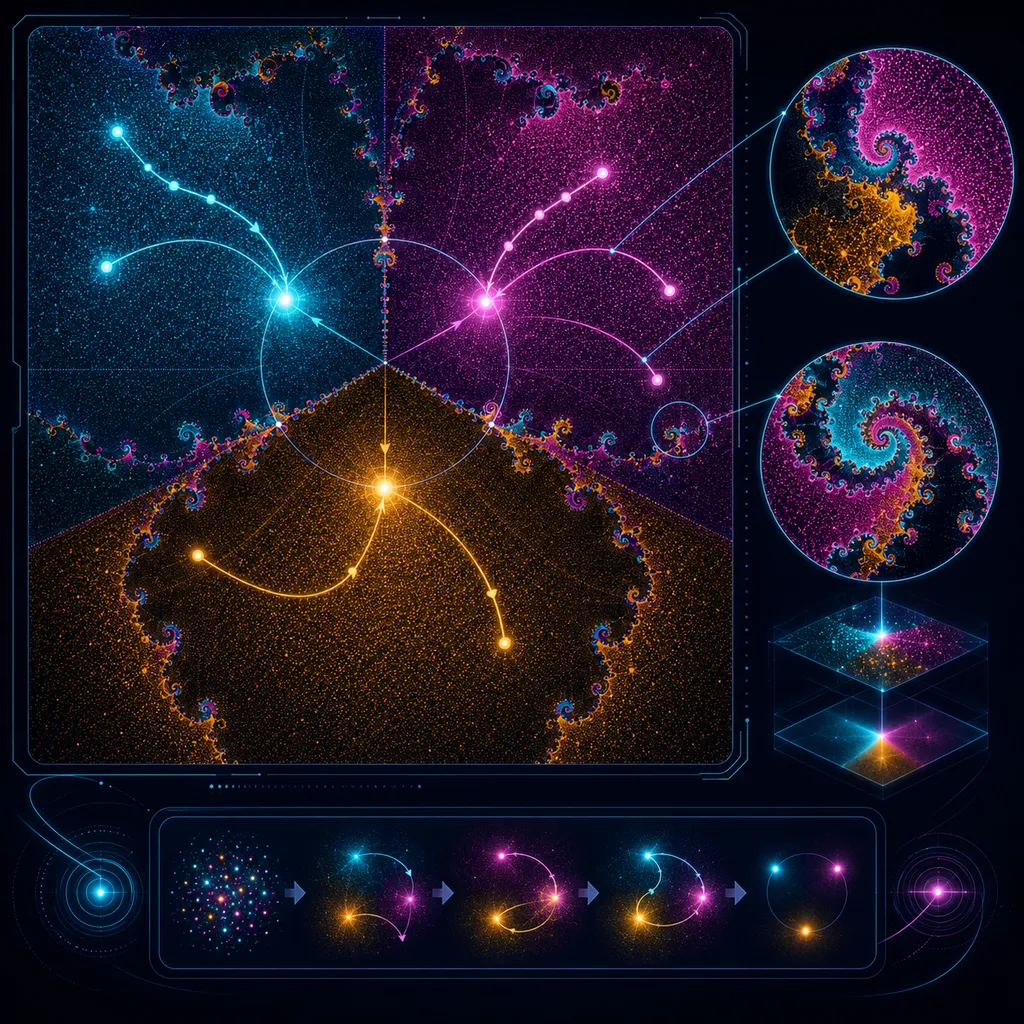
Newton’s method iterates z_{n+1} = z_n − f/f′ to find a root of an equation. For z³ = 1 there are three roots in the complex plane. Colour each starting point by the root it converges to — zoom in and see that the basin boundaries are fractal and self-similar.
I will give you a starting point inside a basin — name the root of z³=1 that Newton’s method will converge to. The roots: z=1, upper (−0.5; +0.87), lower (−0.5; −0.87).
What just happened?
Newton’s method looks for a root of an equation by iterating from a starting point. The equation has three roots in the complex plane. We colour each starting point by the root it converges to. Inside the basins it is smooth — but along the boundaries chaos reigns.
Newton’s iteration:
The three roots (colours) have their own “basins of attraction”. Trouble starts where the basins meet.
Invariant — self-similar boundaries:
The basin edges are fractal: infinitely jagged and self-similar at every scale. What is more — between any two basins you will always find a piece of the third. That is why two nearby starts can end up in completely different places.
Why this matters:
This is a university-level extension of the derivative and of methods for approximate equation solving. Newton’s method is everywhere in numerical analysis — and the way it “gets lost” on boundaries is a beautiful example of chaos and fractals.
Remember: . The basins of attraction of the three roots have fractal, self-similar boundaries.
Theory & formulas
Newton’s method in the complex numbers
For we iterate: The equation has three roots (the cube roots of unity) spaced apart on a circle.
Basins of attraction
We colour each starting point by the root it converges to. The interiors of the basins are “smooth”.
The fractal boundary
The basin boundaries are self-similar, and between any two basins there is always a piece of the third wedged in — no amount of zooming can smooth it out.
Notation: the iteration point, the equation, the spacing of the roots.
Frequently asked questions
›Why does Newton’s method “get lost”?
Near the boundaries between basins of attraction, successive iterations can “jump” between the neighbourhoods of different roots before settling on one. Two almost identical starts can fall into different basins — hence the chaotic, jagged boundary.
›What is a basin of attraction?
The set of all starting points from which Newton’s method converges to a given root. Each of the three roots of z³=1 has its own basin (colour). Inside a basin it is “smooth”; all the complexity sits on the boundaries.
›Why is the boundary a fractal?
Because it is self-similar — it looks equally jagged at every zoom level — and it has a striking property: between any two basins there is always a piece of the third wedged in. Such a boundary cannot be “smoothed out” by any magnification.
Teaching? Embed this experiment on your site.
Free widget — paste it on your school site, blog or notes. It links to the full version.