Sierpiński triangle
An extension of the topic of geometric sequences and self-similarity. By removing the middle triangle at each step we obtain a fractal in which the area is multiplied by 3/4 per iteration — so it tends to zero, while the structure stays self-similar. The triangle was described by the Polish mathematician Wacław Sierpiński in 1915. A curiosity: it coincides with the odd entries of Pascal's triangle.
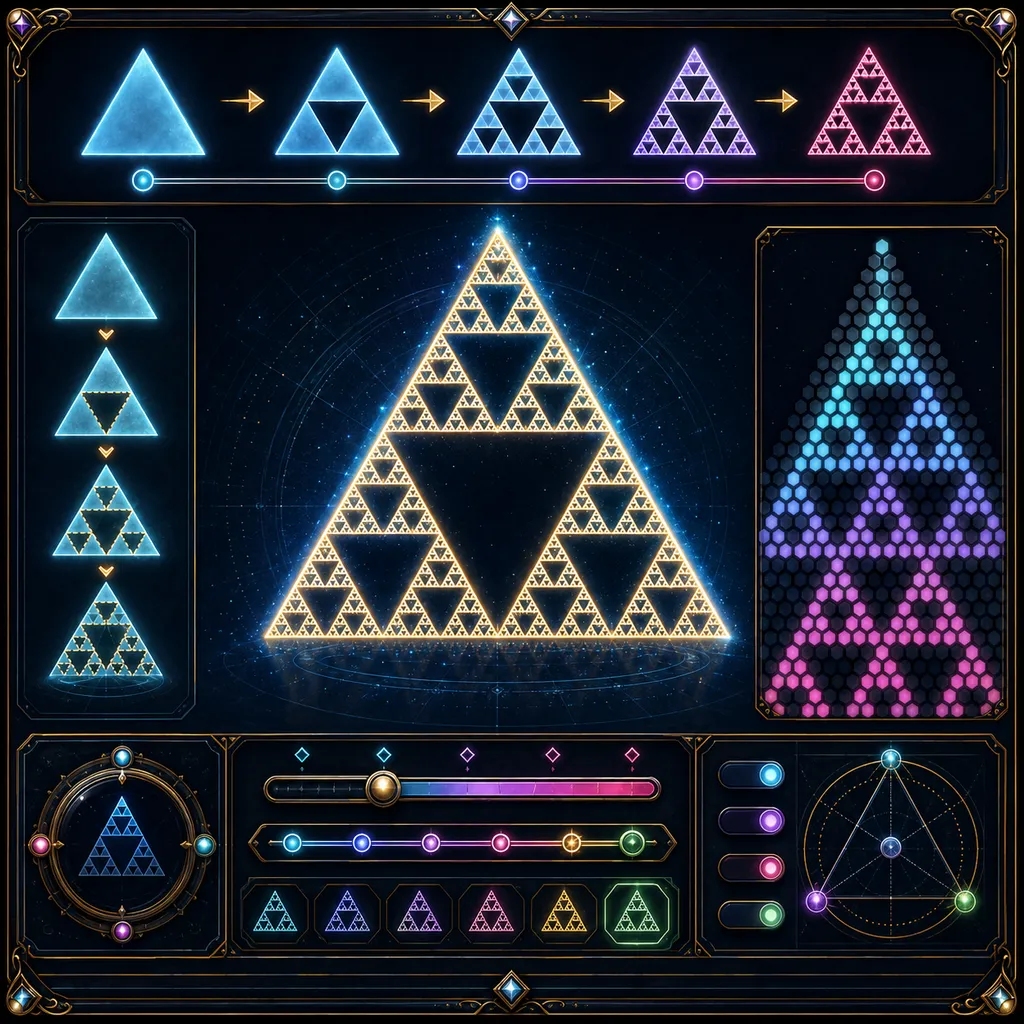
I’ll give you a number of iterations k — work out how many filled sub-triangles remain. 3 remain from each triangle.
What just happened?
You started with a solid equilateral triangle. In each iteration you split every filled triangle into 4 smaller ones (by joining the midpoints of the sides) and remove the middle one — 3 corner ones remain. After many steps the solid figure becomes an ever more “holey” lace (the dashed triangle is the starting figure, from which the middles disappear).
The area decreases geometrically to zero:
Since 3 of the 4 equal sub-triangles remain, the area is multiplied by per iteration. The ratio , so the sequence is convergent to zero — after infinitely many steps the filled area vanishes, even though the number of sub-triangles grows like .
Self-similarity and fractal dimension:
Each of the 3 corners is a miniature copy of the whole — the figure is self-similar. Its fractal dimension is — it lies between a line (1) and a plane (2): the structure is “more than a line, less than a plane”.
Who discovered it?
The Polish mathematician Wacław Sierpiński (1882–1969) described this fractal in 1915. He was one of the founders of modern set theory and topology, author of over 700 papers. Striking is the connection of his triangle with Pascal’s triangle: marking the odd numbers in it yields exactly the pattern of the Sierpiński triangle. The same shape also appears in the chaotic “chaos game” (random jumps toward the vertices) and in fractal antennas.
Why this matters for your exams:
It is a model example of a geometric sequence convergent to zero (, ) alongside a divergent sequence (). It combines limits of sequences, powers and fractal geometry. Wacław Sierpiński is one of the two Polish touches in this collection (alongside Banach and Tarski).
Remember: the area of the Sierpiński triangle decreases ×3/4 per iteration and tends to zero (), while the number of sub-triangles grows ×3 (). Vanishing area, infinitely rich structure.
Theory & formulas
Construction
In a triangle we remove the middle one of four smaller triangles; we repeat this in each remaining one.
The area tends to zero
At each step of the area remains:
Fractal dimension
copies at scale give the dimension: Marking the odd entries of Pascal's triangle yields the same pattern.
Notation: initial area, after steps, fractal dimension.
Frequently asked questions
›What happens to the area of the Sierpiński triangle after many steps?
It tends to zero — at each step the area is multiplied by 3/4.
›How is the Sierpiński triangle formed?
By iteratively removing the middle one of four sub-triangles in every filled triangle.
›What is the connection with Pascal's triangle?
Marking the odd numbers in Pascal's triangle yields the pattern of the Sierpiński triangle.
Teaching? Embed this experiment on your site.
Free widget — paste it on your school site, blog or notes. It links to the full version.