The Cantor set
An extension of the topic of infinity and geometric sequences. By repeatedly removing the middle ⅓ of each segment, the limit is a set of total length 0 ((2/3)^n → 0), yet still uncountable (as many points as the whole interval). One of the first fractals, described by Georg Cantor in 1883.
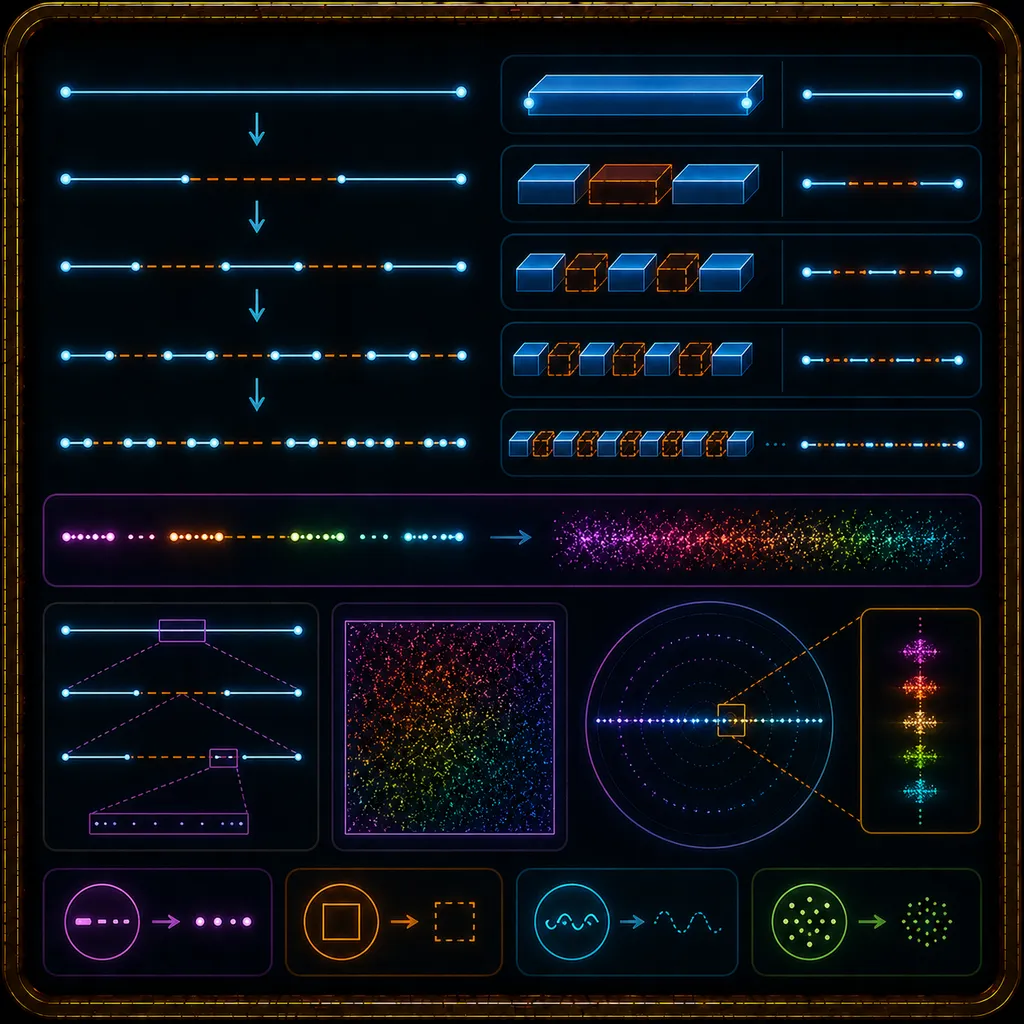
I will give you the number of iterations n — work out how many segments remain after removing the middle thirds. Each one leaves 2.
What just happened?
You started from the interval . At each iteration, from every segment you remove the open middle third (at the start the interval ) — leaving two segments, each of the length. You repeat this forever. The full bar turns into an ever finer “dust” of points (the grey line is the full starting segment, from which the middles disappear).
The length shrinks geometrically to zero:
Since each segment leaves two with a combined length of of the previous one, the length is multiplied by each iteration. The ratio , so the sequence is convergent to zero — after infinitely many steps no “length” is left, even though the number of segments grows like .
The paradox: length 0, yet uncountably many points
And yet the Cantor set is not empty — it contains uncountably many points, exactly as many as the whole interval (it has the cardinality of the continuum). These are the points that, in their ternary expansion, can be written without the digit 1. So we have a set of length (measure) zero, yet equinumerous with the whole interval — a paradox linking measure theory with Cantor’s set theory.
Self-similarity and fractal dimension:
Each of the 2 halves is a scaled-down copy of the whole (scale 1/3) — the set is self-similar. Its fractal dimension is — it lies between a point (0) and a line (1): the structure is “more than a set of points, less than an interval”.
Who discovered it?
The German mathematician Georg Cantor (1845–1918) described this set in 1883. He founded set theory and the notion of different “sizes” of infinity (cardinal numbers). The Cantor set is one of the first and most famous fractals — and at the same time a classic example of how unreliable intuition can be when it comes to infinity.
Why this matters:
This is a textbook example of a geometric sequence convergent to zero (, ) alongside a divergent sequence (). It ties together limits of sequences, powers and fractal geometry — and teaches caution: “length 0” does not mean “empty”.
Remember: the length of the Cantor set shrinks by ×2/3 each iteration and tends to zero (), and yet it still contains uncountably many points. Vanishing length, uncountable richness.
Theory & formulas
Construction
From the interval we remove the middle , then the middle of each remaining segment — and so on forever.
Length (measure) zero
After steps there remain segments, each of length :
Yet uncountable
The points of the set are the numbers whose ternary expansion uses only the digits and — there are as many of them as in all of (the cardinality of the continuum). Dimension: .
Notation: the step number, the fractal dimension.
Frequently asked questions
›What remains after the infinite construction of the Cantor set?
A set of total length 0 that nonetheless contains uncountably many points — as many as the whole interval [0,1].
›How is the Cantor set built?
From the interval [0,1] we remove the middle third, then remove the middle third of each remaining segment — and so on forever.
›Why is the Cantor set a paradox?
Because it has measure (length) zero and at the same time the cardinality of the continuum — it links measure theory with set theory.
Teaching? Embed this experiment on your site.
Free widget — paste it on your school site, blog or notes. It links to the full version.