Compass-and-straightedge constructions
An extension of the topic of geometric constructions. With compass and straightedge we construct only numbers obtained through arithmetic operations and square roots. Some constructions are feasible (dividing a segment, √n, the regular 17-gon — Gauss 1796), and some have been proved impossible (trisecting an arbitrary angle, doubling the cube — Wantzel 1837).
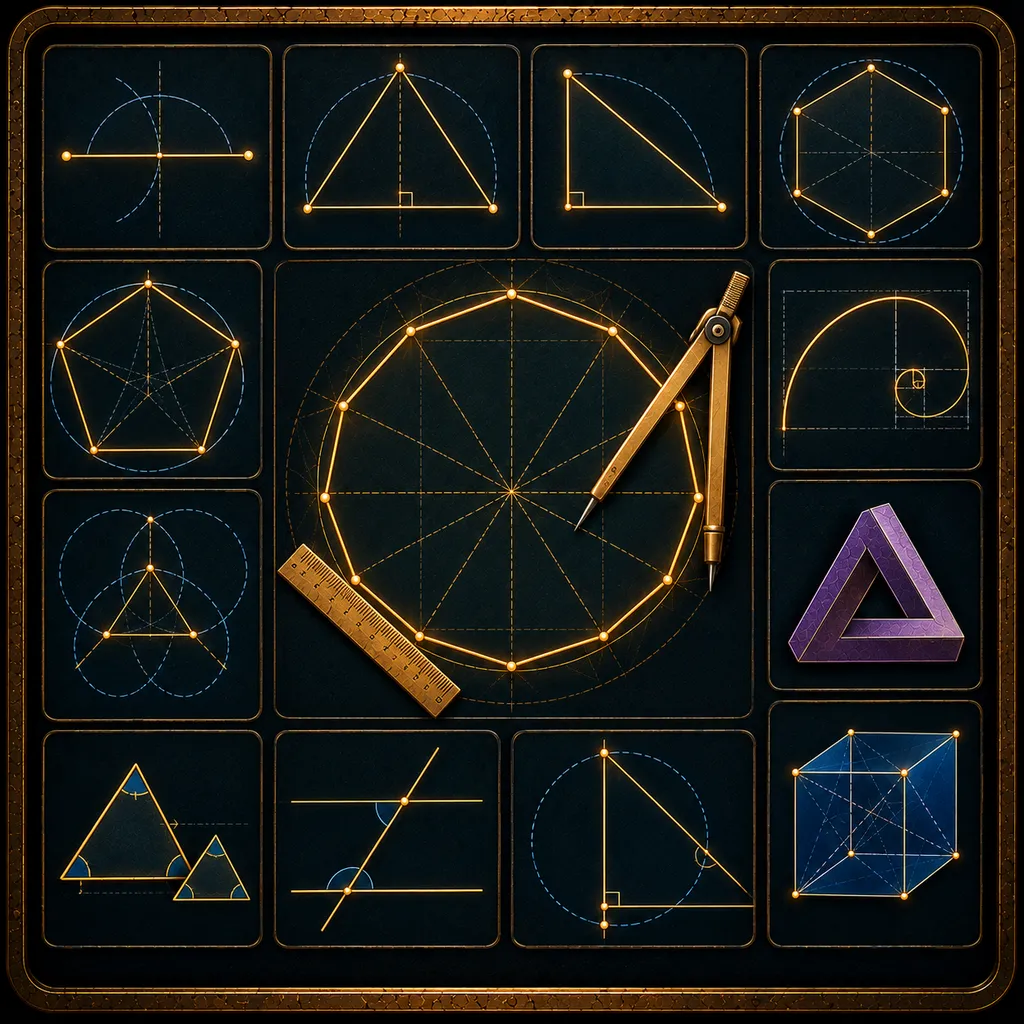
I’ll give you a construction task — decide whether it can be done with compass and straightedge. Only +, −, ×, ÷ and √ are available.
What just happened?
The compass and straightedge (unmarked) are the classical tools of Greek geometry — but not everything can be constructed with them. Some famous constructions are feasible, while others — despite attempts spanning millennia — turned out to be impossible, which was only proved in the 19th century.
Which lengths are constructible?
Mathematically: the lengths constructible with compass and straightedge are exactly those obtainable from a unit segment by addition, subtraction, multiplication, division and square roots:
So the feasible ones include: dividing a segment into any number of equal parts (Thales’ theorem), constructing (as a geometric mean), bisecting an angle, and regular polygons with a suitable number of sides.
Gauss’s breakthrough (1796):
The young Carl Gauss proved that the regular 17-gon is constructible — unknown since antiquity. In general a regular -gon is constructible when is a product of a power of two and distinct Fermat primes. Gauss thus gave the full condition for the constructibility of regular polygons.
What was proved to be IMPOSSIBLE:
Some constructions require numbers that cannot be obtained with square roots alone — e.g. requires a cube root. That is why the following are impossible:
- Trisecting (dividing into 3 equal parts) an arbitrary angle — Pierre Wantzel, 1837
- Doubling the cube (constructing the side of a cube of double volume, i.e. ) — Pierre Wantzel, 1837
- Squaring the circle — Ferdinand Lindemann, 1882
The invariant:
Only numbers obtainable from one by arithmetic operations () and square roots () are constructible with compass and straightedge — not, for example, a cube root.
Why this matters for the exam:
This story shows the power of algebra: purely geometric questions (“can it be drawn?”) are settled by number theory and the theory of algebraic fields, turning “we cannot” into “it has been proved impossible”. Remember the criterion — only arithmetic operations and the square root are available.
Remember: with compass and straightedge you can construct what arises from 1 by and . Dividing a segment, and the 17-gon — yes; trisecting an angle and doubling the cube () — proved impossible.
Theory & formulas
What is constructible
From a unit segment, with compass and straightedge, we obtain numbers reached through and square roots (the "quadratically constructible" numbers).
What has been proved impossible
- trisecting an arbitrary angle — leads to a degree- equation,
- doubling the cube — requires .
This was shown by Wantzel (1837).
Regular polygons
Gauss (1796): a regular -gon is constructible, among others, when is a product of a power of and distinct Fermat primes — hence the constructible -gon.
Notation: the number of sides, the cube root of .
Frequently asked questions
›Is trisecting an arbitrary angle with compass and straightedge possible?
No — Pierre Wantzel proved this in 1837.
›Which numbers are constructible with compass and straightedge?
Only those obtained from one through arithmetic operations and square roots (not, for example, a cube root).
›What did Gauss discover about constructions?
That the regular 17-gon is constructible (1796) — and he gave the general condition for the constructibility of regular polygons.
Teaching? Embed this experiment on your site.
Free widget — paste it on your school site, blog or notes. It links to the full version.