Morley's theorem
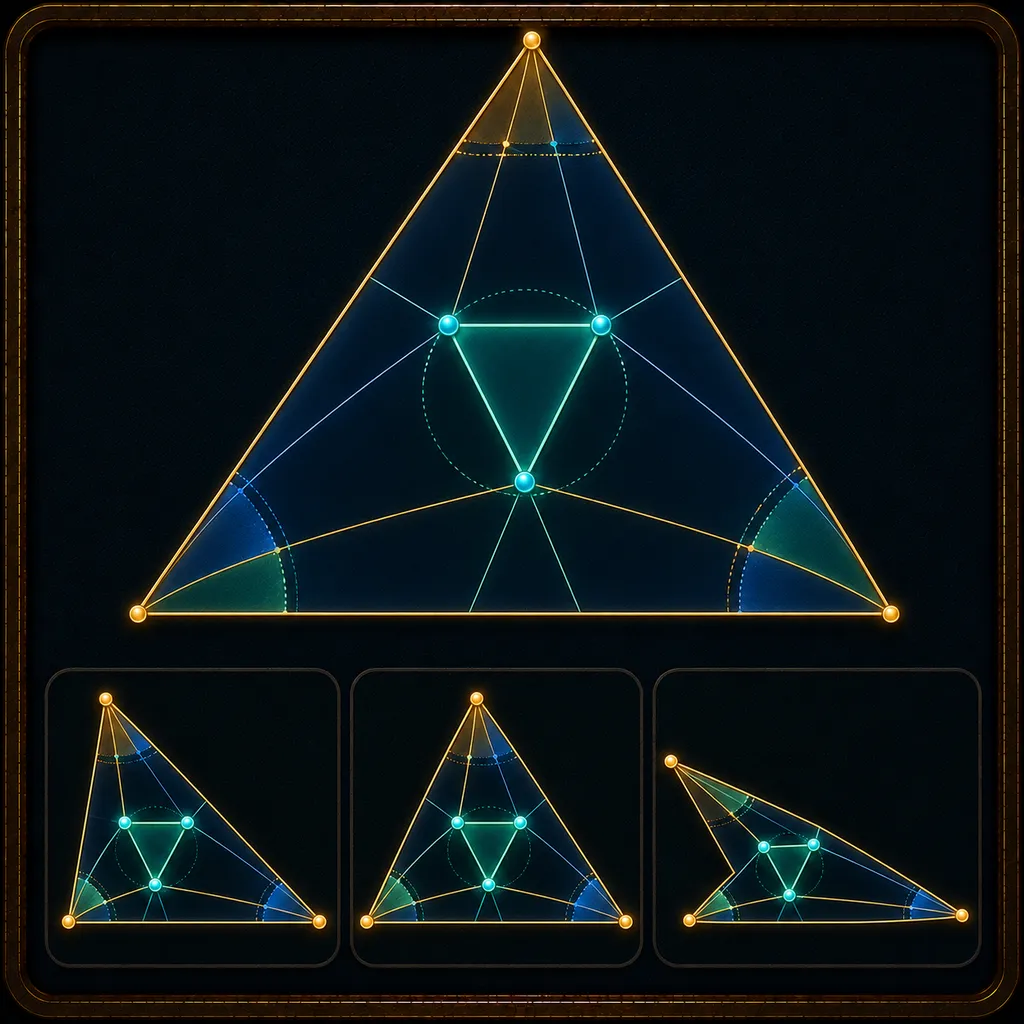
Beyond the core curriculum — angles and triangles ("the most beautiful theorem in geometry"). Divide each angle of a triangle into three equal parts, and the intersection points of adjacent trisectors always form an equilateral triangle — regardless of the starting shape. Frank Morley discovered this in 1899.
I’ll give you a statement about Morley’s theorem — decide whether it is true or false.
What just happened?
We divided each of the triangle’s three angles into three equal parts (we drew the trisectors). Adjacent trisectors met at three points — and those points formed a perfectly equilateral triangle, even though the original triangle is completely arbitrary.
Morley’s theorem:
Frank Morley’s theorem (1899) is sometimes called “the most beautiful theorem of elementary geometry” — because it is astonishingly simple to state yet completely unexpected. Take any triangle and divide each of its three angles into three equal parts. Adjacent trisectors meet at three points — and those three points always form an equilateral triangle, no matter how “lopsided” the original triangle was.
This perfect, equilateral triangle (the Morley triangle) appears like a magical order hidden inside every triangle.
Why is this so remarkable?
The theorem eluded mathematicians for a long time — even though it concerns elementary geometry, it was not discovered until the late 19th century. Classical geometry rarely dealt with trisecting an angle, which moreover cannot be done with compass and straightedge. Today there are many elegant proofs of this fact.
Why this matters:
This goes beyond the core curriculum (angles, triangles), but it shows something important: geometry can hide invariants that hold firm “in spite of” arbitrariness. A “wow” effect worth keeping in your pocket.
Remember: the angle trisectors of every triangle mark out an equilateral triangle — three equal sides, 60° angles. Always.
Theory & formulas
Trisecting the angles
We divide each angle of the triangle into three equal parts (trisectors). The intersection points of adjacent trisectors (at neighbouring vertices) determine an inner triangle.
Morley's theorem
That triangle is always equilateral — all of its angles measure — regardless of the shape of the original triangle.
Why it is surprising
Trisecting an angle is "hard" (not constructible with compass and straightedge), yet it leads to a perfectly regular result. Hence the name "the most beautiful theorem in elementary geometry".
Notation: the measure of each angle of Morley's equilateral triangle.
Frequently asked questions
›What triangle do the angle trisectors form?
Always an equilateral triangle — regardless of the shape of the original triangle (Morley's theorem).
›Why is it called "the most beautiful theorem in geometry"?
Because it is astonishingly simple to state, yet completely non-obvious and elegant.
›When was Morley's theorem discovered?
Not until 1899 (Frank Morley) — because classical geometry rarely dealt with trisecting an angle.
Teaching? Embed this experiment on your site.
Free widget — paste it on your school site, blog or notes. It links to the full version.