Squaring the Circle — Why It Is Impossible
An extension of the topic of the area of a circle and geometric constructions. A square with the area of a circle (πr²) would have to have a side of r√π — but π is a transcendental number, so √π cannot be constructed with compass and straightedge. Ferdinand von Lindemann proved the transcendence of π in 1882, settling this ancient problem as IMPOSSIBLE.
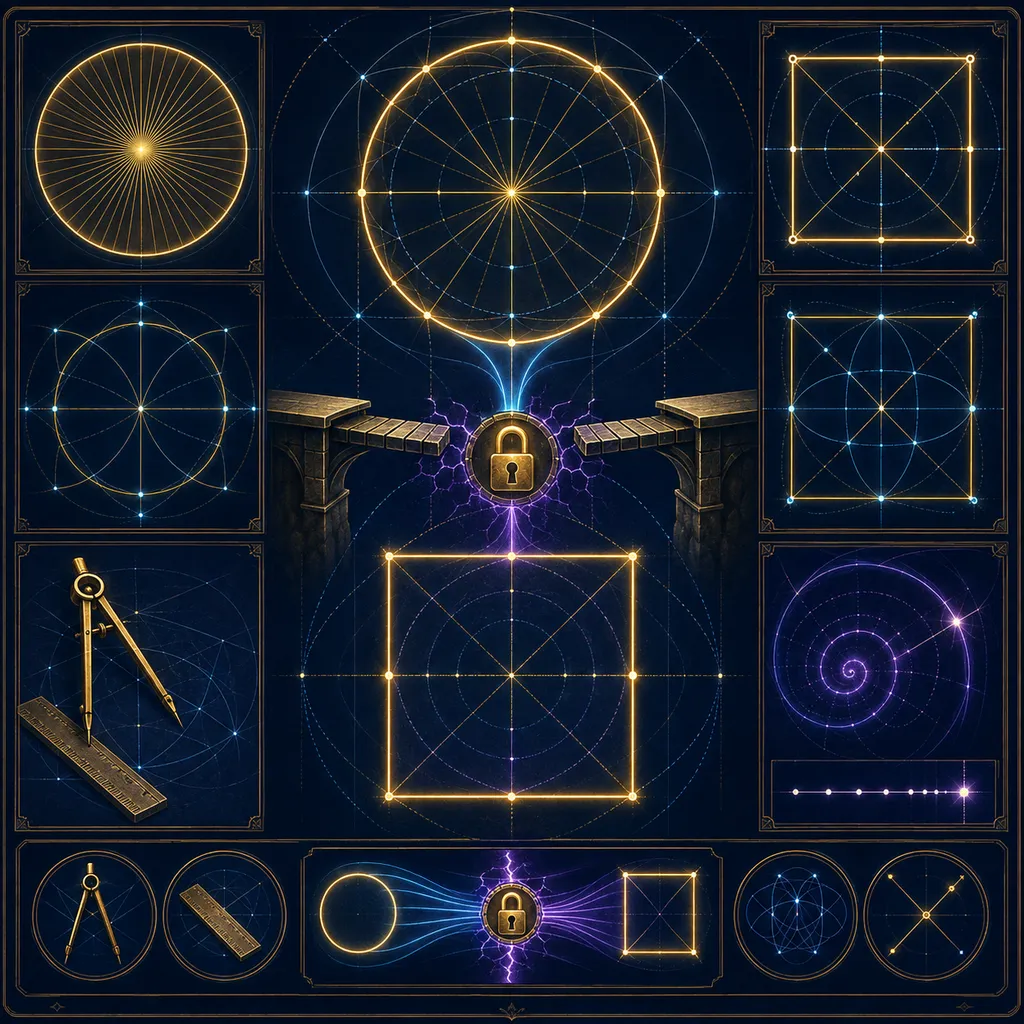
I will give you a length — decide whether it can be constructed with compass and straightedge. Constructible numbers come from 1 via +, −, ×, ÷ and square roots.
What just happened?
You tried to "hit" the area of the circle with the area of the square. Equality holds for only one single value of the side: . You can get arbitrarily close to it, but you will never hit it exactly by construction with compass and straightedge.
What is the problem?
"Squaring the circle" is one of the three great unsolvable construction problems of ancient Greece (alongside trisecting an arbitrary angle and doubling the cube): given a circle, construct with compass and straightedge a square of equal area. A circle of radius has area:
A square of the same area would have to have a side satisfying , that is:
Why is it impossible?
With compass and straightedge you can construct only certain numbers — constructible numbers. These are numbers obtained from one by addition, subtraction, multiplication, division and square roots. All of them are algebraic (they are roots of polynomials with rational coefficients). However:
Since is transcendental, so is — and therefore the side of the sought square does not belong to the constructible numbers. The construction is impossible.
The invariant — what decides the outcome:
Constructible with compass and straightedge are only numbers obtained by arithmetic operations and square roots (algebraic numbers of a certain type). The number (and hence ) does not belong to them, because it is transcendental. This one property of the number settles the entire problem of over two thousand years.
Who settled it, and when?
For over 2000 years mathematicians tried in vain to "square the circle" — the phrase itself became a synonym for an impossible task. The solution came only in 1882, when Ferdinand von Lindemann proved that is a transcendental number. It is a beautiful example of how deep number theory settles a concrete geometric problem — showing not "we cannot do it yet", but "it has been proven impossible".
Why you need this for the exam:
It is a classic context for the concepts: the area of a circle , irrational and algebraic vs transcendental numbers, and the role of . Remember the mechanism: the side of a square with the area of a circle is , and is transcendental — which is why the construction is impossible.
Remember: squaring the circle is impossible with compass and straightedge, because the side of the sought square is , and is a transcendental number (Lindemann, 1882) — it cannot be constructed.
Theory & formulas
The problem
To construct, with compass and straightedge, a square whose area equals a circle of radius . The area of the circle is , so the side of the square would have to be:
Why it is impossible
With compass and straightedge we can construct only certain algebraic numbers (those obtained by arithmetic operations and square roots). Lindemann (1882) proved that is transcendental — and then is not constructible either.
Conclusion
Squaring the circle is IMPOSSIBLE — an ancient problem settled after more than two thousand years.
Notation: — radius of the circle, — the sought side of the square, .
Frequently asked questions
›Can you square a circle with compass and straightedge?
No — the construction would require a side of r√π, but π is transcendental, so it cannot be constructed.
›Why is squaring the circle impossible?
Because with compass and straightedge we can construct only algebraic numbers of a certain type, and π (and √π) is transcendental.
›Who settled the problem of squaring the circle?
Ferdinand von Lindemann, by proving the transcendence of π in 1882.
Teaching? Embed this experiment on your site.
Free widget — paste it on your school site, blog or notes. It links to the full version.